 Back
BackSolutions, Solubility, and Colligative Properties: General Chemistry Study Notes
Study Guide - Smart Notes
 Tailored notes based on your materials, expanded with key definitions, examples, and context.
Solutions and Their Properties
Definition and Components of Solutions
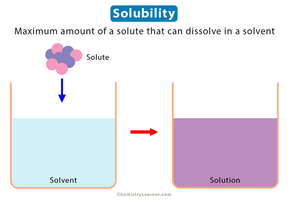
A solution is a homogeneous mixture of two or more substances that are physically combined. The major component is called the solvent, which does the dissolving, while the minor component is the solute, which is dissolved and uniformly distributed throughout the solvent. When water is the solvent, the solution is termed aqueous.
Solvent: Substance present in the greatest amount; dissolves the solute.
Solute: Substance present in a lesser amount; is dissolved by the solvent.
Solutions can exist in all physical states: solid, liquid, or gas.
Characteristics of Solutions
Solute particles are too small to be seen or filtered out.
Solutions are stable; solute does not settle out over time.
Composition can be varied (e.g., sweet tea can be more or less sweet).
Solute and solvent are in the same physical state after mixing.
Examples of Solutions
Solid in liquid: Saltwater (NaCl in H2O)
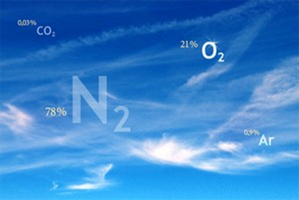
Gas in gas: Air (N2, O2, Ar, CO2)
Liquid in liquid: Vinegar (acetic acid in water)
How Substances Dissolve
Covalent Compounds
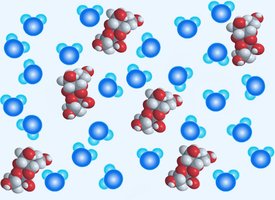
Covalent compounds dissolve as whole molecules and do not dissociate into ions. They remain intact in solution.
Example: Sugar (C6H12O6) dissolves as C6H12O6 molecules.
Ionic Compounds
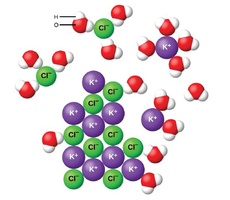
Ionic compounds dissociate into cations and anions when dissolved in water. Water molecules surround and insulate the ions, pulling them from the crystal lattice.
Example: $\mathrm{KCl} \rightarrow \mathrm{K}^+ + \mathrm{Cl}^-$
Example: $\mathrm{Li_2CO_3} \rightarrow 2\,\mathrm{Li}^+ + \mathrm{CO_3}^{2-}$
Acids
Acids ionize in water to produce hydrogen ions and anions. Strong acids ionize completely, while weak acids only partially ionize.
Strong acid example: $\mathrm{H_2SO_4} \rightarrow 2\,\mathrm{H}^+ + \mathrm{SO_4}^{2-}$
Weak acid example: $\mathrm{HF} \rightleftharpoons \mathrm{H}^+ + \mathrm{F}^-$
Electrolytes and Nonelectrolytes
Definitions and Types
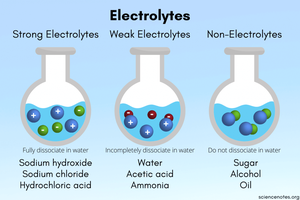
Electrolytes are substances that produce ions in solution and can conduct electricity. They are classified as strong, weak, or nonelectrolytes based on the extent of ionization or dissociation.
Strong electrolytes: Completely dissociate or ionize (e.g., NaCl, HCl, KOH).
Weak electrolytes: Partially dissociate or ionize (e.g., acetic acid, ammonia).
Nonelectrolytes: Do not produce ions (e.g., sugar, alcohol).
Electrical Conductivity of Solutions
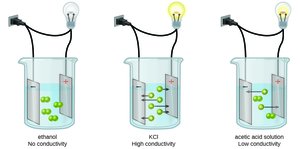
The ability of a solution to conduct electricity depends on the presence and concentration of ions.
Strong electrolytes: High conductivity
Weak electrolytes: Low conductivity
Nonelectrolytes: No conductivity
Solubility and Factors Affecting Solubility
Definition of Solubility
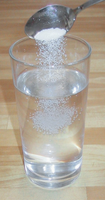
Solubility is the maximum amount of solute that can dissolve in a given amount of solvent at a specific temperature, usually expressed in grams of solute per 100 grams of solvent.
Factors Affecting Solubility
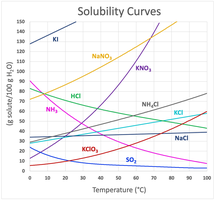
Temperature: For most solids and liquids, solubility increases with temperature. For gases, solubility decreases as temperature increases.
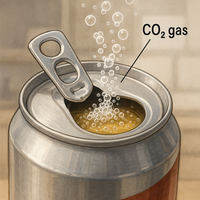
Pressure: Mainly affects gases; higher pressure increases gas solubility in liquids (e.g., carbonated beverages).
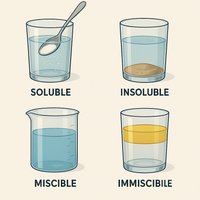
Solubility Terms
Soluble: Large amount of solute dissolves
Insoluble: Little to no solute dissolves
Miscible: Liquids that mix in all proportions
Immiscible: Liquids that do not mix
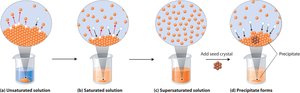
Saturation Levels
Unsaturated: Less than the maximum solute; more can dissolve
Saturated: Maximum solute dissolved; equilibrium exists
Supersaturated: More solute than normally possible; unstable and can precipitate
Precipitation Reactions and Solubility Rules
Precipitation Reactions
A precipitation reaction occurs when two aqueous solutions combine to form an insoluble solid (precipitate). Solubility rules are used to predict the formation of a precipitate.
Write balanced molecular, complete ionic, and net ionic equations for these reactions.
Spectator ions are ions that do not participate in the reaction and appear unchanged on both sides of the equation.
Concentration of Solutions
Qualitative and Quantitative Descriptions
Dilute: Small amount of solute relative to solvent
Concentrated: Large amount of solute relative to solvent
Molarity and Percent Concentration
Molarity (M): $\mathrm{M} = \frac{\text{moles of solute}}{\text{liters of solution}}$
Percent by mass: $\%\,\text{by mass} = \frac{\text{mass of solute}}{\text{mass of solution}} \times 100\%$
Percent by volume: $\%\,\text{by volume} = \frac{\text{volume of solute}}{\text{volume of solution}} \times 100\%$
Dilution
Dilution is the process of decreasing the concentration of a solution by adding more solvent. The amount of solute remains constant.
Use the equation: $M_1V_1 = M_2V_2$
Solution Stoichiometry
Stoichiometric Calculations
Solution stoichiometry involves using balanced chemical equations and molarity to relate volumes and concentrations of reactants and products.
Convert between grams, moles, and liters using molar mass and molarity.
Identify limiting and excess reactants, calculate theoretical and percent yields.
Colligative Properties
Definition and Types
Colligative properties depend on the number of solute particles in a solution, not their identity. These include:
Vapor Pressure Lowering: Solute particles reduce the vapor pressure of the solvent.
Boiling Point Elevation: Solution boils at a higher temperature than pure solvent.
Freezing Point Depression: Solution freezes at a lower temperature than pure solvent.
Osmotic Pressure: Pressure required to stop osmosis across a semipermeable membrane.
Vapor Pressure Lowering
Solute particles occupy surface sites, reducing the number of solvent molecules that can escape into the vapor phase.
Boiling Point Elevation
More heat is required to boil a solution than the pure solvent due to lower vapor pressure.
Freezing Point Depression
Solute disrupts the formation of the solid structure, lowering the freezing point of the solution.
Osmosis and Osmotic Pressure
Osmosis is the movement of solvent through a semipermeable membrane from low to high solute concentration. Osmotic pressure is the pressure needed to stop this flow.
In biological systems, isotonic solutions prevent cell shrinkage (crenation) or swelling (hemolysis).
Summary Table: Types of Solutions and Their Properties
Type | Solute State | Solvent State | Example |
|---|---|---|---|
Solid in Liquid | Solid | Liquid | Saltwater (NaCl in H2O) |
Gas in Gas | Gas | Gas | Air (N2, O2, Ar, CO2) |
Liquid in Liquid | Liquid | Liquid | Vinegar (acetic acid in water) |
Additional info: This guide covers the core concepts of solutions, solubility, electrolytes, and colligative properties, as well as practical calculations and qualitative/quantitative descriptions relevant to general chemistry.
