 Back
BackSolutions, Solubility, and Electrolytes: Core Concepts in General Chemistry
Study Guide - Smart Notes
 Tailored notes based on your materials, expanded with key definitions, examples, and context.
Solutions and Their Properties
Definition and Components of Solutions
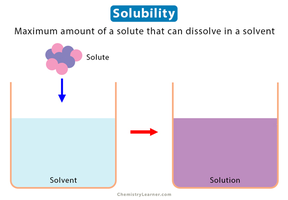
A solution is a homogeneous mixture of two or more substances that are physically combined. The solvent is the substance present in the greatest amount and does the dissolving, while the solute is the substance that is dissolved and is present in a lesser amount. In aqueous solutions, water is the solvent.
Homogeneous mixture: Uniform composition throughout.
Solvent: Major component (e.g., water in sweet tea).
Solute: Minor component, uniformly distributed.
Physical Characteristics of Solutions
Solutes can be solids, liquids, or gases.
Solute and solvent mix to form a single physical state.
Solute particles do not settle out and cannot be separated by filtration, but can be separated by evaporation.
The composition of a solution can be varied (e.g., different concentrations of sweet tea).

Examples of Solutions
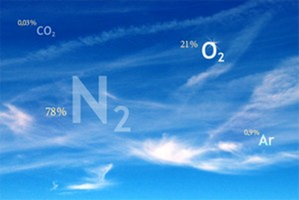
Air (gas in gas): Nitrogen, oxygen, argon, carbon dioxide.
Sugar water (solid in liquid): Sugar dissolved in water.
Soda (gas in liquid): Carbon dioxide dissolved in water.
How Substances Dissolve
Covalent Compounds in Water
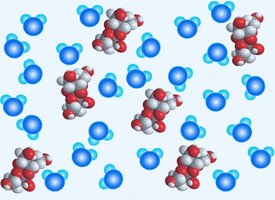
Covalent compounds dissolve as whole molecules and do not dissociate into ions. They remain intact and are evenly distributed throughout the solvent.
Example: Sugar (C6H12O6) dissolves as molecules: C6H12O6 → C6H12O6
Ionic Compounds in Water
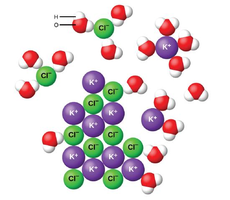
Ionic compounds dissociate into cations and anions when dissolved in water. Water molecules surround and insulate the ions, pulling them from the crystal lattice.
Example:
Example (polyatomic):
Acids in Water
Acids ionize in water to produce hydrogen ions and anions. Strong acids ionize completely, while weak acids only partially ionize.
Strong acid example:
Weak acid example:
Electrolytes and Conductivity
Types of Electrolytes
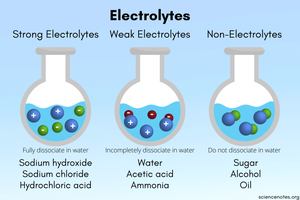
Electrolytes are substances that produce ions in solution and can conduct electricity. They are classified as strong, weak, or nonelectrolytes based on their degree of ionization or dissociation.
Strong electrolytes: Completely dissociate or ionize (e.g., ionic compounds, strong acids).
Weak electrolytes: Partially dissociate or ionize (e.g., weak acids, weak bases).
Nonelectrolytes: Do not produce ions (e.g., sugar, alcohol).
Electrical Conductivity of Solutions
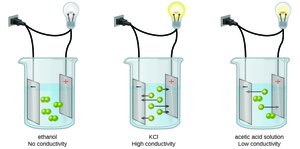
The ability of a solution to conduct electricity depends on the presence and concentration of ions. Strong electrolytes conduct well, weak electrolytes conduct poorly, and nonelectrolytes do not conduct.
Example: KCl solution lights a bulb brightly (strong electrolyte), acetic acid solution lights it dimly (weak electrolyte), ethanol does not light the bulb (nonelectrolyte).
Solubility and Solution Behavior
Solubility: Definition and Measurement
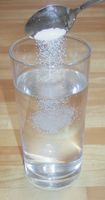
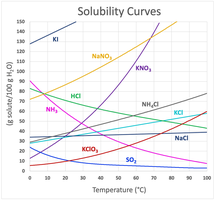
Solubility is the maximum amount of solute that can dissolve in a given amount of solvent at a specific temperature, usually expressed in grams of solute per 100 grams of solvent.
Factors Affecting Solubility
Temperature: For most solids and liquids, solubility increases with temperature. For gases, solubility decreases as temperature increases.
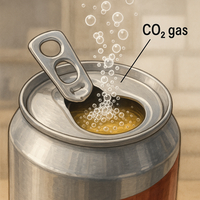
Pressure: Mainly affects gases; higher pressure increases gas solubility in liquids (e.g., carbonated beverages).
Solubility Terms
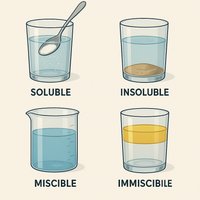
Soluble: Large amount of solute dissolves.
Insoluble: Little to no solute dissolves.
Miscible: Liquids that mix in all proportions.
Immiscible: Liquids that do not mix.
Saturation Levels
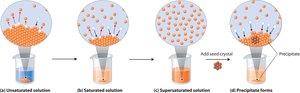
Unsaturated: Less than the maximum solute is dissolved; more can dissolve.
Saturated: Maximum amount of solute is dissolved; no more dissolves at that temperature.
Supersaturated: More solute is dissolved than normally possible at that temperature; unstable and excess solute can precipitate out.
Precipitation Reactions and Solubility Rules
Precipitation Reactions
A precipitation reaction occurs when two aqueous solutions react to form an insoluble product (precipitate). Solubility rules are used to predict whether a precipitate will form.
Write reactant formulas.
Determine products (double replacement reaction).
Use solubility rules to identify precipitate (label as (s)).
Write balanced molecular, complete ionic, and net ionic equations.
Concentration of Solutions
Qualitative and Quantitative Descriptions
Dilute: Small amount of solute relative to solvent.
Concentrated: Large amount of solute relative to solvent.
Molarity (M): Moles of solute per liter of solution ().
Percent concentration: Amount of solute per 100 parts of solution (by mass or volume).
Dilution
Dilution decreases the concentration of a solution by adding more solvent. The amount of solute remains constant.
Formula:
Solution Stoichiometry
Stoichiometric Calculations in Solution
Stoichiometry in solutions involves using balanced chemical equations and molarity to relate volumes and concentrations of reactants and products.
Convert between grams, moles, and liters using molar mass and molarity.
Use mole ratios from balanced equations for calculations.
Colligative Properties
Definition and Types
Colligative properties depend on the number of solute particles, not their identity. These include vapor pressure lowering, boiling point elevation, freezing point depression, and osmotic pressure.
Vapor pressure lowering: Solute particles reduce evaporation rate.
Boiling point elevation: Solution boils at a higher temperature than pure solvent.
Freezing point depression: Solution freezes at a lower temperature than pure solvent.
Osmotic pressure: Pressure required to stop osmosis across a semipermeable membrane.
Osmosis and Biological Relevance
Osmosis is the movement of solvent through a semipermeable membrane from low to high solute concentration. In biological systems, osmotic pressure is crucial for cell function and IV fluid preparation.
Summary Table: Types of Solutions and Their Properties
Type | Solute State | Solvent State | Example |
|---|---|---|---|
Gas in Gas | Gas | Gas | Air (O2 in N2) |
Solid in Liquid | Solid | Liquid | Sugar in water |
Gas in Liquid | Gas | Liquid | CO2 in soda |
Liquid in Liquid | Liquid | Liquid | Alcohol in water |
