 Back
BackSolutions: Structure, Formation, and Properties (General Chemistry Study Notes)
Study Guide - Smart Notes
 Tailored notes based on your materials, expanded with key definitions, examples, and context.
Solutions: Structure, Formation, and Properties
Basics of Solutions
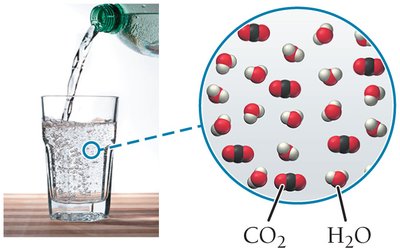
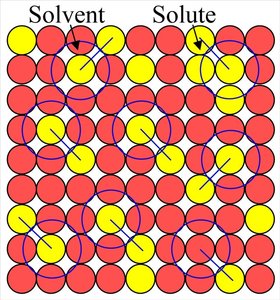
Solutions are homogeneous mixtures composed of a solvent (major component) and one or more solutes (minor components). The solvent determines the phase of the solution, and the solute is dispersed uniformly throughout.
Homogeneity: No phase separation; all components are evenly distributed.
Types of solutions: Classified by the phases of solute and solvent.
Solution Type | Solute Phase | Solvent Phase | Example |
|---|---|---|---|
Gaseous solution | Gas | Gas | Air (N2, O2) |
Liquid solution | Gas | Liquid | Club soda (CO2 in water) |
Liquid solution | Liquid | Liquid | Vodka (ethanol in water) |
Liquid solution | Solid | Liquid | Ocean water (salt in water) |
Solid solution | Solid | Solid | Brass (Zn in Cu) |
Energetic Perspective of Solution Formation
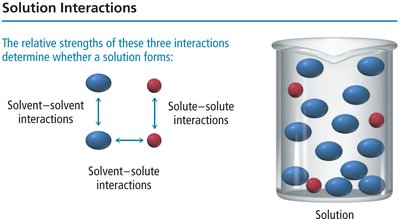
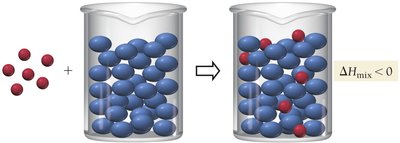
The formation of a solution depends on the relative strengths of three types of intermolecular interactions: solute–solute, solvent–solvent, and solvent–solute. Breaking solute–solute and solvent–solvent interactions is endothermic (requires energy), while forming solvent–solute interactions is exothermic (releases energy).
Solute–solute interactions: Must be overcome for dissolution.
Solvent–solvent interactions: Must be overcome for dissolution.
Solvent–solute interactions: Formed during mixing; energetically favorable.
Entropic Perspective of Solution Formation
Entropy (S) measures the disorder of a system. According to the second law of thermodynamics, processes that increase entropy are thermodynamically favorable. Mixing solute and solvent increases disorder, making solution formation entropically favorable.
Before mixing: Pure phases, low entropy.
After mixing: Disordered mixture, high entropy.
Unifying Energetic and Entropic Perspectives: Free Energy
Both enthalpy and entropy contribute to the free energy change (ΔG) of solution formation. The process is thermodynamically favorable if ΔG < 0:
Exothermic (ΔH < 0): Always favorable.
Athermic (ΔH ≈ 0): Favorable due to entropy.
Endothermic (ΔH > 0): Favorable only if ΔH is moderate.
Equation:

Enthalpy of Solution Formation (ΔHsoln)
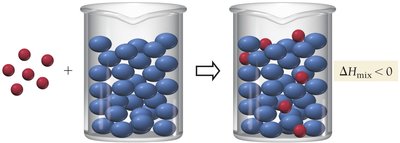
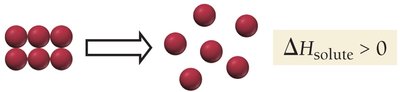
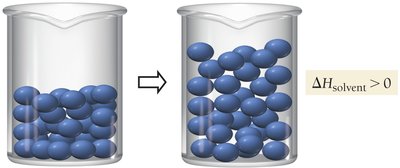
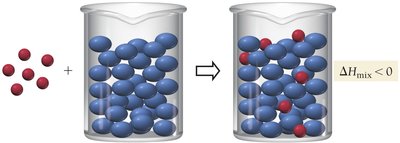
ΔHsoln is the enthalpy change upon solution formation and can be broken down into three steps:
ΔHsolute > 0: Separating solute particles (endothermic).
ΔHsolvent > 0: Separating solvent particles (endothermic).
ΔHmix < 0: Mixing solute and solvent (exothermic).
Overall:


Intermolecular Forces in Solution Formation
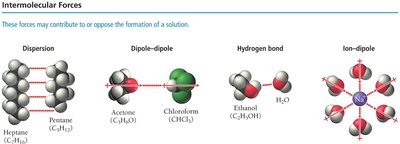
Different types of intermolecular forces affect solution formation:
Dispersion forces: Weak, present in nonpolar molecules.
Dipole–dipole forces: Stronger, present in polar molecules.
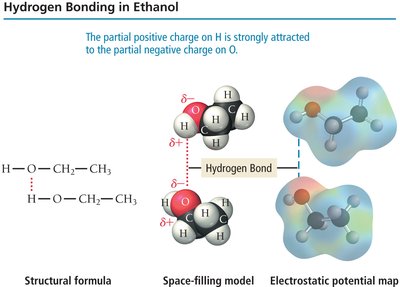
Hydrogen bonds: Very strong, present in molecules with H—O/N/F bonds.
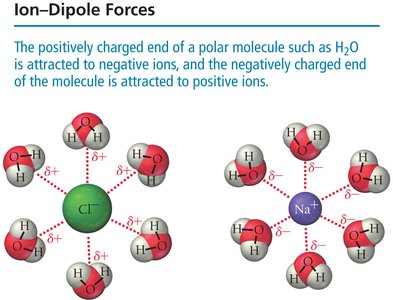
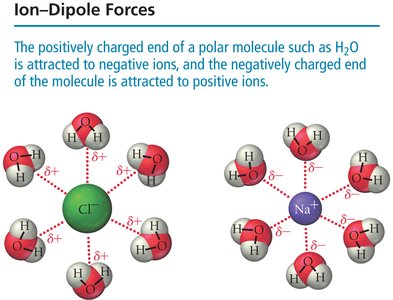
Ion–dipole forces: Occur between ions and polar molecules.
Nonpolar Solutes in Nonpolar Solvents: Entropy Driven
Liquids composed of nonpolar molecules are usually mutually miscible. The weak dispersion forces make the energetic cost of mixing negligible, so solution formation is driven by entropy.
Example: Hexane and pentane are both nonpolar and mix in any ratio.
ΔHsoln ≈ 0: Solution formation is entropy driven.
Polar Solutes in Polar Solvents: Energy and Entropy Driven
Polar molecules interact through dipole–dipole forces and often hydrogen bonds, which stabilize solute particles. The energy gain from solvent–solute interactions can compensate for the energy loss from breaking solute–solute and solvent–solvent interactions.
Hydrogen bonding: Strong interaction in molecules with H—O/N/F bonds.
Ion–dipole forces: Allow polar solvents to dissolve salts.
Example: Ethanol and water are miscible; salts like NaCl dissolve in water.
Polar Meets Nonpolar: Energetically Unfavorable
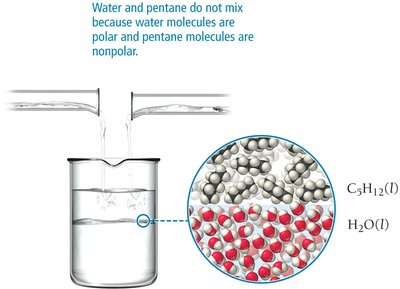
Polar solvents (e.g., water) and nonpolar solutes (e.g., pentane) do not mix well. The energetic cost of breaking strong hydrogen bonds in water is not compensated by weak interactions with nonpolar molecules, making the process largely endothermic and unfavorable.
Like dissolves like: Polar solvents dissolve polar/ionic solutes; nonpolar solvents dissolve nonpolar solutes.
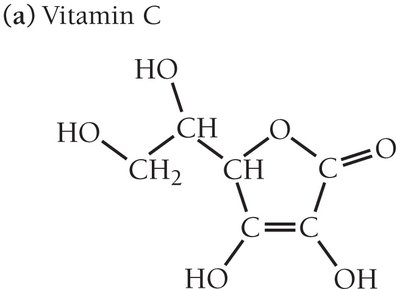
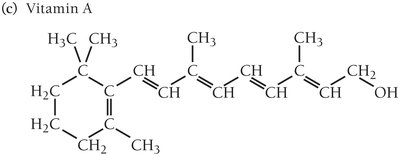
Vitamins: Water-Soluble vs Fat-Soluble
Vitamins are classified based on their solubility:
Water-soluble vitamins: Dissolve in body fluids, easily eliminated, low risk of overconsumption.
Fat-soluble vitamins: Accumulate in fatty deposits, risk of toxicity if overconsumed.
Solution Equilibrium: Dissolution vs Precipitation
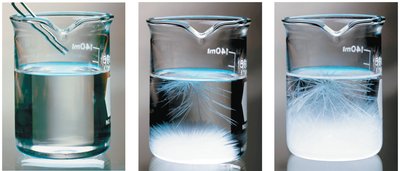
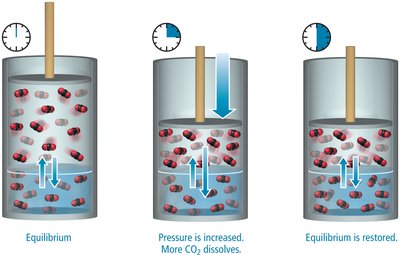
Dissolution and precipitation are reverse processes. As more solute dissolves, the rate of precipitation increases until a dynamic equilibrium is reached, where the rates of dissolution and precipitation are equal.
Saturation and Solubility
A solution is saturated when dissolved solute is in dynamic equilibrium with undissolved solute. Solubility is the maximum amount of solute that can dissolve in a given amount of solvent. Supersaturated solutions contain more solute than equilibrium allows and are unstable.
Solute | Solubility in Water (g/100 g) at 25°C |
|---|---|
NaCl | 36.5 |
NaHCO3 | 9.6 |
Sucrose (Sugar) | 200 |
Ethanol | Infinity |
Temperature Effects on Solubility of Solids
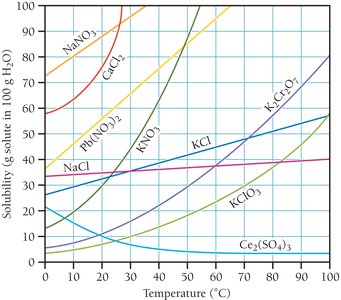
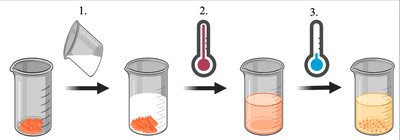
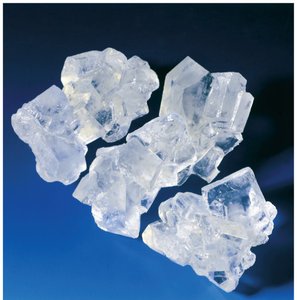
Most solid solutes become more soluble at higher temperatures, though exceptions exist. This principle is used in recrystallization for purification.
Example: Sucrose solubility increases from 200 g/100 g water at 25°C to 490 g/100 g water at 100°C.
Temperature and Pressure Effects on Solubility of Gases
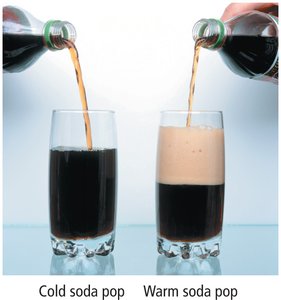
All gases become less soluble at higher temperatures, opposite to most solids. Gases become more soluble at higher pressures, as described by Henry's law.
Application: Soda is kept cold to retain dissolved CO2.
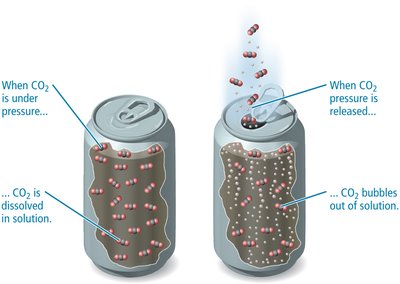
Understanding Pressure Effects: Dynamic Equilibrium
Increasing pressure increases the solubility of gases by shifting the equilibrium toward more dissolved gas. When pressure is released, gas escapes until equilibrium is restored.
Henry's Law: Quantifying Pressure Effects
Henry's law relates the solubility of a gas to its partial pressure:
Solubility: Molarity (mol/L)
Partial pressure: Pgas (atm)
Henry's constant: kH (M/atm)
Expressing Solution Concentration
Several units are used to express solution concentration:
Molarity (M): (amount of solute per volume of solution)
Molality (m): (amount of solute per mass of solvent)
Parts per million (ppm):
Parts per billion (ppb):
Volume percentage:
Summary
Solutions are homogeneous mixtures.
Solution formation is always entropically favorable due to increased disorder.
Enthalpy of solution (ΔHsoln) determines if a solution can form.
Increasing temperature increases solubility of solids but decreases that of gases.
Increasing pressure increases solubility of gases (Henry’s law).
Concentrations can be expressed in molarity, molality, ppm, ppb, and volume percentage.
