 Back
BackStandard Entropy and Free Energy Changes in Chemical Reactions
Study Guide - Smart Notes
 Tailored notes based on your materials, expanded with key definitions, examples, and context.
Entropy and Free Energy in Chemical Reactions
Standard State and Standard Molar Entropy
The standard state of a substance is defined as its pure form at 1 bar (or 1 atm, historically) and 25°C (298 K). The standard molar entropy, S°, is the absolute entropy of 1 mole of a pure substance in its standard state at 25°C. Unlike standard enthalpy of formation (ΔH°f), which is zero for elements in their standard state, S° is always positive for all substances, including elements.
Standard State (Gas): Pure gas at exactly 1 bar (or 1 atm) pressure and 25°C.
Standard State (Liquid/Solid): Pure substance in its most stable form at 1 bar and 25°C.
Standard State (Solution): 1 M concentration at 25°C.
Units: J/mol·K (joules per mole per kelvin).
The Third Law of Thermodynamics
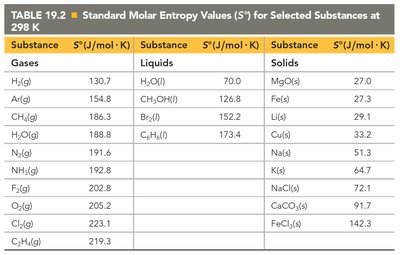
The Third Law of Thermodynamics states that the entropy of a perfect crystal at absolute zero (0 K) is zero: S(0 K, perfect crystal) = 0. This provides an absolute reference point for entropy, allowing us to assign absolute entropy values to all substances.
At 0 K, a perfect crystal has only one possible arrangement (W = 1), so S = k ln(1) = 0.
As temperature increases, energy disperses and the number of microstates (W) increases, so S increases.
No real substance at room temperature has S = 0; all have S > 0.
Calculating Standard Entropy Change (ΔS°rxn)
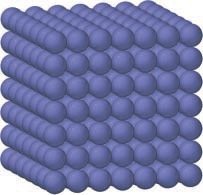
The standard entropy change for a reaction is calculated using the standard molar entropies of the reactants and products:
All stoichiometric coefficients must be included as multipliers.
Unlike enthalpy, absolute entropy values can be measured directly.
Trends in Standard Molar Entropy
Standard molar entropy values show clear trends based on physical state, molar mass, and molecular complexity:
Physical State: Gases have the highest S°, followed by liquids, then solids.
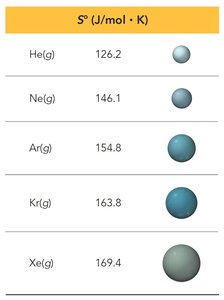
Molar Mass: Heavier atoms and molecules generally have higher S° due to more closely spaced energy levels and more microstates.
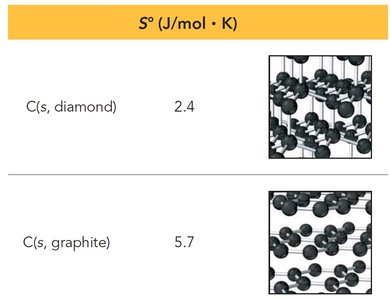
Molecular Complexity: More complex molecules (more atoms, more vibrational modes) have higher S°.
Dissolution: Dissolving a solid or liquid in water usually increases entropy.
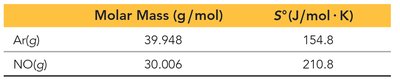
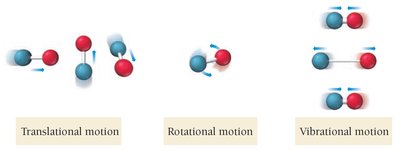
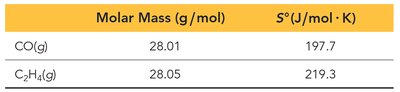
Example: Calculating ΔS°rxn
For the reaction: 4 NH3(g) + 5 O2(g) → 4 NO(g) + 6 H2O(g)

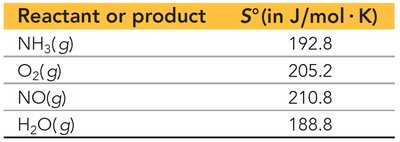
Predicting the Sign of ΔS°rxn
The sign of ΔS°rxn can often be predicted by comparing the number of moles of gas on each side of the reaction:
More moles of gas on the product side → ΔS°rxn is positive.
Fewer moles of gas on the product side → ΔS°rxn is negative.
Free Energy Changes in Chemical Reactions: Calculating ΔG°rxn
Three Methods to Calculate ΔG°rxn
ΔG°rxn = ΔH°rxn − TΔS°rxn Calculate ΔH°rxn using standard enthalpies of formation, ΔS°rxn using standard entropies, then combine at the specified temperature (usually 298 K).



ΔG°rxn = ΣnpΔG°f(products) − ΣnrΔG°f(reactants) Use tabulated standard free energies of formation (ΔG°f). ΔG°f = 0 for elements in their standard state.

Hess's Law for Free Energy Combine free energy changes from known reactions stepwise. ΔG is a state function, so the total change is path-independent.
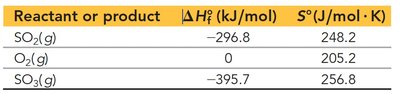
Example: Calculating ΔG°rxn Using ΔH°rxn and ΔS°rxn
For the reaction: SO2(g) + 1/2 O2(g) → SO3(g)
At 25°C (298 K):
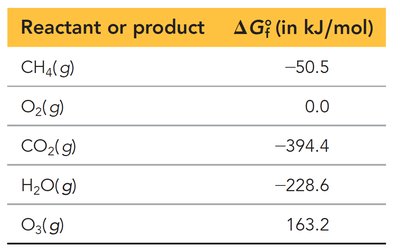
Example: Calculating ΔG°rxn Using Standard Free Energies of Formation
For the reaction: CH4(g) + 8 O2(g) → CO2(g) + 2 H2O(g) + 4 O3(g)
Using tabulated values, ΔG°rxn = −148.3 kJ.
Key Takeaways
The Third Law provides an absolute zero for entropy, allowing calculation of absolute S° values.
S° is always positive; elements in their standard state have S° ≠ 0.
ΔS°rxn is calculated using standard molar entropies and stoichiometric coefficients.
Predict the sign of ΔS°rxn by comparing moles of gas on each side of the equation.
Three methods exist for calculating ΔG°rxn: (1) ΔH°rxn − TΔS°rxn, (2) ΣΔG°f, (3) Hess's Law.
Always check units: ΔH in kJ, TΔS in J (convert as needed); temperature must be in Kelvin.
