Back
BackStates of Matter and Intermolecular Forces
Study Guide - Smart Notes
 Tailored notes based on your materials, expanded with key definitions, examples, and context.
States of Matter and Intermolecular Forces
States of Matter
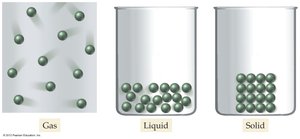
The physical state of a substance—solid, liquid, or gas—is determined by the balance between intermolecular forces and thermal energy. Intermolecular forces hold particles together, while thermal energy tends to disperse them. The relative strength of these forces explains the properties and behaviors of different states of matter.
Solids: Particles are closely packed in a fixed arrangement, resulting in a definite shape and volume. Intermolecular forces are strong.
Liquids: Particles are close but can move past one another, giving liquids a definite volume but an indefinite shape. Intermolecular forces are moderate.
Gases: Particles are far apart and move freely, resulting in indefinite shape and volume. Intermolecular forces are weak.
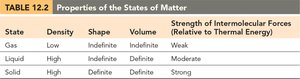
State | Density | Shape | Volume | Strength of Intermolecular Forces (Relative to Thermal Energy) |
|---|---|---|---|---|
Gas | Low | Indefinite | Indefinite | Weak |
Liquid | High | Indefinite | Definite | Moderate |
Solid | High | Definite | Definite | Strong |
Intermolecular Forces (IMFs)
Intermolecular forces are the attractions between molecules that determine many physical properties, such as boiling and melting points. They are distinct from intramolecular forces (chemical bonds within molecules).
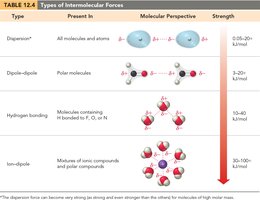
Dispersion (London) Forces: Present in all molecules and atoms due to temporary fluctuations in electron distribution.
Dipole-Dipole Forces: Occur between polar molecules with permanent dipoles.
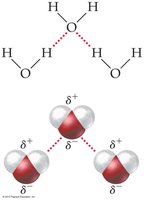
Hydrogen Bonding: A strong type of dipole-dipole interaction found in molecules with H bonded to F, O, or N.
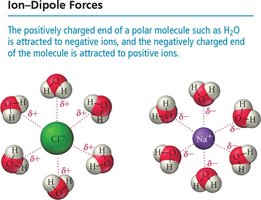
Ion-Dipole Forces: Occur between ions and polar molecules, important in solutions of ionic compounds.
Type | Present In | Molecular Perspective | Strength (kJ/mol) |
|---|---|---|---|
Dispersion | All molecules and atoms | Temporary dipoles | 0.05–20 |
Dipole-dipole | Polar molecules | Permanent dipoles | 2–30 |
Hydrogen bonding | Molecules with H bonded to F, O, or N | Strong dipole-dipole | 10–40 |
Ion-dipole | Ions and polar compounds | Ions interacting with dipoles | 50–600 |
Dispersion Forces
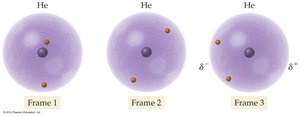
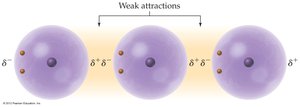
Dispersion forces arise from temporary shifts in electron density, creating instantaneous dipoles that induce dipoles in neighboring atoms or molecules. These forces are present in all substances but are the only IMFs in nonpolar molecules and noble gases. The strength increases with the number of electrons and molecular size.
Noble Gas | Molar Mass (g/mol) | Boiling Point (K) |
|---|---|---|
He | 4.00 | 4.2 |
Ne | 20.18 | 27 |
Ar | 39.95 | 87 |
Kr | 83.80 | 120 |
Xe | 131.29 | 165 |
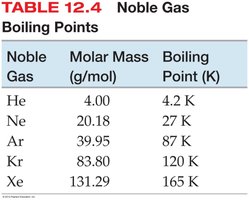
Example: The boiling points of noble gases increase with molar mass due to stronger dispersion forces.
Dipole-Dipole Forces
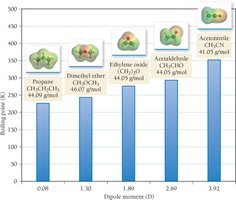
Dipole-dipole forces occur between polar molecules, where the positive end of one molecule is attracted to the negative end of another. The strength of these forces depends on the magnitude of the molecular dipole moment.
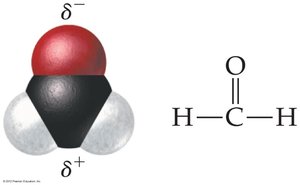
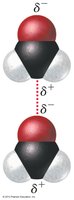
Example: Formaldehyde (CH2O) is polar and has a higher boiling point than ethane (C2H6), which is nonpolar and only exhibits dispersion forces.
Name | Formula | Molar mass (g/mol) | Structure | bp (°C) | mp (°C) |
|---|---|---|---|---|---|
Formaldehyde | CH2O | 30.0 | H2C=O | -19.5 | -92 |
Ethane | C2H6 | 30.1 | H3C-CH3 | -88 | -172 |
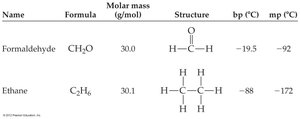
As dipole moment increases, boiling point increases, as shown in the following graph:
Polarity and Miscibility/Solubility
Miscibility refers to the ability of a liquid to mix with another liquid without separating. Polar liquids are generally miscible with other polar liquids, while nonpolar liquids mix with nonpolar liquids. "Like dissolves like" is a useful rule of thumb.
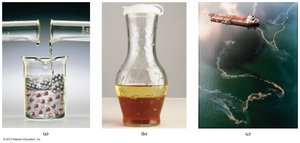
Hydrogen Bonding
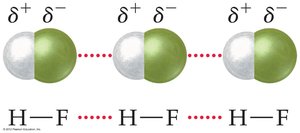
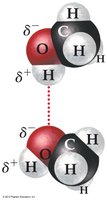
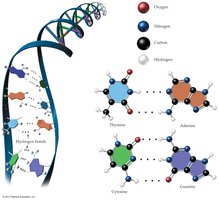
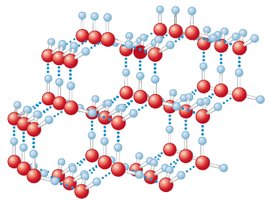
Hydrogen bonding is a particularly strong type of dipole-dipole interaction that occurs when hydrogen is bonded to highly electronegative atoms (F, O, or N). This interaction is responsible for many unique properties of water and biological molecules like DNA.
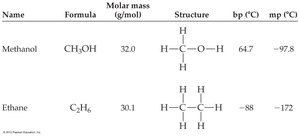
Name | Formula | Molar mass (g/mol) | Structure | bp (°C) | mp (°C) |
|---|---|---|---|---|---|
Methanol | CH3OH | 32.0 | CH3OH | 64.7 | -97.8 |
Ethane | C2H6 | 30.1 | H3C-CH3 | -88 | -172 |
Ion-Dipole Forces
Ion-dipole forces are the strongest intermolecular forces and occur between ions and polar molecules. These are especially important in solutions of ionic compounds in water, where the positive or negative end of the polar molecule interacts with the ion.
Phase Diagrams
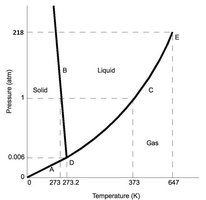
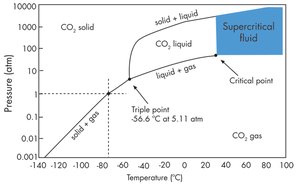
Phase diagrams show the relationship between the physical states of a substance, temperature, and pressure. They indicate the conditions under which a substance exists as a solid, liquid, or gas, and show phase transitions such as melting, boiling, and sublimation.
Triple Point: The unique set of conditions where all three phases coexist.
Critical Point: The end point of the liquid-gas boundary; above this, the substance is a supercritical fluid.
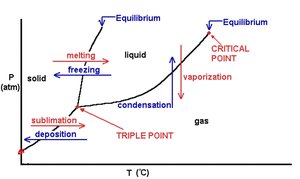
Example: The normal boiling point is the temperature at which the vapor pressure equals 1 atm.
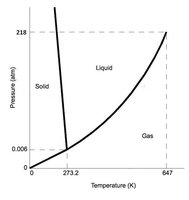
Water is an exception: increasing pressure lowers its melting point due to its unique structure.
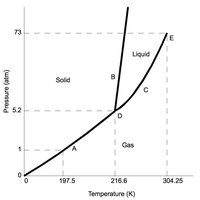

CO2 sublimes at 1 atm and cannot exist as a liquid under normal atmospheric pressure.
Vapor Pressure and Boiling Point
Vapor pressure is the pressure exerted by a vapor in equilibrium with its liquid. At equilibrium, the rate of vaporization equals the rate of condensation. The boiling point is the temperature at which the vapor pressure equals atmospheric pressure.
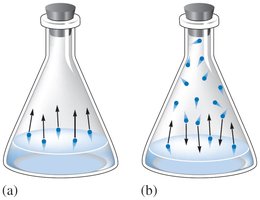
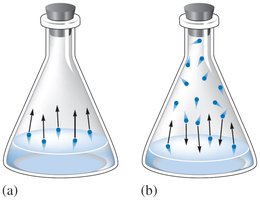
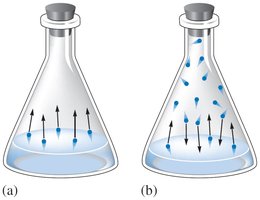
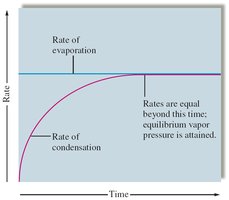
As temperature increases, vapor pressure increases because more molecules have enough kinetic energy to escape the liquid phase.
Substances with weaker intermolecular forces have higher vapor pressures and lower boiling points.
Substance | Intermolecular Forces | Vapor Pressure | Boiling Point |
|---|---|---|---|
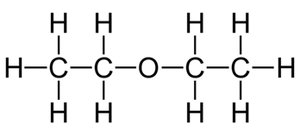
(C2H5)O(C2H5) | Dispersion | Highest | Lowest |
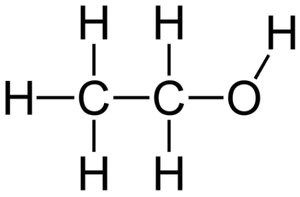
C2H5OH | Hydrogen bonding | Intermediate | Intermediate |
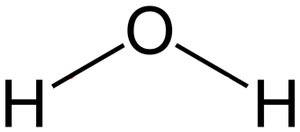
H2O | Hydrogen bonding | Lowest | Highest |
Liquid Interactions: Viscosity, Surface Tension, and Capillary Action
Liquids exhibit several important properties due to intermolecular forces:
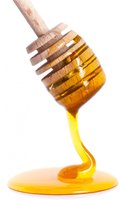
Viscosity: The resistance of a liquid to flow. Stronger intermolecular forces result in higher viscosity (e.g., honey is more viscous than water).
Surface Tension: The energy required to increase the surface area of a liquid. Liquids form droplets to minimize surface area due to cohesive forces.
Capillary Action: The ability of a liquid to flow up a narrow tube against gravity, due to adhesive forces between the liquid and the tube and cohesive forces within the liquid.

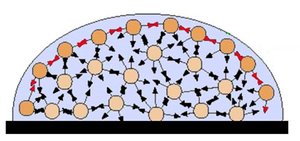
Example: Water has greater surface tension than acetone due to hydrogen bonding.
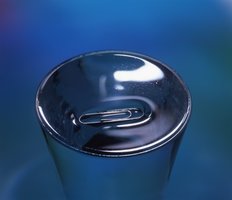
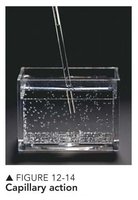
The shape of the meniscus in a tube depends on the balance between adhesive and cohesive forces:
Concave meniscus: Adhesive forces dominate (e.g., water in glass).
Convex meniscus: Cohesive forces dominate (e.g., mercury in glass).