 Back
Step-by-Step General Chemistry Study Guidance
Study Guide - Smart Notes
 Tailored notes based on your materials, expanded with key definitions, examples, and context.
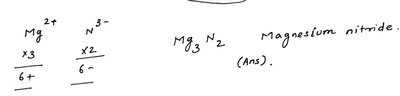
Q1. What is the chemical formula for magnesium nitride? Use the crisscross method to show your work.
Background
Topic: Ionic Compounds & Crisscross Method
This question tests your ability to determine the correct formula for an ionic compound by balancing the charges of the ions using the crisscross method.
Key Terms and Formulas:
Magnesium ion:
Nitride ion:
Crisscross method: Swap the magnitude of the charges to get the subscripts for each ion.
Step-by-Step Guidance
Write the ions with their charges: and .
Apply the crisscross method: The charge on Mg becomes the subscript for N, and the charge on N becomes the subscript for Mg.
Write the formula with these subscripts, making sure to reduce to the simplest ratio if possible.
Try solving on your own before revealing the answer!
Final Answer: Mg3N2
Using the crisscross method, the formula for magnesium nitride is Mg3N2. This balances the charges: 3 Mg2+ (total +6) and 2 N3- (total -6).
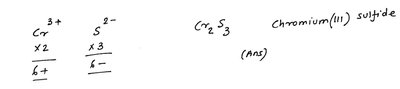
Q2. What is the chemical formula for chromium(III) sulfide? Use the crisscross method to show your work.
Background
Topic: Ionic Compounds & Crisscross Method
This question tests your ability to write the formula for an ionic compound using the crisscross method, based on the charges of the ions.
Key Terms and Formulas:
Chromium(III) ion:
Sulfide ion:
Crisscross method: Swap the magnitude of the charges to get the subscripts for each ion.
Step-by-Step Guidance
Write the ions with their charges: and .
Apply the crisscross method: The charge on Cr becomes the subscript for S, and the charge on S becomes the subscript for Cr.
Write the formula with these subscripts, and check if it can be reduced to the simplest ratio.
Try solving on your own before revealing the answer!
Final Answer: Cr2S3
The formula for chromium(III) sulfide is Cr2S3. This balances the charges: 2 Cr3+ (total +6) and 3 S2- (total -6).
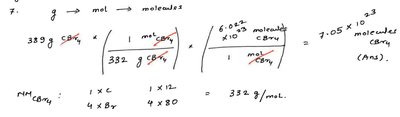
Q3. How many molecules are there in 389 g of CBr4?
Background
Topic: Mole Concept & Avogadro's Number
This question tests your ability to convert mass to moles and then to molecules using Avogadro's number.
Key Terms and Formulas:
Molar mass (): The mass of one mole of a substance.
Avogadro's number: molecules/mol
Conversion steps:
Step-by-Step Guidance
Calculate the molar mass of CBr4: g/mol.
Convert grams to moles: .
Convert moles to molecules: .
Try solving on your own before revealing the answer!
Final Answer: 7.05 × 10²³ molecules
By converting 389 g of CBr4 to moles and then multiplying by Avogadro's number, you get approximately 7.05 × 10²³ molecules.
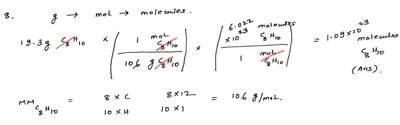
Q4. How many molecules are there in 19.3 g of C8H10?
Background
Topic: Mole Concept & Avogadro's Number
This question tests your ability to convert mass to moles and then to molecules using Avogadro's number.
Key Terms and Formulas:
Molar mass (): The mass of one mole of a substance.
Avogadro's number: molecules/mol
Conversion steps:
Step-by-Step Guidance
Calculate the molar mass of C8H10: g/mol.
Convert grams to moles: .
Convert moles to molecules: .
Try solving on your own before revealing the answer!
Final Answer: 1.09 × 10²³ molecules
By converting 19.3 g of C8H10 to moles and then multiplying by Avogadro's number, you get approximately 1.09 × 10²³ molecules.
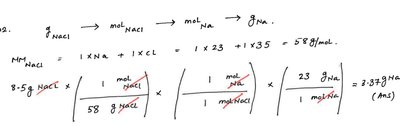
Q6. Calculate the mass of sodium in 8.5 g of NaCl.
Background
Topic: Mass Percent & Stoichiometry
This question tests your ability to determine the mass of a specific element in a compound using stoichiometric relationships.
Key Terms and Formulas:
Molar mass of NaCl: g/mol
Mass percent:
Stoichiometry: Use mole ratios to relate NaCl to Na.
Step-by-Step Guidance
Calculate the molar mass of NaCl: g/mol.
Convert grams of NaCl to moles: .
Use the mole ratio to find moles of Na: 1 mol Na per 1 mol NaCl.
Convert moles of Na to grams: g/mol.
Try solving on your own before revealing the answer!
Final Answer: 3.37 g Na
By converting 8.5 g NaCl to moles and then to grams of Na, you get approximately 3.37 g sodium.
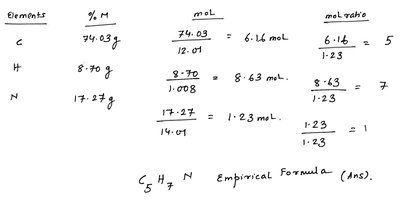
Q7. Calculate the empirical formula based on the mass percent compositions: C: 74.03%, H: 8.70%, N: 17.27%.
Background
Topic: Empirical Formula Calculation
This question tests your ability to convert mass percent to moles and then to the simplest whole-number ratio for an empirical formula.
Key Terms and Formulas:
Empirical formula: The simplest whole-number ratio of atoms in a compound.
Convert mass percent to moles:
Divide each by the smallest number of moles to get the ratio.
Step-by-Step Guidance
Convert each mass percent to moles: C: , H: , N: .
Find the mole ratio by dividing each by the smallest value.
Round to the nearest whole number to get the empirical formula.
Try solving on your own before revealing the answer!
Final Answer: C5H7N
The empirical formula is C5H7N, based on the calculated mole ratios.
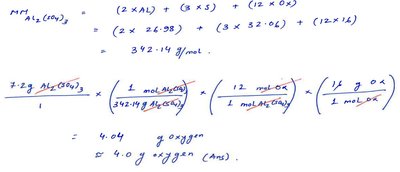
Q9. Determine the mass of oxygen in 7.2 g of Al2(SO4)3.
Background
Topic: Stoichiometry & Mass Percent
This question tests your ability to calculate the mass of a specific element in a compound using stoichiometric relationships.
Key Terms and Formulas:
Molar mass of Al2(SO4)3:
Number of oxygen atoms per formula unit: 12
Stoichiometry: Use mole ratios to relate Al2(SO4)3 to O.
Step-by-Step Guidance
Calculate the molar mass of Al2(SO4)3.
Convert grams to moles: .
Use the mole ratio to find moles of O: 12 mol O per 1 mol Al2(SO4)3.
Convert moles of O to grams: g/mol.
Try solving on your own before revealing the answer!
Final Answer: 4.0 g O
By converting 7.2 g Al2(SO4)3 to moles and then to grams of O, you get approximately 4.0 g oxygen.
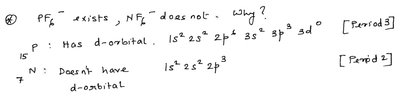
Q12. PF6- exists but NF6- does not. Explain using relevant electron configurations.
Background
Topic: Electron Configuration & Expanded Octet
This question tests your understanding of why certain molecules can form expanded octets based on their electron configurations and the presence of d-orbitals.
Key Terms and Formulas:
Electron configuration: Shows the arrangement of electrons in an atom.
Expanded octet: Atoms in period 3 or higher can have more than 8 electrons due to available d-orbitals.
Step-by-Step Guidance
Write the electron configuration for phosphorus (P) and nitrogen (N).
Identify if each element has access to d-orbitals (period 3 or higher).
Explain why P can form PF6- (expanded octet) but N cannot (limited to octet).
Try solving on your own before revealing the answer!
Final Answer:
Phosphorus (period 3) has available d-orbitals, allowing it to expand its octet and form PF6-. Nitrogen (period 2) does not have d-orbitals, so it cannot form NF6-.
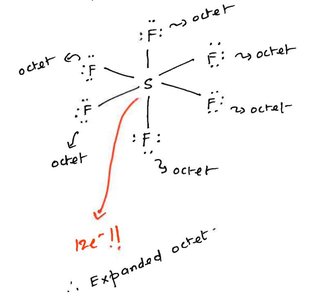
Q13. Draw the Lewis structure for SF6. Make sure to show all lone pairs.
Background
Topic: Lewis Structures & Expanded Octet
This question tests your ability to draw Lewis structures for molecules with expanded octets and to show all lone pairs.
Key Terms and Formulas:
Lewis structure: Shows the arrangement of atoms, bonds, and lone pairs.
Expanded octet: Central atom can have more than 8 electrons.
Step-by-Step Guidance
Count the total number of valence electrons for SF6.
Place S in the center and surround it with 6 F atoms.
Distribute the remaining electrons as lone pairs on the F atoms.
Check that each F has an octet and S has 12 electrons (expanded octet).
Try solving on your own before revealing the answer!
Final Answer:
The Lewis structure for SF6 shows S in the center with 6 single bonds to F, and each F has three lone pairs. S has an expanded octet (12 electrons).
