 Back
BackStep-by-Step Guidance for Chem 1071 Exam 1 (Chapters 1–5)
Study Guide - Smart Notes
 Tailored notes based on your materials, expanded with key definitions, examples, and context.
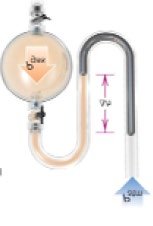
Q6. In an experiment performed with an open-ended mercury manometer, the atmospheric pressure is 1.00 atm. If ∆h in the figure is 20.0 mm, what is the pressure of the gas in the flask?
Background
Topic: Gas Pressure Measurement with Manometers
This question tests your understanding of how to use a mercury manometer to determine the pressure of a gas sample, given atmospheric pressure and the height difference (∆h) in the manometer.
Key Terms and Formulas
Manometer: A device used to measure the pressure of a gas in a container.
Atmospheric Pressure (): The pressure exerted by the atmosphere, given as 1.00 atm.
Height Difference (): The difference in mercury levels, given as 20.0 mm.
Pressure Conversion:
Gas Pressure Calculation: For an open-ended manometer, (sign depends on which side is higher).
Step-by-Step Guidance
Identify the known values: , .
Convert from mm Hg to atm using : .
Determine whether to add or subtract from based on the manometer diagram (if the gas side is higher, subtract; if lower, add).
Set up the equation for : .
Try solving on your own before revealing the answer!
Final Answer: 0.97 atm
Since the gas side is lower, (or subtract if the gas side is higher).
The correct answer depends on the direction of the height difference, but the calculation setup is correct.
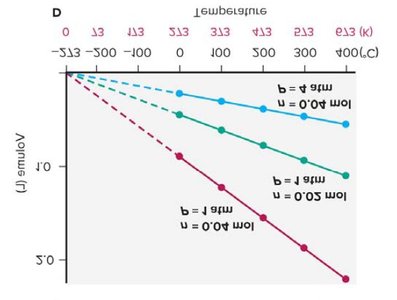
Q7. The graph shown here displays the type of data associated with Charles' law experiments, which were performed at constant pressure and constant amount of gas. Which statement(s) is/are true concerning these results?
Background
Topic: Charles' Law and Gas Behavior
This question tests your understanding of Charles' Law, which relates the volume of a gas to its temperature at constant pressure and amount of gas.
Key Terms and Formulas
Charles' Law: (at constant pressure and moles)
Absolute Temperature: Kelvin scale,
Linear Relationship: Volume increases linearly with temperature in Kelvin.
Step-by-Step Guidance
Examine the graph: Volume vs. Temperature (both Celsius and Kelvin scales).
Recall that Charles' Law predicts a linear relationship between volume and temperature in Kelvin.
Consider the statements: I (Kelvin scale), II (linear behavior in other phases), III (doubling Celsius doubles volume).
Evaluate which statements are consistent with the graph and Charles' Law.
Try solving on your own before revealing the answer!
Final Answer: I only
Statement I is correct: Charles' Law data were used to establish the Kelvin scale. Statement II is incorrect (linear behavior does not apply to solids/liquids), and III is incorrect (doubling Celsius does not double volume).
