 Back
BackStep-by-Step Guidance for CHEM131 Exam 1 Review
Study Guide - Smart Notes
 Tailored notes based on your materials, expanded with key definitions, examples, and context.
Q1. Fill in the following chart for 35Cl-.
Background
Topic: Atomic Structure and Isotopes
This question tests your understanding of atomic structure, including how to determine the number of protons, neutrons, electrons, mass number, net charge, and electron configuration for a given isotope.
Key Terms and Formulas:
Atomic Number (): Number of protons in the nucleus.
Mass Number (): (protons + neutrons).
Isotope: Atoms of the same element with different numbers of neutrons.
Ion: Atom with a net charge due to loss/gain of electrons.
Electron Configuration: Distribution of electrons in atomic orbitals.
Step-by-Step Guidance
Identify the atomic number of chlorine (), which tells you the number of protons.
Calculate the number of neutrons: , where is the mass number (should be 35 for Cl).
Determine the number of electrons for the ion: For , add one electron to the neutral atom.
Write the full electron configuration for , making sure to account for the extra electron.
Check the net charge: For , the net charge is -1.
Try solving on your own before revealing the answer!
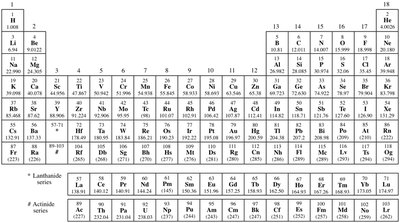
Q2. Name or provide the formula for the following compounds or molecules.
Background
Topic: Nomenclature of Ionic and Covalent Compounds
This question tests your ability to name compounds from their formulas and write formulas from their names, using IUPAC rules.
Key Terms:
Ionic Compound: Formed from metal and nonmetal ions.
Covalent Compound: Formed from nonmetals.
Polyatomic Ion: Charged group of atoms.
Step-by-Step Guidance
For each formula, identify the cation and anion, and use their names to write the compound name.
For each name, determine the correct formula by assigning charges and balancing them.
Recall common polyatomic ions (e.g., carbonate, phosphate).
Apply the rules for naming transition metals (use Roman numerals for charge).
Try solving on your own before revealing the answer!
Q3. Circle the element with the largest numerical value for each property.
Background
Topic: Periodic Trends
This question tests your understanding of periodic trends such as atomic radius, ionization energy, and electron affinity.
Key Terms:
Atomic Radius: Size of an atom.
Ionization Energy: Energy required to remove an electron.
Electron Affinity: Energy change when an atom gains an electron.
Step-by-Step Guidance
Recall the general trends: Atomic radius increases down a group and decreases across a period.
Ionization energy increases across a period and decreases down a group.
Electron affinity is highest for elements that readily accept electrons (usually halogens).
Compare the given elements based on their positions in the periodic table.
Try solving on your own before revealing the answer!
Q4. Fill in the chart for Iodine and Se-1 (inner, outer, valence electrons).
Background
Topic: Electron Configuration and Valence Electrons
This question tests your ability to determine the number of inner, outer, and valence electrons for elements and ions.
Key Terms:
Valence Electrons: Electrons in the outermost shell.
Inner Electrons: Electrons not in the outermost shell.
Outer Electrons: Electrons in the highest energy level.
Step-by-Step Guidance
Write the electron configuration for each element/ion.
Identify the electrons in the outermost shell (highest principal quantum number).
Count the valence electrons (usually those in the outermost s and p orbitals).
Subtract the valence electrons from the total to find the number of inner electrons.
Try solving on your own before revealing the answer!
Q5. Circle all choices that contain an ionic bond.
Background
Topic: Chemical Bonding
This question tests your ability to identify ionic bonds, which form between metals and nonmetals.
Key Terms:
Ionic Bond: Electrostatic attraction between oppositely charged ions.
Covalent Bond: Sharing of electrons between atoms.
Step-by-Step Guidance
Identify which compounds are formed from a metal and a nonmetal.
Recall that polyatomic ions can also form ionic compounds.
Circle all compounds that fit the criteria for ionic bonding.
Try solving on your own before revealing the answer!
Q6. Given the following table, circle which photon(s) will eject an electron from the surface of a material with a binding energy of J.
Background
Topic: Photoelectric Effect
This question tests your understanding of the photoelectric effect, where photons with enough energy can eject electrons from a material.
Key Formula:
= energy of photon (J)
= Planck's constant ( J·s)
= speed of light ( m/s)
= wavelength (m)
Step-by-Step Guidance
Convert the given wavelengths to meters.
Calculate the energy of each photon using .
Compare each photon energy to the binding energy ( J).
Circle the photon(s) with energy greater than or equal to the binding energy.
Try solving on your own before revealing the answer!
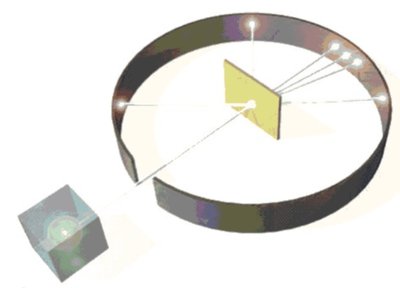
Q7. What did the following experiment conclude?
Background
Topic: Atomic Structure Experiments
This question tests your knowledge of classic experiments in atomic structure, such as Rutherford's gold foil experiment.
Key Terms:
Gold Foil Experiment: Led to the discovery of the nucleus.
Mass-to-Charge Ratio: Determined by Thomson's experiment.
Step-by-Step Guidance
Recall the main findings of each experiment listed.
Match the experiment to its conclusion (e.g., Rutherford's experiment showed the nucleus is small and dense).
Eliminate answers that do not fit the experiment shown.
Try solving on your own before revealing the answer!
Q8. Circle the bond with the largest difference in electronegativity and box the bond with the smallest difference.
Background
Topic: Electronegativity and Bond Polarity
This question tests your understanding of how electronegativity differences affect bond polarity.
Key Terms:
Electronegativity: Tendency of an atom to attract electrons.
Bond Polarity: Determined by the difference in electronegativity between atoms.
Step-by-Step Guidance
Look up the electronegativity values for each element involved.
Calculate the difference for each bond.
Circle the bond with the largest difference and box the one with the smallest.
Try solving on your own before revealing the answer!
Q9. Which electronic transition in a hydrogen atom will emit a photon with the least amount of energy?
Background
Topic: Atomic Spectra and Energy Levels
This question tests your understanding of energy transitions in hydrogen atoms and how energy is related to quantum numbers.
Key Formula:
= energy change
= Rydberg constant ( J)
= initial quantum number
= final quantum number
Step-by-Step Guidance
For each transition, plug in the values for and .
Calculate for each transition.
Identify which transition emits the least energy (smallest ).
Try solving on your own before revealing the answer!
Q10. Provide the quantum numbers for the final energy of the electron that emitted 1875 nm and 97 nm of light.
Background
Topic: Quantum Numbers and Electronic Transitions
This question tests your ability to assign quantum numbers to energy levels in hydrogen based on emission wavelengths.
Key Terms:
Principal Quantum Number (): Energy level.
Angular Momentum Quantum Number (): Subshell type.
Magnetic Quantum Number (): Orbital orientation.
Step-by-Step Guidance
Use the emission wavelength to determine the energy transition.
Identify the final energy level () for each emission.
Assign and values based on the final orbital.
Try solving on your own before revealing the answer!
Q11. Silver has two naturally occurring isotopes. The Ag-109 isotope (108.91 g/mol) is 48.16%. What is the mass, in g/mol, of the other isotope?
Background
Topic: Isotopic Mass and Abundance
This question tests your ability to calculate the mass of an unknown isotope given the average atomic mass and percent abundance.
Key Formula:
Fraction = percent abundance / 100
Mass = isotopic mass
Step-by-Step Guidance
Write the equation for average atomic mass using the given values.
Plug in the percent abundance and mass for Ag-109.
Set up the equation to solve for the unknown isotope's mass.
Try solving on your own before revealing the answer!
Q12. Draw and label the atomic orbital energy diagram for copper +1’s ground state electron configuration. Begin at [Ne].
Background
Topic: Electron Configuration and Orbital Diagrams
This question tests your ability to draw and label orbital energy diagrams for ions, starting from a noble gas core.
Key Terms:
Orbital Diagram: Visual representation of electron arrangement.
Ground State: Lowest energy configuration.
Cu+1: Copper ion with one electron removed.
Step-by-Step Guidance
Write the electron configuration for neutral copper and then for Cu+1.
Draw the energy levels starting from [Ne].
Fill in the electrons according to the Aufbau principle and Hund’s rule.
Try solving on your own before revealing the answer!
Q13a. Calculate the wavelength, in nm, for an electron in a 2p orbital in hydrogen transitioning to a 5s orbital.
Background
Topic: Electronic Transitions and Spectroscopy
This question tests your ability to calculate the wavelength of light emitted or absorbed during electronic transitions in hydrogen.
Key Formula:
= Rydberg constant
= Planck's constant
= speed of light
= wavelength
Step-by-Step Guidance
Identify the initial () and final () quantum numbers for the transition.
Calculate using the Rydberg formula.
Relate to wavelength using .
Set up the equation to solve for in nm.
Try solving on your own before revealing the answer!
Q13b. Set up the expression with numerical values and units, do not solve, for the energy associated with this electron.
Background
Topic: Energy Calculations for Electronic Transitions
This question tests your ability to set up the energy calculation for an electronic transition, including all necessary constants and units.
Key Formula:
J
= initial quantum number
= final quantum number
Step-by-Step Guidance
Write the formula for .
Plug in the numerical values for , , and .
Include units for each value.
Try solving on your own before revealing the answer!
Q14. Based on X-Ray Photoelectron Spectroscopy (XPS) data, determine which substance was present in the pocket lint.
Background
Topic: X-Ray Photoelectron Spectroscopy (XPS) and Binding Energy
This question tests your ability to analyze XPS data to identify substances based on binding energies and kinetic energies.
Key Formula:
= Planck's constant
= photon frequency
= kinetic energy of ejected electron
= binding energy of electron
Step-by-Step Guidance
For each photon frequency, calculate using .
Subtract the kinetic energy from to find .
Convert from J to eV if needed ( J).
Compare the calculated binding energy to the values in Table 2 to identify the substance.
Try solving on your own before revealing the answer!
