Back
BackStep-by-Step Guidance for General Chemistry Exam Questions
Study Guide - Smart Notes
 Tailored notes based on your materials, expanded with key definitions, examples, and context.
Q1. In the reaction 2 A + 3 B → 2 C, which statement is correct?
Background
Topic: Stoichiometry
This question tests your understanding of stoichiometric relationships in chemical reactions, specifically how reactants and products relate in balanced equations.
Key Terms and Formulas:
Stoichiometry: The calculation of reactants and products in chemical reactions.
Mole ratio: The ratio of moles of one substance to moles of another in a balanced equation.
Step-by-Step Guidance
Examine the balanced equation: .
Identify the mole ratios between A, B, and C from the coefficients.
Consider what happens if you mix different amounts of A and B—determine which is the limiting reagent.
Use the mole ratios to predict the amount of C produced based on the limiting reagent.
Try solving on your own before revealing the answer!
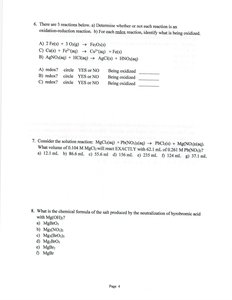
Q6. Determine whether each reaction is an oxidation-reduction reaction. For each redox reaction, identify what is being oxidized and what is being reduced.
Background
Topic: Redox Reactions
This question tests your ability to identify oxidation-reduction (redox) reactions and determine which species are oxidized and reduced.
Key Terms and Formulas:
Oxidation: Loss of electrons (increase in oxidation state).
Reduction: Gain of electrons (decrease in oxidation state).
Redox reaction: A reaction where oxidation and reduction occur simultaneously.
Step-by-Step Guidance
Assign oxidation states to each element in the reactants and products.
Compare oxidation states to determine if any element increases (oxidation) or decreases (reduction).
If both occur, the reaction is a redox reaction. Identify the species being oxidized and reduced.
Repeat for each reaction listed.
Try solving on your own before revealing the answer!
Q7. Consider the reaction: Mg(NO3)2 + Pb(NO3)2 → Pb(s) + Mg(NO3)2. What volume of 0.140 M Mg(NO3)2 will give 43.1 mL of 0.145 M Pb(NO3)2?
Background
Topic: Solution Stoichiometry
This question tests your ability to use molarity and volume to calculate the amount of reactant needed for a reaction.
Key Terms and Formulas:
Molarity ():
Stoichiometry: Use the balanced equation to relate moles of reactants.
Step-by-Step Guidance
Calculate the moles of Pb(NO3)2 using its molarity and volume: .
Use the balanced equation to determine the mole ratio between Mg(NO3)2 and Pb(NO3)2.
Calculate the moles of Mg(NO3)2 needed based on the ratio.
Convert moles of Mg(NO3)2 to volume using its molarity.
Try solving on your own before revealing the answer!
Q15. A sample of 70.5 mg of potassium phosphate is added to 15.0 mL of 0.0100 M silver nitrate, resulting in the formation of a precipitate. What is the limiting reactant in the reaction?
Background
Topic: Limiting Reactant and Precipitation Reactions
This question tests your ability to identify the limiting reactant in a precipitation reaction using mass and molarity.
Key Terms and Formulas:
Limiting reactant: The reactant that is completely consumed first, limiting the amount of product formed.
Moles: or
Step-by-Step Guidance
Write the balanced equation for the reaction.
Calculate the moles of potassium phosphate using its mass and molar mass.
Calculate the moles of silver nitrate using its molarity and volume.
Compare the mole ratios from the balanced equation to determine which reactant is limiting.
Try solving on your own before revealing the answer!
Q16. How many grams of Na2SO4 are required to make 0.250 L of 0.500 M Na2SO4?
Background
Topic: Solution Preparation
This question tests your ability to calculate the mass of solute needed to prepare a solution of a given molarity and volume.
Key Terms and Formulas:
Molarity ():
Mass:
Step-by-Step Guidance
Calculate the moles of Na2SO4 needed using molarity and volume: .
Find the molar mass of Na2SO4 (provided in the question).
Multiply the moles by the molar mass to find the required mass.
Try solving on your own before revealing the answer!