 Back
BackStep-by-Step Guidance for General Chemistry: Chemical Formulae and Reactions
Study Guide - Smart Notes
 Tailored notes based on your materials, expanded with key definitions, examples, and context.
Q1. Write the formula of a metal that can react with acid to form salt and hydrogen gas. Write the reaction equation.
Background
Topic: Metal-Acid Reactions
This question tests your understanding of how metals react with acids to produce a salt and hydrogen gas, a classic single displacement reaction.
Key Terms and Formulas:
Metal (M): Typically a reactive metal such as zinc, magnesium, or iron.
Acid (HA): Common acids include hydrochloric acid (HCl), sulfuric acid (H2SO4).
General reaction:
Step-by-Step Guidance
Choose a suitable metal that reacts with acids (e.g., zinc, magnesium).
Write the formula for the metal and the acid (e.g., Zn and HCl).
Set up the reaction equation:
Balance the equation to ensure atoms and charges are conserved.
Try solving on your own before revealing the answer!
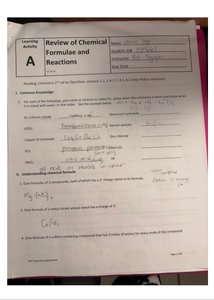
Final Answer: Zn + 2HCl → ZnCl2 + H2
This is a typical reaction for a metal (zinc) with hydrochloric acid, producing zinc chloride and hydrogen gas.
Q2. Write the formula for a salt formed when a metal reacts with a non-metal.
Background
Topic: Ionic Compound Formation
This question tests your understanding of how metals and non-metals combine to form ionic compounds (salts).
Key Terms and Formulas:
Metal (M): Donates electrons to become a cation.
Non-metal (X): Accepts electrons to become an anion.
General formula:
Step-by-Step Guidance
Identify a metal (e.g., sodium) and a non-metal (e.g., chlorine).
Write their formulas: Na and Cl.
Combine to form the salt:
Check the charges to ensure the compound is neutral.
Try solving on your own before revealing the answer!
Final Answer: NaCl
Sodium chloride is formed when sodium reacts with chlorine.
Q3. Write a balanced equation for the reaction of iron(III) chloride with sodium hydroxide.
Background
Topic: Double Displacement Reactions
This question tests your ability to write and balance equations for reactions between ionic compounds, often resulting in a precipitate.
Key Terms and Formulas:
Iron(III) chloride: FeCl3
Sodium hydroxide: NaOH
General reaction:
Step-by-Step Guidance
Write the formulas for reactants: FeCl3 and NaOH.
Predict the products: Fe(OH)3 (precipitate) and NaCl.
Set up the equation:
Balance the equation for atoms and charges.
Try solving on your own before revealing the answer!
Final Answer: FeCl3 + 3NaOH → Fe(OH)3 + 3NaCl
Iron(III) hydroxide forms as a precipitate in this reaction.
Q4. Write a balanced equation for the reaction of silver nitrate with sodium chloride.
Background
Topic: Precipitation Reactions
This question tests your ability to write equations for reactions that produce an insoluble salt (precipitate).
Key Terms and Formulas:
Silver nitrate: AgNO3
Sodium chloride: NaCl
General reaction:
Step-by-Step Guidance
Write the formulas for reactants: AgNO3 and NaCl.
Predict the products: AgCl (precipitate) and NaNO3.
Set up the equation:
Balance the equation for atoms and charges.
Try solving on your own before revealing the answer!
Final Answer: AgNO3 + NaCl → AgCl + NaNO3
Silver chloride forms as a white precipitate in this reaction.
Q5. Write a balanced equation for the reaction of barium chloride with sodium sulfate.
Background
Topic: Precipitation Reactions
This question tests your ability to write equations for reactions that produce an insoluble salt (precipitate).
Key Terms and Formulas:
Barium chloride: BaCl2
Sodium sulfate: Na2SO4
General reaction:
Step-by-Step Guidance
Write the formulas for reactants: BaCl2 and Na2SO4.
Predict the products: BaSO4 (precipitate) and NaCl.
Set up the equation:
Balance the equation for atoms and charges.
Try solving on your own before revealing the answer!
Final Answer: BaCl2 + Na2SO4 → BaSO4 + 2NaCl
Barium sulfate forms as a white precipitate in this reaction.
Q6. Write a balanced equation for the reaction of calcium carbonate with hydrochloric acid.
Background
Topic: Acid-Carbonate Reactions
This question tests your understanding of how carbonates react with acids to produce a salt, water, and carbon dioxide.
Key Terms and Formulas:
Calcium carbonate: CaCO3
Hydrochloric acid: HCl
General reaction:
Step-by-Step Guidance
Write the formulas for reactants: CaCO3 and HCl.
Predict the products: CaCl2, H2O, and CO2.
Set up the equation:
Balance the equation for atoms and charges.
Try solving on your own before revealing the answer!
Final Answer: CaCO3 + 2HCl → CaCl2 + H2O + CO2
This reaction produces calcium chloride, water, and carbon dioxide gas.
