Back
Step-by-Step Study Guidance for General Chemistry Exam Review
Study Guide - Smart Notes
 Tailored notes based on your materials, expanded with key definitions, examples, and context.
Q1. How much heat is absorbed when 50.0 g of water is heated from 20.0°C to 60.0°C?
Background
Topic: Calorimetry and Heat Transfer
This question tests your understanding of how to calculate the amount of heat absorbed by a substance when its temperature changes, using the concept of specific heat capacity.
Key Terms and Formulas:
Specific heat capacity (): The amount of heat required to raise the temperature of 1 gram of a substance by 1°C.
Heat (): The energy transferred due to temperature difference.
Key formula:
= mass of water (in grams)
= specific heat capacity of water ()
= change in temperature ()
Step-by-Step Guidance
Identify the mass of water: .
Determine the temperature change: .
Use the specific heat capacity of water: .
Set up the equation: .
Plug in the values, but stop before calculating the final numeric result.
Try solving on your own before revealing the answer!
Final Answer: 8,360 J
The heat absorbed is 8,360 Joules. This calculation uses the mass, specific heat, and temperature change for water.
Q2. What is the percent composition of sodium in sodium carbonate (Na2CO3)?
Background
Topic: Percent Composition
This question tests your ability to calculate the percent by mass of an element in a compound.
Key Terms and Formulas:
Molar mass: The mass of one mole of a substance.
Percent composition: The percentage by mass of each element in a compound.
Key formula:
Step-by-Step Guidance
Calculate the molar mass of Na2CO3 by adding the atomic masses of Na, C, and O.
Find the total mass of sodium in one mole (2 atoms of Na).
Set up the percent composition formula for sodium.
Plug in the values, but do not compute the final percentage yet.
Try solving on your own before revealing the answer!
Final Answer: 43.4%
Sodium makes up 43.4% of the mass of sodium carbonate.
Q3. How many moles of oxygen are in 50.0 g of sodium carbonate (Na2CO3)?
Background
Topic: Mole Concept and Stoichiometry
This question tests your ability to convert mass to moles and use the formula to find the number of moles of a specific element in a compound.
Key Terms and Formulas:
Mole: A unit representing particles.
Molar mass: The mass of one mole of a substance.
Key formula:
Step-by-Step Guidance
Calculate the molar mass of Na2CO3.
Find the number of moles of Na2CO3 in 50.0 g.
Multiply the moles of Na2CO3 by 3 (since there are 3 O atoms per formula unit).
Set up the calculation, but do not compute the final value yet.
Try solving on your own before revealing the answer!
Final Answer: 1.42 mol O
There are 1.42 moles of oxygen atoms in 50.0 g of sodium carbonate.
Q4. What is the empirical formula for a compound containing 40.0% C, 6.7% H, and 53.3% O?
Background
Topic: Empirical Formula Determination
This question tests your ability to determine the simplest whole-number ratio of atoms in a compound based on percent composition.
Key Terms and Formulas:
Empirical formula: The simplest ratio of elements in a compound.
Mole: A unit representing particles.
Step-by-Step Guidance
Assume 100 g of the compound, so the masses are 40.0 g C, 6.7 g H, and 53.3 g O.
Convert each mass to moles using the atomic masses.
Divide each mole value by the smallest number of moles to get the ratio.
Set up the ratio, but do not simplify to the final empirical formula yet.
Try solving on your own before revealing the answer!
Final Answer: CH2O
The empirical formula is CH2O, which is the simplest whole-number ratio for the given percentages.
Q5. What is the molar mass of magnesium chloride (MgCl2)?
Background
Topic: Molar Mass Calculation
This question tests your ability to calculate the molar mass of a compound by summing the atomic masses of its constituent elements.
Key Terms and Formulas:
Molar mass: The mass of one mole of a substance.
Key formula:
Step-by-Step Guidance
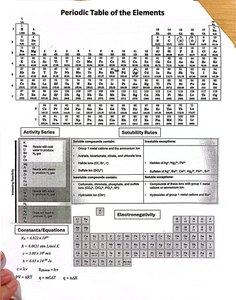
Find the atomic mass of Mg and Cl from the periodic table.
Multiply the atomic mass of Cl by 2.
Add the masses together to get the molar mass.
Set up the calculation, but do not compute the final value yet.
Try solving on your own before revealing the answer!
Final Answer: 95.21 g/mol
The molar mass of magnesium chloride is 95.21 g/mol.