 Back
Stoichiometry and Titration: Mass Relationships and Solution Concentration
Study Guide - Smart Notes
 Tailored notes based on your materials, expanded with key definitions, examples, and context.
Chemical Quantities & Aqueous Reactions
Stoichiometry: Mass Relationships in Chemical Reactions
Stoichiometry is the quantitative study of reactants and products in a chemical reaction. It allows chemists to predict the amounts of substances consumed and produced using balanced chemical equations.
Balanced Equation: The reaction of chalcocite (Cu2S) with oxygen produces copper and sulfur dioxide:
Mole Ratios: The coefficients in the balanced equation indicate the ratio in which substances react and are formed.
Mass-to-Mole Conversion: To determine how much Cu2S is needed to produce a given mass of Cu, convert the mass of Cu to moles, use the mole ratio from the equation, then convert moles of Cu2S to mass.
Example: To produce 274.0 g of Cu, calculate moles of Cu, use the 2:1 ratio (2 Cu per 1 Cu2S), then find the mass of Cu2S required.
Additional info: This process is fundamental for predicting yields and planning laboratory syntheses.
Solutions & Titration
Introduction to Titration
Titration is a laboratory technique used to determine the concentration of an unknown solution (analyte) by reacting it with a solution of known concentration (titrant). The titrant is added gradually until the reaction reaches the equivalence point, where stoichiometrically equivalent amounts of reactants have reacted.
Titrant: The solution of known concentration added to the analyte.
Analyte: The solution whose concentration is being determined.
Equivalence Point: The point at which the amount of titrant added exactly reacts with all of the analyte.
Indicator: A substance added to signal the end point of the titration, often by a color change.
End Point: The point at which the indicator changes color, signaling that the titration is complete. This may differ slightly from the equivalence point.
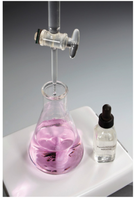
Example: In acid-base titrations, phenolphthalein is a common indicator that turns pink at the end point.
Real-World Analogy for Titration
To understand titration, consider a party where you want to know the number of guests. If each guest eats 2 slices of pizza and you distribute 12 pizzas (each with 8 slices), you can calculate the number of guests by dividing the total slices by slices per guest.
Calculation: Total slices = 12 pizzas × 8 slices = 96 slices. Number of guests = 96 slices / 2 slices per guest = 48 guests.
Analogy: In titration, the titrant is like the pizza slices, and the analyte is like the guests. The amount of titrant used tells you about the amount of analyte present.
Titration Calculations: Acid-Base Example
Stoichiometry is used in titration calculations to relate the volume and concentration of titrant to the amount of analyte present.
Balanced Equation:
Step 1: Calculate moles of titrant (HCl) used:
Step 2: Use the stoichiometric ratio to find moles of analyte (Ca(OH)2): 2 moles HCl react with 1 mole Ca(OH)2.
Example: If 12.0 L of 0.800 M HCl is used, moles HCl = 0.800 × 12.0 = 9.6 mol. Moles Ca(OH)2 = 9.6 mol / 2 = 4.8 mol.
Additional info: This method is used to determine unknown concentrations in laboratory settings.
Determining Solution Concentration
Once the number of moles of analyte is known, its concentration can be calculated using the volume of the solution.
Formula:
Example: If 4.80 moles of Ca(OH)2 are dissolved in 5.5 L,
Titration Practice: Vitamin C Analysis
The concentration of Vitamin C (ascorbic acid, C6H8O6) in a solution can be determined by titration with IO3- based on the reaction:
Balanced Equation:
Calculation Steps:
Convert volume of IO3- titrant to moles:
Use stoichiometry to find moles of Vitamin C: 1 mole IO3- reacts with 3 moles Vitamin C.
Divide moles of Vitamin C by the volume of the energy drink (in liters) to find molarity.
Example: 2.5 mL of 0.050 M IO3- titrant is used for a 355 mL energy drink sample.

Additional info: The molar mass of Vitamin C is 176.1 g/mol. To find the mass in mg, multiply moles by molar mass and convert to mg.
Titration Practice: Aluminum Hydroxide and Nitric Acid
Another titration example involves Al(OH)3 and HNO3:
Balanced Equation:
Calculation Steps:
Determine moles of Al(OH)3 in the sample using its molarity and volume.
Use the stoichiometric ratio (1:3) to find moles of HNO3 needed.
Calculate the volume of HNO3 solution required using its molarity.
Lab Techniques and Procedures
Indicators in Titration
Indicators are essential in titration to signal the end point. They are chosen based on the type of titration and the expected pH at the equivalence point.
Common Indicators: Phenolphthalein (acid-base titrations), methyl orange, bromothymol blue.
Color Change: The indicator changes color when the reaction is complete, helping to identify the end point visually.
Additional info: The choice of indicator depends on the expected pH at the equivalence point.
Mathematical Operations and Functions
Limiting Reagents
Limiting reagent calculations are important for determining which reactant will be consumed first and thus limit the amount of product formed.
Definition: The limiting reagent is the reactant that is completely consumed in a reaction, determining the maximum amount of product.
Calculation: Compare the mole ratios of reactants to the balanced equation to identify the limiting reagent.
Example: Practice problems often involve calculating the limiting reagent and the amount of product formed.
Additional info: Refer to Sample Exercise 7.6 for detailed calculations.
Summary Table: Titration Calculation Steps
Step | Description |
|---|---|
1 | Convert titrant volume to moles (using molarity) |
2 | Use balanced equation to relate moles of titrant to moles of analyte |
3 | Calculate analyte concentration (moles/volume) |
4 | Convert moles to mass if needed (using molar mass) |
