 Back
BackStoichiometry: Calculations with Chemical Formulas and Equations
Study Guide - Smart Notes
 Tailored notes based on your materials, expanded with key definitions, examples, and context.
Stoichiometry and the Law of Conservation of Mass
Introduction to Stoichiometry
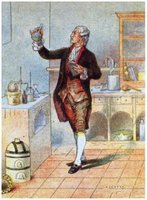
Stoichiometry is the study of the quantitative relationships between the amounts of reactants and products in chemical reactions. It is fundamentally based on the Law of Conservation of Mass, which states that matter is neither created nor destroyed in a chemical reaction. This principle, established by Antoine Lavoisier in 1789, underpins all stoichiometric calculations in chemistry.
Chemical Equations
Structure and Interpretation of Chemical Equations
Chemical equations are concise representations of chemical reactions. They show the substances involved, their physical states, and the quantitative relationships between them. The general format is:
Reactants appear on the left side of the equation.
Products appear on the right side of the equation.
States of matter are indicated in parentheses: (g) for gas, (l) for liquid, (s) for solid, and (aq) for aqueous solution.
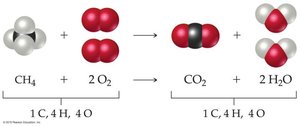
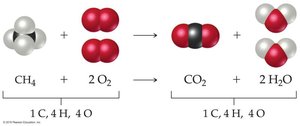
Coefficients are used to balance the equation, ensuring the law of conservation of mass is obeyed.
Balancing Chemical Equations
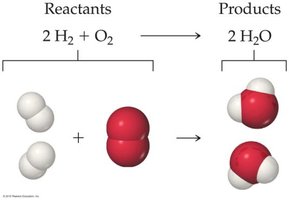
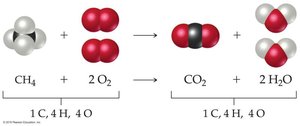
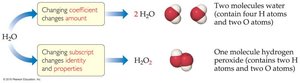
To balance a chemical equation, coefficients are added in front of compounds or elements to ensure the same number of each type of atom appears on both sides of the equation. Subscripts in chemical formulas indicate the number of atoms in a molecule and should never be changed to balance an equation, as this would alter the identity of the substance.
Types of Chemical Reactions
Classification of Reactions
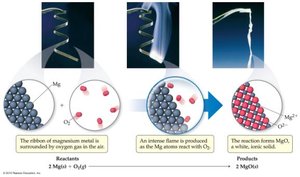
Combination (Synthesis) Reactions: Two or more substances combine to form one product. Example:
Decomposition Reactions: One substance breaks down into two or more simpler substances. Example:
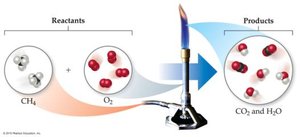
Combustion Reactions: A substance reacts rapidly with oxygen, often producing a flame. Example:

Formula Weight, Molecular Weight, and Percent Composition
Formula Weight (FW) and Molecular Weight (MW)
The formula weight is the sum of the atomic weights of all atoms in a chemical formula, typically used for ionic compounds. The molecular weight is the sum of the atomic weights of all atoms in a molecule, used for molecular compounds.
Formula weight of CaCl2: amu
Molecular weight of C2H6: amu
Percent Composition
The percent composition of an element in a compound is calculated as:
Example: For ethane (C2H6), the percent of carbon is:
The Mole and Avogadro’s Number
Definition of the Mole
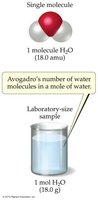
A mole is the amount of substance that contains as many elementary entities (atoms, molecules, ions, etc.) as there are atoms in exactly 12 grams of carbon-12. This number is known as Avogadro’s number:
entities/mol
Molar Mass
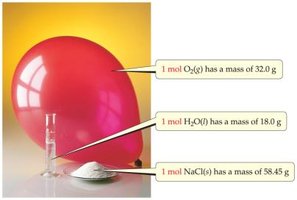
The molar mass of a substance is the mass in grams of one mole of that substance. For elements, it is numerically equal to the atomic weight in amu; for compounds, it is the sum of the atomic weights of the atoms in the formula.
Mole Relationships
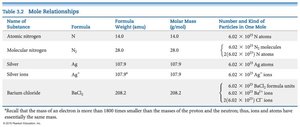
One mole of a substance contains Avogadro’s number of particles. The relationship between moles, mass, and number of particles is fundamental in stoichiometric calculations.
Name of Substance | Formula | Formula Weight (amu) | Molar Mass (g/mol) | Number and Kind of Particles in One Mole |
|---|---|---|---|---|
Atomic nitrogen | N | 14.0 | 14.0 | N atoms |
Molecular nitrogen | N2 | 28.0 | 28.0 | N2 molecules |
Silver | Ag | 107.9 | 107.9 | Ag atoms |
Barium chloride | BaCl2 | 208.2 | 208.2 | BaCl2 formula units |
Empirical and Molecular Formulas
Determining Empirical Formulas
The empirical formula gives the simplest whole-number ratio of atoms in a compound. It can be determined from percent composition data using the following steps:
Convert mass percent to grams (assume 100 g sample).
Convert grams to moles using atomic masses.
Divide by the smallest number of moles to get the simplest ratio.

Combustion Analysis
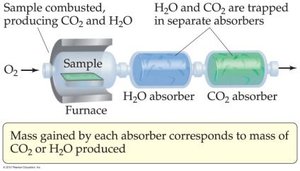
Combustion analysis is a laboratory technique used to determine the empirical formula of compounds containing carbon, hydrogen, and oxygen. The compound is combusted in oxygen, and the masses of CO2 and H2O produced are measured to calculate the amounts of C and H, with O determined by difference.
Stoichiometric Calculations
Quantitative Relationships in Chemical Reactions
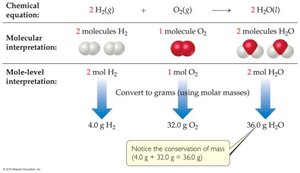
The coefficients in a balanced chemical equation indicate the relative numbers of moles (and thus masses) of reactants and products. Stoichiometric calculations allow chemists to predict the amounts of substances consumed and produced in a reaction.
Steps in Stoichiometric Calculations
Convert the mass of a substance to moles using its molar mass.
Use the mole ratio from the balanced equation to convert moles of one substance to moles of another.
Convert moles back to mass if required.




Limiting Reactants and Theoretical Yield
Limiting Reactant
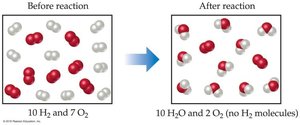
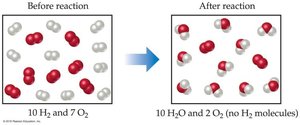
The limiting reactant is the reactant that is completely consumed first in a chemical reaction, thus limiting the amount of product formed. The other reactant(s) are in excess.
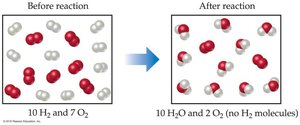
Theoretical Yield and Percent Yield
The theoretical yield is the maximum amount of product that can be formed from the given amounts of reactants, as calculated from stoichiometry. The actual yield is the amount of product actually obtained from the reaction. The percent yield is calculated as:
Summary Table: Key Stoichiometric Concepts
Concept | Definition | Key Equation |
|---|---|---|
Law of Conservation of Mass | Matter is neither created nor destroyed in a chemical reaction. | Mass of reactants = Mass of products |
Formula Weight | Sum of atomic weights in a formula (amu) | FW = Σ (atomic weights) |
Mole | 6.02 × 10²³ entities | 1 mol = 6.02 × 10²³ entities |
Percent Composition | Percent by mass of each element in a compound | |
Limiting Reactant | Reactant that is completely consumed first | Determined by mole ratio |
Theoretical Yield | Maximum possible amount of product | Calculated from stoichiometry |
Percent Yield | Actual yield as a percentage of theoretical yield |
