 Back
Stoichiometry, Chemical Equations, and Percent Yield: Study Guide for General Chemistry
Study Guide - Smart Notes
 Tailored notes based on your materials, expanded with key definitions, examples, and context.
Stoichiometry and Chemical Quantities
Key Concepts in Chemical Quantities
Stoichiometry is the quantitative relationship between reactants and products in a chemical reaction. Understanding how to convert between mass, moles, molecules, and atoms is essential for solving stoichiometric problems.
Mole: The SI unit for amount of substance, defined as containing Avogadro's number () of particles.
Molar Mass: The mass (in grams) of one mole of a substance, used to convert between mass and moles.
Molarity: The concentration of a solution, defined as moles of solute per liter of solution.
Avogadro’s Number: , used to convert between moles and number of particles.
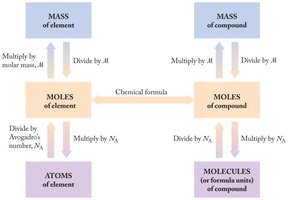
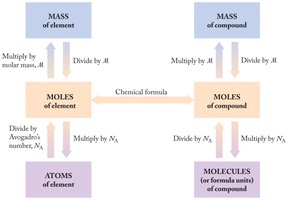
To convert between mass, moles, and number of particles, use the following relationships:
Mass → Moles: Divide by molar mass
Moles → Mass: Multiply by molar mass
Moles → Particles: Multiply by Avogadro’s number
Particles → Moles: Divide by Avogadro’s number
Converting Solution Volume and Moles
For solutions, molarity () is used to relate volume and moles:
Volume (L) → Moles: Multiply by molarity
Moles → Volume (L): Divide by molarity
Writing and Balancing Chemical Equations
Balanced Chemical Equations
Chemical equations must be balanced to reflect the conservation of mass. Each side of the equation must have the same number of atoms for each element.
Example:
Use coefficients to balance equations.
Stoichiometry: Using Mole Ratios
Relating Reactants and Products
Mole ratios from balanced equations allow calculation of how much product can be formed from a given amount of reactant, or vice versa.
Example: If you have 10.0 mol CO and excess H2, use the equation to determine moles of CH3OH produced.
Use the coefficients as conversion factors.
Macroscopic Analogy
Stoichiometry can be compared to assembling objects, such as bicycles, from parts. The limiting reagent determines how many complete products can be made.
Example: If a bicycle requires 1 frame, 1 seat, and 2 wheels, the number of bikes you can make depends on the limiting part.

Limiting Reactant and Excess Reactant
Identifying the Limiting Reactant
The limiting reactant is the substance that is completely consumed first, thus limiting the amount of product formed.
Calculate moles of each reactant.
Use mole ratios to determine which reactant produces the least amount of product.
Example: Nitrogen Fixation
Stoichiometric Calculations
Nitrogen fixation is the process of converting nitrogen gas and hydrogen gas into ammonia:
Balanced Equation:
To find how much NH3 can be made from a given amount of N2 or H2, convert mass to moles, use mole ratios, and convert back to mass if needed.
Multi-Step Stoichiometry
Some problems require multiple steps:
Convert mass to moles.
Use mole ratios to find moles of product.
Convert moles of product to mass.
Percent Yield
Calculating Percent Yield
Percent yield measures the efficiency of a reaction:
Formula:
Theoretical yield is calculated from stoichiometry; actual yield is measured experimentally.
Example: Aspirin Synthesis
Percent yield is important in industrial and laboratory settings. For example, converting salicylic acid to acetylsalicylic acid (aspirin) may not produce 100% yield due to incomplete reactions or side products.
Calculate theoretical yield based on stoichiometry.
Use percent yield to determine how much starting material is needed for a desired amount of product.
Practice Problems
Sample Calculations
Calculate the mass of 0.25 moles of citric acid (, 192.12 g/mol):
Find moles of methane () in 6.07 g:
Determine moles of magnesium hydroxide (, 58.32 g/mol) in 175 mL of 0.150 M solution:
Advanced Practice: Cisplatin Synthesis
Balance the equation:
Calculate maximum grams of cisplatin from 11.6 g (using molar masses and stoichiometry).
Find grams of ammonia consumed.
Calculate percent yield if actual yield is 6.03 g.
Summary Table: Stoichiometric Relationships
Quantity | Conversion Factor | Example |
|---|---|---|
Mass → Moles | Divide by molar mass | |
Moles → Mass | Multiply by molar mass | |
Moles → Particles | Multiply by Avogadro's number | |
Particles → Moles | Divide by Avogadro's number | |
Volume (L) → Moles (solution) | Multiply by molarity | |
Moles → Volume (L) (solution) | Divide by molarity |
Additional info:
Some context and examples were inferred to ensure completeness and clarity for exam preparation.
Practice problems and stepwise solutions were expanded for academic quality.
