 Back
BackStoichiometry of Chemical Reactions: Study Notes for General Chemistry
Study Guide - Smart Notes
 Tailored notes based on your materials, expanded with key definitions, examples, and context.
Stoichiometry of Chemical Reactions
4.1 Writing and Balancing Chemical Equations
Chemical equations are symbolic representations of chemical reactions, showing the identities and relative quantities of reactants and products. Balancing these equations is essential to reflect the conservation of mass and atoms.
Reactants are substances consumed in the reaction (left side of the equation).
Products are substances formed in the reaction (right side of the equation).
Coefficients indicate the relative number of molecules or moles of each substance. They must be the smallest possible whole numbers.
Subscripts in chemical formulas indicate the number of atoms in a molecule and cannot be changed when balancing equations.
Physical states are indicated by (s), (l), (g), or (aq).
Special conditions (e.g., heat) may be indicated above or below the reaction arrow (e.g., Δ for heat).
Example: The combustion of methane:
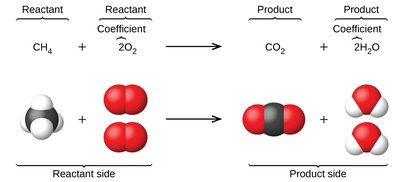
Balancing involves ensuring equal numbers of each atom on both sides. For example, in the above reaction, there is 1 C, 4 H, and 4 O atoms on both sides.

Sometimes, fractional coefficients are used as intermediates but must be converted to whole numbers in the final equation.
Table: Balancing Example
Element | Reactants | Products | Balanced? |
|---|---|---|---|
C | 1 × 1 = 1 | 1 × 1 = 1 | Yes |
H | 1 × 4 = 4 | 2 × 2 = 4 | Yes |
O | 2 × 2 = 4 | (1 × 2) + (2 × 1) = 4 | Yes |
4.2 Classifying Chemical Reactions
Chemical reactions can be classified into several types based on their characteristics and the changes that occur.
Precipitation Reactions
Involve the formation of an insoluble solid (precipitate) from soluble reactants in solution.
Often double displacement (metathesis) reactions.
Solubility rules help predict whether a precipitate will form.

Example:
Net ionic equation:
Acid-Base Reactions
Involve the transfer of a hydrogen ion (H+) from an acid to a base.
Acids produce hydronium ions (H3O+) in water; bases produce hydroxide ions (OH-).
Strong acids and bases dissociate completely; weak acids and bases only partially dissociate.

Example:
Oxidation-Reduction (Redox) Reactions
Involve the transfer of electrons between species.
Oxidation: loss of electrons; Reduction: gain of electrons.
Oxidizing agent: species that gains electrons; Reducing agent: species that loses electrons.
Oxidation numbers are used to track electron transfer.
Example:
Half-reactions:
4.3 Reaction Stoichiometry
Stoichiometry is the quantitative relationship between reactants and products in a chemical reaction, based on the balanced equation.
Coefficients in the balanced equation provide stoichiometric ratios for calculations.
Stoichiometric factors are used to convert between moles, mass, and molecules of reactants and products.
Example:
Stoichiometric factor:
Sample Calculation: How many moles of I2 are required to react with 0.429 mol of Al?
4.4 Reaction Yields
Reaction yields describe the efficiency of a chemical reaction in producing the desired product.
Theoretical yield: Maximum amount of product predicted by stoichiometry, assuming complete reaction of the limiting reactant.
Actual yield: Amount of product actually obtained from the reaction (usually less than theoretical yield).
Percent yield:
Limiting reactant: The reactant that is completely consumed first, limiting the amount of product formed.
Example: If 1.274 g of CuSO4 reacts with excess Zn to produce 0.392 g Cu, percent yield is calculated as:
4.5 Quantitative Chemical Analysis
Quantitative analysis determines the amount or concentration of a substance in a sample. Two common methods are titration and gravimetric analysis.
Titration
Involves adding a titrant of known concentration to an analyte until the reaction reaches the equivalence point.
Indicators are used to detect the end point (color change).
Stoichiometry of the reaction allows calculation of analyte concentration.
Example: Titrating 50.00 mL of HCl with 35.23 mL of 0.250 M NaOH:
Gravimetric Analysis
Involves converting the analyte into an insoluble form, isolating it by filtration, and weighing it.
Mass measurements and stoichiometry are used to determine analyte concentration.
Example: Precipitating BaSO4 from a solution containing MgSO4 and weighing the BaSO4 formed.
Combustion Analysis
Used to determine the empirical formula of organic compounds by burning a known mass and measuring the masses of CO2 and H2O produced.
Example: A sample yields 0.00394 g CO2 and 0.00161 g H2O. The empirical formula is determined from the mole ratios of C and H.
Appendix: Solubility Rules Table
Soluble Compounds | Insoluble Exceptions |
|---|---|
Group 1 metal cations, NH4+, NO3-, C2H3O2-, ClO3-, SO42- | Halides of Ag+, Hg22+, Pb2+; Sulfates of Ag+, Ba2+, Ca2+, Hg22+, Pb2+, Sr2+ |
Halides (Cl-, Br-, I-) | See above |
Carbonate, chromate, phosphate, sulfide, hydroxide | Soluble with group 1 cations or NH4+; hydroxides of group 1 and Ba2+ |

Additional info: This summary covers the core concepts of stoichiometry, reaction classification, balancing equations, and quantitative analysis as outlined in a typical general chemistry curriculum.
