 Back
BackLesson 8.2: Strong and Weak Acids and Bases: Properties, Equilibria, and pH Calculations
Study Guide - Smart Notes
 Tailored notes based on your materials, expanded with key definitions, examples, and context.
Strong and Weak Acids and Bases
Introduction to Acid and Base Strength
Acids and bases are classified as strong or weak based on the extent of their ionization in water. This property is crucial in understanding their behavior in chemical reactions and their effects in biological and industrial contexts.
Strong acids and bases ionize or dissociate almost completely in aqueous solution, producing high concentrations of ions.
Weak acids and bases ionize or dissociate only partially, resulting in lower concentrations of ions in solution.
The strength of an acid or base is determined by the position of the equilibrium in its ionization reaction.
Strong Acids and Weak Acids
When acids dissolve in water, they establish an equilibrium between the non-ionized acid and its ions. The extent of ionization distinguishes strong acids from weak acids.
Strong acid: An acid that ionizes almost 100% in water, producing a high concentration of hydrogen ions, H+(aq).
Weak acid: An acid that only partially ionizes in water, producing a relatively low concentration of hydrogen ions.
The general ionization reaction for an acid, HA, is:
The acid ionization constant, , is given by:
Strong acids have large values; weak acids have very small values.
Table: Comparison of Strong and Weak Acids
Property | Strong Acid | Weak Acid |
|---|---|---|
Value of | Large | Small |
Equilibrium Position | Far to the right | Far to the left |
Ionization in Water | Almost complete | Partial |
Oxyacids and Organic Acids
Most common acids are oxyacids, where the acidic hydrogen is attached to an oxygen atom (e.g., sulfuric acid, H2SO4). Organic acids, also called carboxylic acids, contain a carboxyl group (-COOH) and are typically weak acids (e.g., acetic acid, HC2H3O2).
Strong Bases and Weak Bases
Bases are also classified as strong or weak based on their dissociation in water.
Strong base: A base that dissociates completely in water, producing hydroxide ions, OH-(aq).
Weak base: A base that only partially reacts with water to produce hydroxide ions.
For example, sodium hydroxide (NaOH) dissociates completely:
Ammonia (NH3) is a weak base and reacts with water as follows:
The base ionization constant, , is given by:
Table: Values of Selected Weak Bases at 25°C
Name of Base | Formula | |
|---|---|---|
Dimethylamine | (CH3)2NH | |
Ammonia | NH3 | |
Pyridine | C5H5N | |
Urea | NH2CONH2 | |
... (see full table in text) |
Water as an Acid and a Base (Autoionization of Water)
Water is amphiprotic, meaning it can act as both an acid and a base. Water undergoes autoionization:
The equilibrium constant for this reaction is the ion-product constant for water, :
at 25°C
In neutral solutions: mol/L
In acidic solutions:
In basic solutions:
Relationship Between , , and
For a conjugate acid-base pair, the product of their ionization constants equals :
This relationship allows calculation of or if the other is known.
pH and pOH
The acidity or basicity of a solution is commonly expressed using the pH and pOH scales:
At 25°C,
The pH scale typically ranges from 0 (very acidic) to 14 (very basic), with 7 being neutral.
Measuring pH
pH can be measured using electronic pH meters or acid–base indicators. pH meters provide precise readings, while indicators (such as litmus paper or natural extracts like red cabbage juice) give approximate values based on color changes.
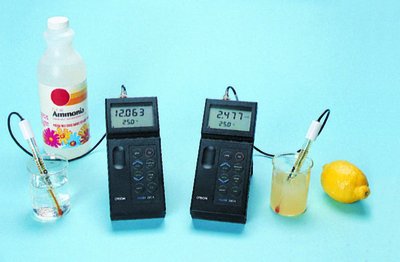
Figure: pH meters measuring the pH of ammonia (basic) and lemon juice (acidic). The digital readouts show the difference in pH values, illustrating the concept of acidity and basicity in everyday substances.
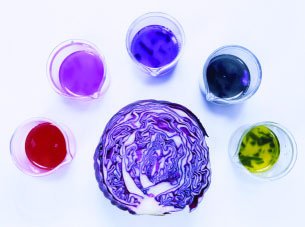
Figure: Red cabbage juice as a natural acid–base indicator. The color of the juice changes depending on the pH of the solution, ranging from red (acidic) to green/yellow (basic).
Calculating pH, pOH, [H+], and [OH-]
To find pH from [H+]:
To find [H+] from pH:
To find pOH from [OH-]:
To find [OH-] from pOH:
To relate pH and pOH: (at 25°C)
Summary Table: Key Equations and Relationships
Equation | Description |
|---|---|
Ion-product constant for water | |
Relationship between acid and base ionization constants | |
Definition of pH | |
Definition of pOH | |
Relationship at 25°C |
Applications and Examples
Household substances: Ammonia (basic, high pH), lemon juice (acidic, low pH).
Indicators: Red cabbage juice changes color with pH, serving as a visual indicator for acidity or basicity.
Calculations: Given [H+] or [OH-], you can calculate pH, pOH, and the other ion concentration using the equations above.
Key Points
Strong acids and bases ionize completely; weak acids and bases ionize partially.
The strength of an acid or base is reflected in its or value.
pH and pOH provide a convenient way to express the acidity or basicity of a solution.
pH meters and indicators are practical tools for measuring pH in the laboratory and in everyday life.
