 Back
BackStructures of Solids: Crystalline and Amorphous Solids
Study Guide - Smart Notes
 Tailored notes based on your materials, expanded with key definitions, examples, and context.
Structures of Solids
Types of Solids
Solids are classified based on the arrangement of their constituent particles. The two primary types are crystalline solids and amorphous solids.
Crystalline solids: Particles are arranged in a highly ordered, repeating pattern. These solids exhibit well-defined geometric shapes and distinct melting points.
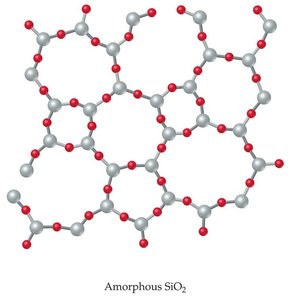
Amorphous solids: Particles lack a regular arrangement, resulting in solids without a definite shape or sharp melting point.
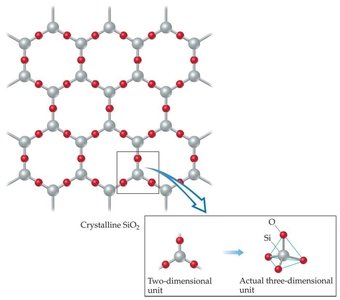
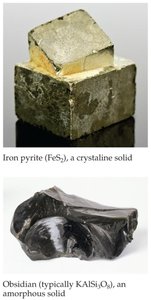
Example: Iron pyrite (FeS2) is a crystalline solid, while obsidian (typically KAlSi3O8) is an amorphous solid.
Crystalline Solids: Structure and Unit Cells
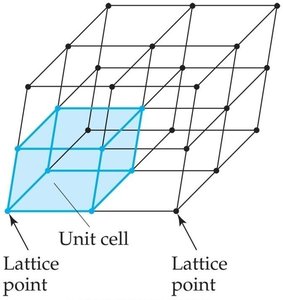
Crystalline solids are characterized by a repeating three-dimensional arrangement of particles, known as a crystal lattice. The smallest repeating unit in this lattice is called the unit cell.
Unit cell: The basic structural unit that, when repeated, builds the entire crystal.
Crystal lattice: A three-dimensional array of points representing the positions of particles in a crystal.
Fractions of Atoms in a Unit Cell
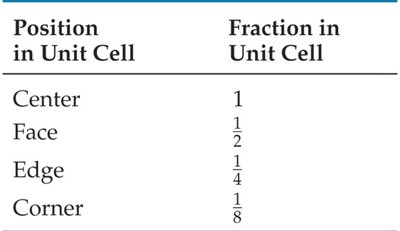
Atoms in a unit cell may be located at different positions, each contributing a fraction to the unit cell:
Position in Unit Cell | Fraction in Unit Cell |
|---|---|
Center | 1 |
Face | 1/2 |
Edge | 1/4 |
Corner | 1/8 |
Cubic Unit Cells
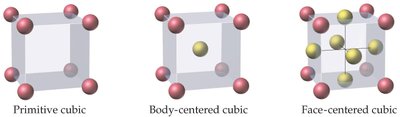
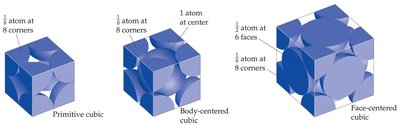
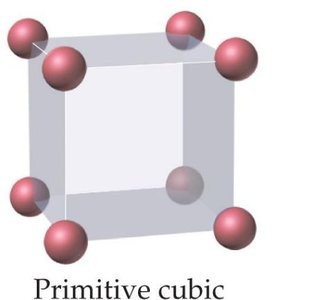
Cubic lattices are the most common arrangements in solids. There are three main types:
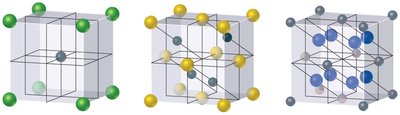
Primitive cubic: Atoms at the corners only. Total atoms per cell:
Body-centered cubic: Atoms at corners and one at the center. Total atoms per cell:
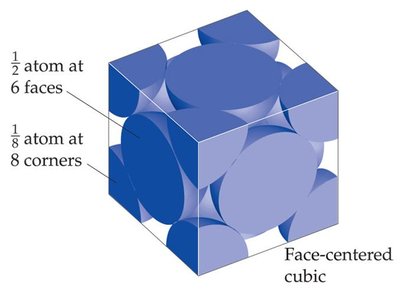
Face-centered cubic: Atoms at corners and faces. Total atoms per cell:
Calculating Density of Solids
The density of a solid can be calculated using the mass and volume of the unit cell:
Formula:
Example: For aluminum (face-centered cubic, edge length 4.045 Å):
Close Packing of Spheres
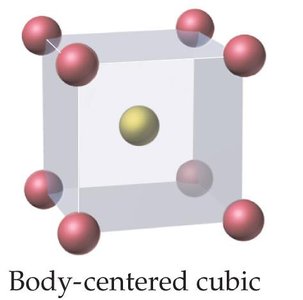
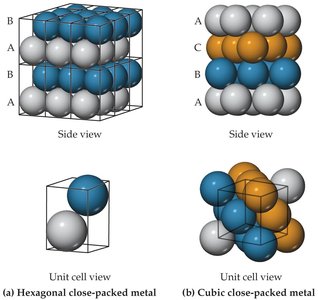
Close packing refers to the arrangement of atoms in layers to maximize packing efficiency and minimize void space. The two main types are:
Hexagonal close-packed (HCP): ABAB stacking
Cubic close-packed (CCP): ABCABC stacking
Packing Efficiency
Packing efficiency is the percentage of space occupied by atoms in a unit cell:
Primitive cubic: , Packing efficiency =
Body-centered cubic: , Packing efficiency =
Face-centered cubic: , Packing efficiency =
Types of Crystalline Solids
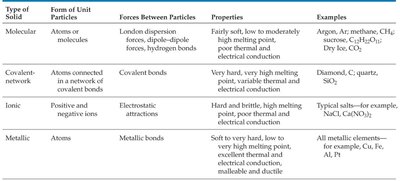
Crystalline solids are classified based on the nature of their bonding and constituent particles:
Type of Solid | Form of Unit Particles | Forces Between Particles | Properties | Examples |
|---|---|---|---|---|
Molecular | Atoms or molecules | London dispersion, dipole-dipole, hydrogen bonds | Fairly soft, low to moderate melting point, poor thermal/electrical conduction | Argon, CH4, C12H22O11, CO2 |
Covalent-network | Atoms connected in a network | Covalent bonds | Very hard, very high melting point, variable thermal/electrical conduction | Diamond, SiO2 |
Ionic | Positive and negative ions | Electrostatic attractions | Hard and brittle, high melting point, poor thermal/electrical conduction | NaCl, Ca(NO3)2 |
Metallic | Atoms | Metallic bonds | Soft to very hard, low to very high melting point, electrical conduction, malleable and ductile | Cu, Fe, Al, Pt |
Covalent-Network Solids
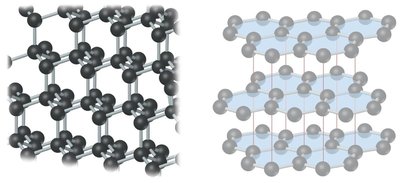
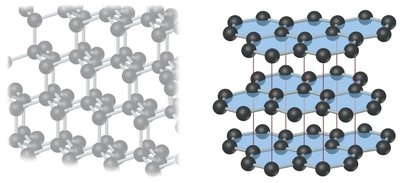
Covalent-network solids are composed of atoms connected by a continuous network of covalent bonds. These solids are typically very hard and have high melting points.
Examples: Diamond (carbon), quartz (SiO2), graphite
Empirical Formulas of Ionic Solids
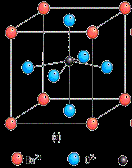
The empirical formula of an ionic solid is determined by counting the number of each type of ion in the unit cell.
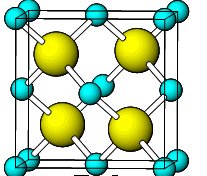
Example: CsCl, ZnS, CaF2
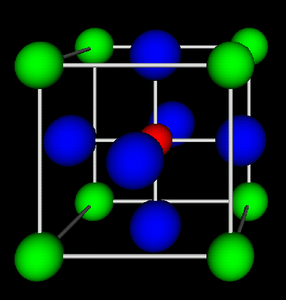
Example: CaTiO3 (calcium at corners, titanium at center, oxygen at faces)
Metallic Solids
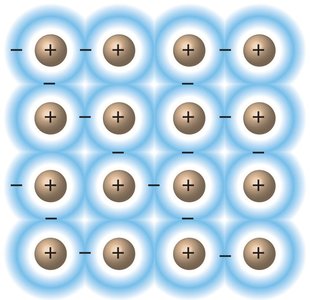
Metallic solids consist entirely of metallic atoms. The bonding is due to delocalized valence electrons, which explains the electrical conductivity and malleability of metals.
Polymers and Nanomaterials
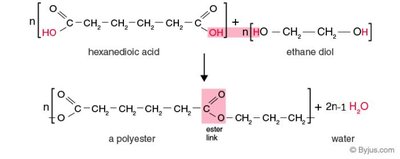
Polymers are large molecules formed by joining smaller units called monomers. There are two main types:
Addition polymers: Formed by breaking bonds and creating new ones without loss of small molecules.
Condensation polymers: Formed by removing a small molecule (often water) between two large molecules.
Nanomaterials are materials with dimensions in the 1–100 nm range, exhibiting unique properties compared to bulk materials.
Example: Finely divided metals can have different properties, such as "red gold" used in stained glass windows.
Additional info: Nanomaterials are an active area of research due to their novel optical, electrical, and mechanical properties.
----------------------------------------
