 Back
BackStudy Guidance for Chemical Bonding, Molecular Shapes, and Lewis Structures
Study Guide - Smart Notes
 Tailored notes based on your materials, expanded with key definitions, examples, and context.
Q1. What are the group number and valence electron configuration of a main-group element that can be characterized by the following Lewis electron-dot symbol?
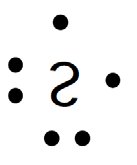
Background
Topic: Lewis Electron-Dot Symbols and Periodic Table Groups
This question tests your understanding of how to interpret Lewis dot structures, relate them to group numbers, and deduce the valence electron configuration for main-group elements.
Key Terms and Concepts:
Lewis dot symbol: A representation of the valence electrons around an atom using dots.
Group number: For main-group elements, the group number corresponds to the number of valence electrons.
Valence electron configuration: The arrangement of electrons in the outermost shell (e.g., (2s)2(2p)4).
Step-by-Step Guidance
Count the number of dots around the element symbol in the Lewis structure. Each dot represents a valence electron.
Recall that for main-group elements, the group number (using the A/B system) equals the number of valence electrons.
Match the number of valence electrons to the possible electron configurations given in the answer choices.
Consider the periodic table: elements in group 6A have 6 valence electrons, and their configuration ends in (ns)2(np)4.
Try solving on your own before revealing the answer!
Q2. Identify the correct Lewis structure for NCl3.
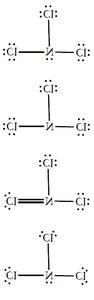
Background
Topic: Lewis Structures for Covalent Compounds
This question tests your ability to draw and interpret Lewis structures, ensuring that all atoms obey the octet rule and that the correct number of bonds and lone pairs are present.
Key Terms and Concepts:
Lewis structure: A diagram showing the arrangement of valence electrons among atoms in a molecule.
Octet rule: Atoms (except H and He) tend to have eight electrons in their valence shell.
Lone pairs: Non-bonding pairs of electrons on an atom.
Step-by-Step Guidance
Count the total number of valence electrons for NCl3 (N = 5, Cl = 7 each).
Determine the central atom (usually the least electronegative, which is N here).
Connect the central atom to the surrounding atoms with single bonds.
Distribute the remaining electrons as lone pairs to satisfy the octet rule for each atom.
Try solving on your own before revealing the answer!
Q3. Which structure(s) have the most lone pairs around the central atom, and which have no lone pairs?
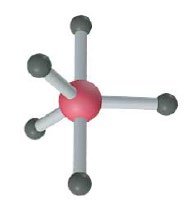
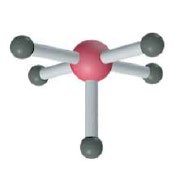
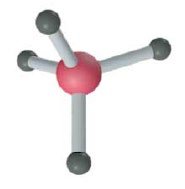
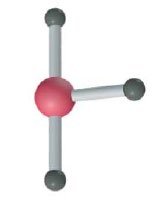
Background
Topic: Molecular Geometry and Lone Pairs
This question tests your ability to interpret 3D molecular models, identify the number of lone pairs on the central atom, and distinguish between different molecular geometries.
Key Terms and Concepts:
Lone pairs: Non-bonding pairs of electrons on the central atom, which affect molecular shape.
Molecular geometry: The 3D arrangement of atoms around a central atom, influenced by both bonding pairs and lone pairs.
Step-by-Step Guidance
Examine each model and count the number of atoms bonded to the central atom.
Recall common geometries (e.g., tetrahedral, trigonal pyramidal, bent) and how lone pairs affect these shapes.
Identify which structure(s) must have lone pairs based on the observed geometry (e.g., a trigonal pyramidal shape indicates one lone pair).
Determine which structure(s) have no lone pairs (e.g., a perfect tetrahedral or linear geometry with all positions occupied by atoms).
Try solving on your own before revealing the answer!
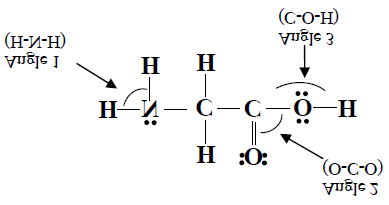
Q4. The simplest amino acid, glycine, is shown below. What are the ideal values of the three indicated angles?
Background
Topic: Molecular Geometry and Bond Angles
This question tests your understanding of how electron domains around atoms determine bond angles, using VSEPR theory to predict idealized angles in a molecule.
Key Terms and Concepts:
VSEPR theory: Valence Shell Electron Pair Repulsion theory, used to predict molecular shapes and bond angles.
Bond angle: The angle formed between three atoms across at least two bonds.
Tetrahedral angle: 109.5° (for four electron domains).
Trigonal planar angle: 120° (for three electron domains).
Linear angle: 180° (for two electron domains).
Step-by-Step Guidance
Identify the central atom for each angle and count the number of electron domains (bonds and lone pairs) around it.
Assign the ideal bond angle based on the electron domain geometry (e.g., tetrahedral, trigonal planar, linear).
Match each labeled angle in the glycine structure to its corresponding geometry and ideal angle.
Be careful not to use the drawn angles, but rather the idealized values from VSEPR theory.
Try solving on your own before revealing the answer!
