 Back
Study Guidance for Solutions and Mixtures (General Chemistry)
Study Guide - Smart Notes
 Tailored notes based on your materials, expanded with key definitions, examples, and context.
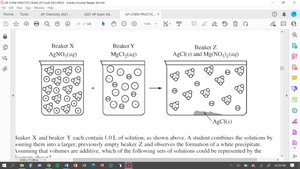
Q16. Beaker X contains 1.0 L of 2.0 M AgNO3(aq). Beaker Y contains 1.0 L of MgCl2(aq). A student combines the solutions by pouring them into a larger, previously empty beaker Z. A white precipitate is formed. Assume that the volumes are additive. Use the information in the particle diagrams above to answer the following questions:
(a) Determine the concentration of MgCl2(aq) in Beaker Y.
(b) Determine the concentration of Mg(NO3)2(aq) in Beaker Z.
Background
Topic: Solution Concentration and Precipitation Reactions
This question tests your understanding of molarity, solution mixing, and the formation of precipitates in double displacement reactions. It also requires you to interpret particle diagrams to deduce concentrations.
Key Terms and Formulas:
Molarity (M):
Double Displacement Reaction:
Precipitate: An insoluble product formed from mixing two solutions.
Step-by-Step Guidance
Examine the particle diagram for Beaker Y and count the number of Mg2+ and Cl- ions. Compare this to the known concentration in Beaker X to estimate the concentration in Beaker Y.
Recall that both beakers have 1.0 L of solution. Use the ratio of ions in the diagrams to set up a proportion for MgCl2 concentration.
When the solutions are combined, a precipitate (AgCl) forms. Write the balanced equation for the reaction and identify the ions that remain in solution.
Determine the total volume in Beaker Z (sum of volumes from X and Y) and use the stoichiometry of the reaction to find the concentration of Mg(NO3)2 in Beaker Z.
Set up the calculation for the concentration of Mg(NO3)2 using the moles of Mg2+ originally present and the new total volume.
Try solving on your own before revealing the answer!
Final Answer:
(a) The concentration of MgCl2 in Beaker Y is 2.0 M.
(b) The concentration of Mg(NO3)2 in Beaker Z is 1.0 M.
We deduced the concentration in Beaker Y by comparing the particle count to Beaker X, and calculated the concentration in Beaker Z by considering the stoichiometry and total volume after mixing.
