 Back
Study Guide: Chapter 6 – Gases (General Chemistry)
Study Guide - Smart Notes
 Tailored notes based on your materials, expanded with key definitions, examples, and context.
Gases: Properties and Laws
Introduction to Gases
Gases are one of the fundamental states of matter, characterized by their ability to expand and fill any container. Their behavior is governed by several physical laws that relate pressure, volume, temperature, and the amount of gas present.
Gas Pressure
Gas pressure is the force exerted per unit area by gas molecules as they collide with surfaces. The pressure depends on the number of gas particles, their speed, and the volume of the container.
Definition: Pressure is the result of molecular collisions with surfaces.
Factors affecting pressure: Number of gas particles, volume, and average speed.
Example: A ball bouncing against a wall exerts force; similarly, gas molecules exert force when colliding with surfaces.
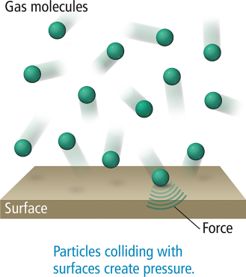
Pressure and Density
The density of gas particles in a container directly affects the pressure. Higher density means more collisions and higher pressure.
Low density: Fewer collisions, lower pressure.
High density: More collisions, higher pressure.
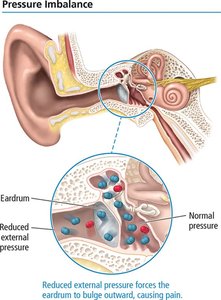
Pressure Imbalance in the Ear
Pressure differences across the eardrum can cause discomfort or pain, as the membrane is pushed outward or inward.
Example: Rapid altitude changes can cause ear pain due to pressure imbalance.

Measuring Gas Pressure: Barometers and Manometers
Gas pressure is measured using instruments such as barometers and manometers.
Barometer: Measures atmospheric pressure using a column of mercury.
Manometer: Measures the pressure of a gas in a container relative to atmospheric pressure.


Simple Gas Laws
The behavior of gases is described by several fundamental laws relating pressure, volume, temperature, and amount (moles).
Boyle’s Law (Pressure-Volume Relationship)
Boyle’s Law states that the volume of a gas is inversely proportional to its pressure at constant temperature and amount.
Mathematical expression:
Graph: Pressure vs. volume is a curve; pressure vs. is a straight line.
Example: Compressing a gas increases its pressure.


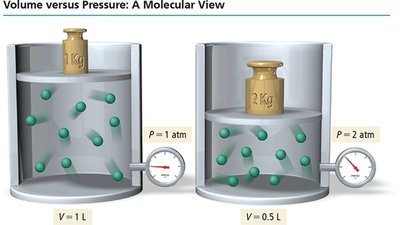
Charles’s Law (Volume-Temperature Relationship)
Charles’s Law states that the volume of a fixed amount of gas at constant pressure increases linearly with temperature (in kelvins).
Mathematical expression: (at constant pressure and amount)
Kelvin temperature:
Example: Heating a balloon causes it to expand.
Avogadro’s Law (Volume-Mole Relationship)
Avogadro’s Law states that the volume of a gas is directly proportional to the number of moles at constant pressure and temperature.
Mathematical expression:
Equal volumes: Equal volumes of gases contain equal numbers of molecules at constant pressure and temperature.
The Ideal Gas Law
The ideal gas law combines the relationships from Boyle’s, Charles’s, and Avogadro’s laws into a single equation:
Equation:
Variables: = pressure (atm), = volume (L), = moles, = gas constant, = temperature (K)
Gas constant:
Standard Conditions and Molar Volume
Standard temperature and pressure (STP) are defined as 0°C (273 K) and 1 atm. At STP, one mole of any ideal gas occupies 22.4 L.
Molar volume: at STP for 1 mole of gas
Gas Density and Molar Mass
The density of a gas is the ratio of its mass to volume, often given in g/L. It is directly proportional to the molar mass.
Equation: at STP
Mixtures of Gases and Partial Pressures
Gas mixtures, such as air, contain several components. The pressure due to each component is called its partial pressure.
Dalton’s Law: The total pressure is the sum of the partial pressures of each gas.
Equation:
Mole fraction:
Partial pressure:
Kinetic Molecular Theory
The kinetic molecular theory explains the behavior of gases at the molecular level.
Postulates:
Gas particles are negligibly small compared to the container.
Particles are in constant, random motion.
Collisions are elastic (no energy loss).
Average kinetic energy is proportional to temperature.
Implication: Explains gas laws and pressure as a result of molecular collisions.
Molecular Velocities and Temperature
The average kinetic energy of gas molecules depends on their mass and velocity. Lighter molecules move faster at the same temperature.
Root mean square velocity:
As temperature increases: Average velocity increases.
Diffusion and Effusion
Diffusion is the spreading of gas molecules from high to low concentration. Effusion is the escape of gas molecules through a small hole.
Graham’s Law of Effusion:
Implication: Lighter gases effuse and diffuse faster than heavier gases.
Real Gases and Deviations from Ideal Behavior
Real gases deviate from ideal behavior at high pressures and low temperatures due to intermolecular attractions and finite molecular volume.
Van der Waals equation: Accounts for molecular volume and intermolecular forces.
Equation:
Constants: and are van der Waals constants specific to each gas.
Summary Table: Common Pressure Units
Unit | Abbreviation | Average Air Pressure at Sea Level |
|---|---|---|
Pascal | Pa | 101,325 Pa |
Pounds per square inch | psi | 14.7 psi |
Torr | torr | 760 torr |
Inches of mercury | in Hg | 29.92 in Hg |
Atmosphere | atm | 1 atm |
Summary Table: Vapor Pressure of Water
Temperature (°C) | Pressure (mm Hg) |
|---|---|
0 | 4.58 |
5 | 6.54 |
10 | 9.21 |
15 | 12.79 |
20 | 17.55 |
25 | 23.48 |
30 | 31.86 |
35 | 42.23 |
40 | 55.40 |
45 | 71.97 |
50 | 92.6 |
55 | 118.2 |
60 | 149.6 |
65 | 187.5 |
70 | 233.7 |
75 | 289.1 |
80 | 355.1 |
85 | 433.6 |
90 | 525.8 |
95 | 633.9 |
100 | 760.0 |
Key Equations
Boyle’s Law:
Charles’s Law:
Avogadro’s Law:
Ideal Gas Law:
Root Mean Square Velocity:
Graham’s Law:
Van der Waals Equation:
Additional info: This study guide covers all major concepts from Chapter 6 (Gases) in a General Chemistry course, including gas laws, kinetic molecular theory, real gas behavior, and relevant mathematical relationships. Images included are directly relevant to the explanation of each paragraph and reinforce key concepts.
