 Back
BackStudy Guide: Gases and Their Properties (Chapter 6)
Study Guide - Smart Notes
 Tailored notes based on your materials, expanded with key definitions, examples, and context.
Gas Pressure and Molecular Collisions
Understanding Gas Pressure
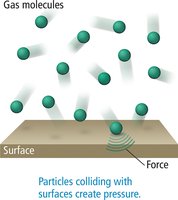
Gas pressure is the force exerted per unit area by gas molecules as they collide with the surfaces around them. The constant motion of gas particles leads to frequent collisions, which collectively create pressure.
Pressure is a result of molecular collisions with container walls.
The number of gas particles, the volume of the container, and the average speed of the particles all affect the pressure.
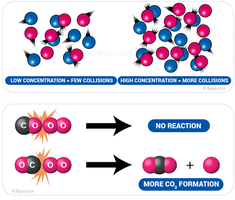
Higher concentration of gas molecules leads to more collisions and higher pressure.
Pressure and Density
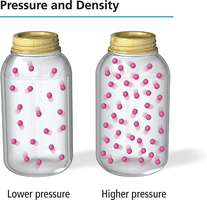
The density of gas particles in a container directly affects the pressure. A higher density means more collisions per unit area, resulting in higher pressure.
Low density: fewer collisions, lower pressure.
High density: more collisions, higher pressure.
Measuring Gas Pressure
The Barometer
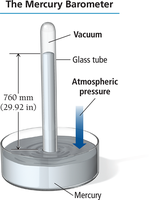
A barometer is used to measure atmospheric pressure. It consists of a glass tube filled with mercury, inverted in a dish of mercury. Atmospheric pressure supports a column of mercury, typically 760 mm high at sea level.
Atmospheric pressure is measured in mmHg or torr.
1 atm = 760 mmHg = 760 torr.
The Manometer
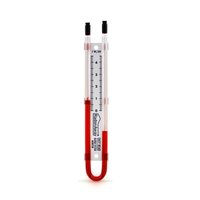
A manometer is used to measure the pressure of a gas in a container. It is a U-shaped tube partially filled with liquid, connected to the gas sample on one side and open to the atmosphere on the other. The difference in liquid levels indicates the pressure difference between the gas and the atmosphere.
Manometers are essential for laboratory measurements of gas pressure.
Blood Pressure
Blood pressure is the force within arteries that drives blood circulation. It is measured using a sphygmomanometer, which consists of an inflatable cuff and a pressure gauge.
Blood pressure is an application of pressure measurement in physiology.

Properties and Types of Gases
Common Gases at Room Temperature
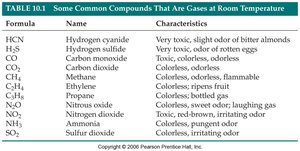
Gases are substances with no defined volume or shape, highly compressible, and capable of forming homogeneous mixtures. Most common gases are small molecules composed of nonmetals.
Examples include hydrogen, oxygen, nitrogen, carbon dioxide, methane, ammonia, and others.
Formula | Name | Characteristics |
|---|---|---|
HCN | Hydrogen cyanide | Very toxic, slight odor of bitter almonds |
H2S | Hydrogen sulfide | Very toxic, odor of rotten eggs |
CO | Carbon monoxide | Toxic, colorless, odorless |
CO2 | Carbon dioxide | Colorless, odorless |
CH4 | Methane | Colorless, odorless, flammable |
C2H4 | Ethylene | Colorless; ripens fruit |
C3H8 | Propane | Colorless; bottled gas |
N2O | Nitrous oxide | Colorless, sweet odor; laughing gas |
NO2 | Nitrogen dioxide | Colorless, pungent odor, irritating odor |
NH3 | Ammonia | Colorless, pungent odor |
SO2 | Sulfur dioxide | Colorless, irritating odor |
The Simple Gas Laws
Boyle’s Law: Pressure-Volume Relationship
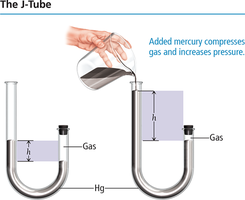
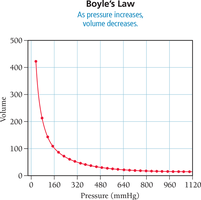
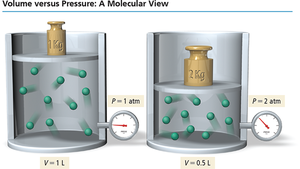
Boyle’s Law states that the volume of a gas is inversely proportional to its pressure, provided temperature and the amount of gas are constant.
Mathematically:
As pressure increases, volume decreases.

Charles’s Law: Volume-Temperature Relationship
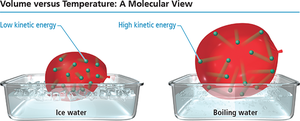
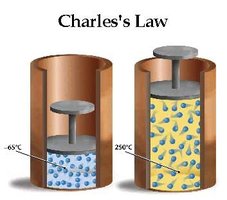
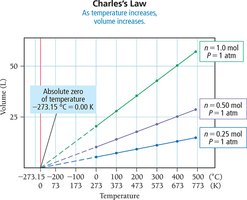
Charles’s Law states that the volume of a fixed amount of gas at constant pressure increases linearly with increasing temperature (in Kelvin).
Mathematically:
As temperature increases, volume increases.
Absolute zero (0 K) is the theoretical temperature at which gas volume becomes zero.

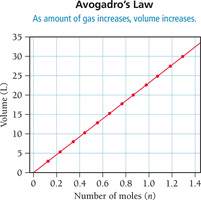
Avogadro’s Law: Volume-Amount Relationship
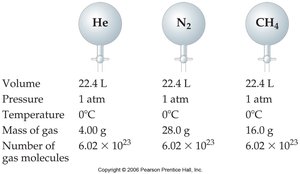
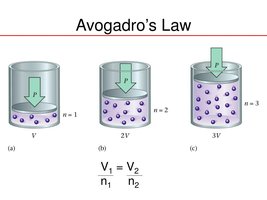
Avogadro’s Law states that the volume of a gas is directly proportional to the number of moles of gas, at constant temperature and pressure.
Mathematically:
Equal volumes of gases contain equal numbers of molecules.

Summary Table: Gas Laws
Law | Relationship | Equation |
|---|---|---|
Boyle's Law | Pressure & Volume (inverse) | |
Charles's Law | Volume & Temperature (direct) | |
Avogadro's Law | Volume & Moles (direct) |
Applications and Calculations
Using Gas Laws for Problem Solving
Gas laws are used to predict changes in gas properties when conditions change. For example, Boyle’s Law can be used to calculate the final volume when pressure changes, and Charles’s Law can be used to find the final volume when temperature changes.
Boyle’s Law:
Charles’s Law:
Avogadro’s Law:
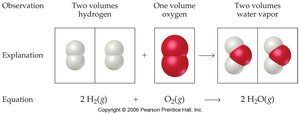
Law of Combining Volumes
Avogadro’s Law is illustrated by the Law of Combining Volumes, which states that gases combine in simple ratios by volume under the same conditions of temperature and pressure.
Conclusion
Understanding the behavior of gases and their laws is fundamental in chemistry. The relationships between pressure, volume, temperature, and amount allow chemists to predict and manipulate gas behavior in both laboratory and real-world settings.
