 Back
BackStudy Guide: Ionic and Molecular Compounds, Ions, and Formulas
Study Guide - Smart Notes
 Tailored notes based on your materials, expanded with key definitions, examples, and context.
Q1. Write the most stable cations from the following main group metals.
Background
Topic: Monoatomic Cations (Type I metal ions)
This question tests your understanding of how main group metals form cations by losing electrons to achieve the electron configuration of the nearest noble gas.
Key Terms and Concepts:
Cation: A positively charged ion formed when an atom loses electrons.
Main group metals: Elements in groups 1, 2, and 13 of the periodic table.
Noble gas configuration: The stable electron arrangement of noble gases (full valence shell).
Step-by-Step Guidance
Identify the group number for each metal (Na, Ca, Al, Li, Ba, K) to determine how many electrons are lost.
Recall that Group 1 metals (Na, Li, K) lose 1 electron to form +1 cations; Group 2 metals (Ca, Ba) lose 2 electrons to form +2 cations; Group 13 metals (Al) lose 3 electrons to form +3 cations.
Write the symbol for each cation, including its charge (e.g., Na+, Ca2+, Al3+).
Try solving on your own before revealing the answer!
Q2. Write the most stable anions from the following main group nonmetals.
Background
Topic: Monoatomic Anions
This question tests your ability to determine how main group nonmetals gain electrons to achieve the electron configuration of the nearest noble gas.
Key Terms and Concepts:
Anion: A negatively charged ion formed when an atom gains electrons.
Main group nonmetals: Elements in groups 15, 16, and 17 of the periodic table.
Noble gas configuration: The stable electron arrangement of noble gases (full valence shell).
Step-by-Step Guidance
Identify the group number for each nonmetal (O, N, F, S, Br, P) to determine how many electrons are gained.
Recall that Group 17 elements (F, Br) gain 1 electron to form -1 anions; Group 16 elements (O, S) gain 2 electrons to form -2 anions; Group 15 elements (N, P) gain 3 electrons to form -3 anions.
Write the symbol for each anion, including its charge (e.g., O2−, N3−, F−).
Try solving on your own before revealing the answer!
Q3. Write the most stable cations from the following transition metals.
Background
Topic: Transition Metal Cations (Type II metal ions)
This question tests your knowledge of common charges for transition metal ions, which can vary and are not easily predicted.
Key Terms and Concepts:
Transition metals: Elements in the d-block of the periodic table, often forming multiple stable cations.
Type II metal ions: Metals that can form more than one stable cation with different charges.
Step-by-Step Guidance
Recall common oxidation states for each transition metal listed (Cu, Fe, Cr, Ni, Zn, Ag, Cd).
Write the symbols for each cation, including their possible charges (e.g., Cu+ and Cu2+).
Note that some transition metals (like Zn, Ag, Cd) typically form only one stable cation.
Try solving on your own before revealing the answer!
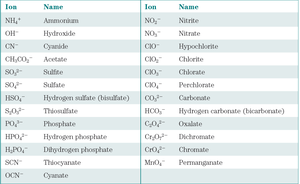
Q4. List the names and formulas of common polyatomic ions.
Background
Topic: Polyatomic Ions
This question tests your ability to recognize and recall the names and formulas of polyatomic ions, which are groups of atoms bonded together with a net charge.
Key Terms and Concepts:
Polyatomic ion: A charged species composed of two or more atoms covalently bonded.
Common polyatomic ions: Examples include ammonium, sulfate, nitrate, carbonate, etc.
Step-by-Step Guidance
Review the table of polyatomic ions and their formulas.
Note the naming conventions, such as -ate and -ite endings for oxygen-containing ions.
Practice writing the formula for each ion next to its name (e.g., sulfate is SO42−).
Try solving on your own before revealing the answer!
Q5. Predict the empirical formula for ionic compounds formed from given ions.
Background
Topic: Empirical Formula of Ionic Compounds
This question tests your ability to combine cations and anions in the correct ratio to form neutral ionic compounds.
Key Terms and Concepts:
Empirical formula: The simplest whole-number ratio of ions in an ionic compound.
Charge balance: The total positive and negative charges must cancel out.
Step-by-Step Guidance
Write the charges for each ion involved (e.g., Na+ and Cl−).
Determine the ratio of ions needed to balance the charges (e.g., one Na+ for one Cl−).
Write the empirical formula using the smallest whole-number ratio (e.g., NaCl).
Repeat for other pairs, including polyatomic ions (e.g., NH4+ and SO42−).
Try solving on your own before revealing the answer!
Q6. Predict whether the following compounds are ionic or molecular.
Background
Topic: Classification of Compounds
This question tests your ability to distinguish between ionic and molecular compounds based on their composition.
Key Terms and Concepts:
Ionic compound: Formed from a metal and a nonmetal (or polyatomic ions).
Molecular compound: Formed from two or more nonmetals.
Step-by-Step Guidance
Identify the elements in each compound and determine if they are metals or nonmetals.
If the compound contains a metal and a nonmetal (or polyatomic ions), it is ionic; if it contains only nonmetals, it is molecular.
Apply this rule to each compound listed (e.g., CO2, CaF2, NH3, etc.).
Try solving on your own before revealing the answer!
