Back
BackStudy Guide: Lewis Structures, Lattice Energy, and Chemical Bonding
Study Guide - Smart Notes
 Tailored notes based on your materials, expanded with key definitions, examples, and context.
Q1. Write the electron configuration for N. Then write the Lewis symbol for N.
Background
Topic: Electron Configuration and Lewis Symbols
This question tests your understanding of how to write the electron configuration for an element and how to represent its valence electrons using a Lewis symbol.
Key Terms and Formulas:
Electron configuration: The arrangement of electrons in an atom's orbitals.
Lewis symbol: A representation of an element showing its symbol and valence electrons as dots.
Step-by-Step Guidance
Find the atomic number of nitrogen (N) on the periodic table. This tells you the number of electrons in a neutral atom of N.
Write the electron configuration by filling the orbitals in order of increasing energy (1s, 2s, 2p, etc.).
Determine the number of valence electrons (electrons in the outermost shell).
Draw the Lewis symbol for N by writing the symbol 'N' and placing dots around it to represent the valence electrons.
Try solving on your own before revealing the answer!
Q2. Write the Lewis symbol for each atom or ion: Al, Na+, Cl, S2-, Mg, Mg2+
Background
Topic: Lewis Symbols for Atoms and Ions
This question tests your ability to represent atoms and ions using Lewis symbols, which show valence electrons.
Key Terms and Formulas:
Lewis symbol: Shows the element symbol and dots for valence electrons.
Ions: Atoms that have gained or lost electrons to achieve a full outer shell.
Step-by-Step Guidance
Determine the number of valence electrons for each atom or ion.
For cations (positive ions), remove electrons from the Lewis symbol of the neutral atom.
For anions (negative ions), add electrons to the Lewis symbol of the neutral atom.
Draw the Lewis symbol for each, showing the correct number of dots around the element symbol.
Try solving on your own before revealing the answer!
Q3. Write the Lewis symbols for the ions in each ionic compound: NaF, CaO, SrBr2, K2O
Background
Topic: Lewis Symbols in Ionic Compounds
This question tests your understanding of how to represent the ions that make up ionic compounds using Lewis symbols.
Key Terms and Formulas:
Ionic compound: A compound composed of cations and anions held together by electrostatic forces.
Lewis symbol for ions: Shows the element symbol and the number of valence electrons after gaining or losing electrons.
Step-by-Step Guidance
Identify the cation and anion in each compound.
Determine the charge on each ion based on the periodic table and the compound formula.
Draw the Lewis symbol for each ion, showing the correct number of valence electrons (full octet for most anions, empty for most cations).
Try solving on your own before revealing the answer!
Q4. Use Lewis symbols to determine the formula for the compound that forms between each pair of elements: Sr and Se, Ba and Cl, Na and S, Al and O
Background
Topic: Predicting Ionic Compound Formulas
This question tests your ability to use Lewis symbols to predict the formulas of ionic compounds formed between pairs of elements.
Key Terms and Formulas:
Lewis symbol: Shows valence electrons for each atom.
Ionic compound formula: Determined by balancing the charges of the ions so the compound is neutral.
Step-by-Step Guidance
Write the Lewis symbol for each element, showing valence electrons.
Determine how many electrons each atom will lose or gain to achieve a full octet.
Balance the charges by adjusting the ratio of cations to anions so the total positive and negative charges are equal.
Try solving on your own before revealing the answer!
Q5. Explain the trend in the lattice energies of the alkaline earth metal oxides (e.g., MgO, CaO, SrO, BaO).
Background
Topic: Lattice Energy Trends
This question tests your understanding of how lattice energy changes as you move down a group in the periodic table for ionic compounds.
Key Terms and Formulas:
Lattice energy: The energy required to separate one mole of an ionic solid into its gaseous ions.
Alkaline earth metals: Group 2 elements (e.g., Mg, Ca, Sr, Ba).
General trend: Lattice energy decreases as the size of the ions increases.
Step-by-Step Guidance
Recall that lattice energy is more exothermic (more negative) for smaller ions and higher charges.
Compare the ionic radii of Mg2+, Ca2+, Sr2+, and Ba2+.
Explain how increasing ionic size affects the magnitude of lattice energy.
Try solving on your own before revealing the answer!
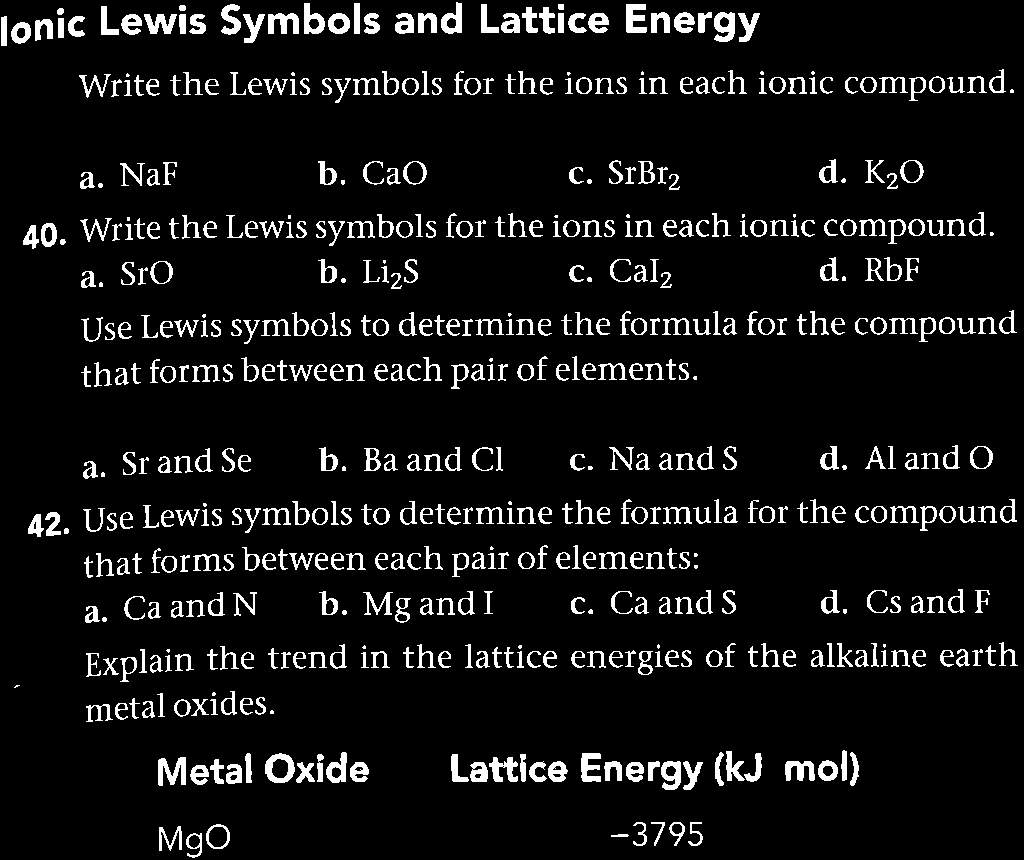
Q6. Why is the lattice energy of potassium bromide more exothermic than the lattice energy of rubidium iodide?
Background
Topic: Factors Affecting Lattice Energy
This question tests your understanding of how ion size and charge affect the lattice energy of ionic compounds.
Key Terms and Formulas:
Lattice energy: Depends on the charges of the ions and the distance between them (ionic radii).
Coulomb's Law: (where is lattice energy, and are ion charges, is the distance between ion centers).
Step-by-Step Guidance
Compare the charges on the ions in both compounds (KBr and RbI).
Compare the sizes of the ions (K+ vs. Rb+, Br- vs. I-).
Explain how smaller ions lead to a more exothermic lattice energy according to Coulomb's Law.
Try solving on your own before revealing the answer!