 Back
BackStudy Guide: Properties and Laws of Gases (Chapter 11)
Study Guide - Smart Notes
 Tailored notes based on your materials, expanded with key definitions, examples, and context.
Properties and Behavior of Gases
Introduction to Gases
Gases are a fundamental state of matter characterized by their ability to expand and fill the shape and volume of their container. Unlike solids and liquids, gases are highly compressible and have low densities due to the large amount of empty space between their particles.
Compressibility: Gases can be compressed because their particles are far apart.
Shape and Volume: Gases assume the shape and volume of their container.
Density: Gases have much lower densities compared to solids and liquids.
Kinetic Molecular Theory
The kinetic molecular theory provides a model for understanding the behavior of gases. It explains gas properties based on the motion and interactions of gas particles.
Postulates:
A gas is a collection of particles in constant, straight-line motion.
Gas particles do not attract or repel each other; they do not interact.
There is a lot of space between gas particles compared to their size.
The average kinetic energy of gas particles is proportional to the temperature in kelvins.
Implications: As temperature increases, gas particles move faster and have more energy.
Example: If liquid water in a soda can is converted to steam, the steam occupies a much larger volume due to the low density and high compressibility of gases.
Pressure: The Result of Molecular Collisions
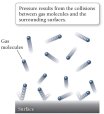
Pressure is the force exerted by gas molecules as they collide with the surfaces around them. The result of many collisions is the measurable pressure of a gas.
Definition: Pressure is force per unit area, typically measured in atmospheres (atm), pascals (Pa), or millimeters of mercury (mm Hg).
Atmospheric Pressure: At sea level, atmospheric pressure is about 101,325 Pa or 1 atm.
Factors Affecting Pressure: The number of gas particles in a given volume, temperature, and volume all affect the pressure exerted by a gas.
Gas Laws
Boyle’s Law: Pressure and Volume
Boyle’s law describes the relationship between the pressure and volume of a gas at constant temperature and number of particles. The law states that the volume of a gas is inversely proportional to its pressure.
Mathematical Expression:
Implication: If the volume decreases, the pressure increases, and vice versa.
Example: Scuba divers must ascend slowly to avoid rapid changes in pressure that can cause lung damage.
Charles’s Law: Volume and Temperature
Charles’s law states that the volume of a gas at constant pressure is directly proportional to its temperature in kelvins.
Mathematical Expression:
Implication: As temperature increases, the volume increases.
Absolute Zero: The lowest possible temperature, 0 K (–273 °C), is where the volume of a gas theoretically becomes zero.
Avogadro’s Law: Volume and Moles
Avogadro’s law states that the volume of a gas at constant temperature and pressure is directly proportional to the number of moles of gas present.
Mathematical Expression:
Implication: Adding more gas molecules increases the volume.
The Ideal Gas Law
The ideal gas law combines Boyle’s, Charles’s, and Avogadro’s laws into a single equation that relates pressure, volume, temperature, and moles of gas.
Equation:
Variables:
P = pressure (atm)
V = volume (L)
n = moles of gas
R = ideal gas constant (0.0821 L·atm/mol·K)
T = temperature (K)
Application: Used to calculate any one property of a gas if the others are known.
Pressure in the Atmosphere and Applications
Atmospheric Pressure and Drinking Straws
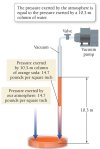
Atmospheric pressure is responsible for the operation of drinking straws. When you suck on a straw, you reduce the pressure inside, allowing atmospheric pressure to push the liquid up the straw. However, there is a limit to how high a liquid can be pushed by atmospheric pressure.
Maximum Height: The maximum height a column of water can be pushed by atmospheric pressure is about 10.3 meters (34 feet).
Reason: At this height, the pressure exerted by the column of water equals atmospheric pressure.
Partial Pressures and Gas Mixtures
In mixtures of gases, each component exerts its own partial pressure, independent of the others. Dalton’s law of partial pressures states that the total pressure is the sum of the partial pressures of each gas.
Equation:
Application: Used to calculate the partial pressure of gases in air and in specialized mixtures for scuba diving.
Units of Pressure
Common Units
Pressure can be measured in several units, each useful in different contexts.
Unit | Definition | Conversion |
|---|---|---|
Atmosphere (atm) | Average pressure at sea level | 1 atm = 101,325 Pa = 760 mm Hg |
Pascals (Pa) | SI unit, 1 N/m2 | 1 atm = 101,325 Pa |
Millimeters of mercury (mm Hg) | Height of mercury column | 1 atm = 760 mm Hg |
Torr | Same as mm Hg | 1 atm = 760 torr |
Pounds per square inch (psi) | English unit | 1 atm = 14.7 psi |
Environmental Chemistry: Air Pollution
Major Gaseous Air Pollutants
Air pollution is caused by various gases released from industrial, vehicular, and natural sources. Major pollutants include:
Sulfur dioxide (SO2): Lung and eye irritant, precursor to acid rain.
Carbon monoxide (CO): Displaces oxygen in blood, causes health issues.
Ozone (O3): Eye and lung irritant, damages lungs with prolonged exposure.
Nitrogen dioxide (NO2): Causes haze, eye and lung irritant, precursor to acid rain.
Example: Legislation such as the Clean Air Act has significantly reduced pollutant levels in U.S. cities over the past decades.
Summary Table: Gas Laws
Law | Relationship | Equation | Variables Held Constant |
|---|---|---|---|
Boyle’s Law | Pressure & Volume (inverse) | Temperature, moles | |
Charles’s Law | Volume & Temperature (direct) | Pressure, moles | |
Avogadro’s Law | Volume & Moles (direct) | Pressure, temperature | |
Ideal Gas Law | All variables | None |
Additional info: Academic context was added to clarify the kinetic molecular theory, gas laws, and environmental chemistry topics. All equations are provided in LaTeX format as required.
