Back
Study Guide: Quiz Topics from Chapters 4, 5, and 10 (General Chemistry)
Study Guide - Smart Notes
 Tailored notes based on your materials, expanded with key definitions, examples, and context.
Quiz Overview
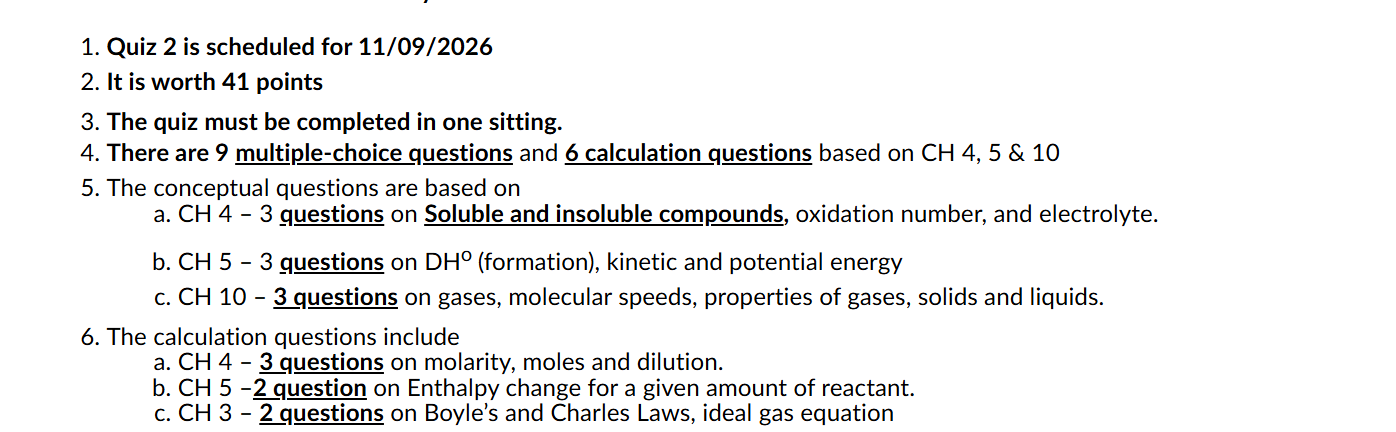
Quiz Structure and Content
This quiz covers key concepts and calculations from Chapters 4, 5, and 10 of General Chemistry. It includes both multiple-choice and calculation questions, focusing on reactions in aqueous solution, thermochemistry, and the properties of gases, solids, and liquids.
9 multiple-choice questions on conceptual understanding
6 calculation questions on quantitative skills
Chapter 4: Reactions in Aqueous Solution
Soluble and Insoluble Compounds
Understanding solubility rules is essential for predicting whether a compound will dissolve in water. Soluble compounds form aqueous solutions, while insoluble compounds form precipitates.
Soluble Compounds: Most salts containing Na+, K+, NH4+, NO3-, and ClO4- are soluble.
Insoluble Compounds: Most salts containing Ag+, Pb2+, and Hg22+ are insoluble.
Oxidation Number
The oxidation number indicates the degree of oxidation of an atom in a compound. It is used to track electron transfer in redox reactions.
Rules: Elements in their standard state have an oxidation number of 0. Oxygen is usually -2, hydrogen is +1, and halogens are usually -1.
Electrolytes
An electrolyte is a substance that produces ions when dissolved in water, allowing the solution to conduct electricity.
Strong Electrolytes: Completely dissociate in water (e.g., NaCl).
Weak Electrolytes: Partially dissociate (e.g., acetic acid).
Nonelectrolytes: Do not dissociate (e.g., sugar).
Calculation Questions: Molarity, Moles, and Dilution
Quantitative skills in solution chemistry involve calculating concentrations and preparing solutions.
Molarity (M):
Moles:
Dilution:
Chapter 5: Thermochemistry
Enthalpy of Formation ()
The standard enthalpy of formation is the heat change when one mole of a compound is formed from its elements in their standard states.
Calculation:
Kinetic and Potential Energy
Chemical reactions involve changes in energy. Kinetic energy is the energy of motion, while potential energy is stored energy due to position or composition.
Kinetic Energy:
Potential Energy: Energy stored in chemical bonds.
Calculation Questions: Enthalpy Change
Calculating enthalpy change for a given amount of reactant requires using stoichiometry and enthalpy values.
Example: If for a reaction is given per mole, multiply by the number of moles of reactant used.
Chapter 10: Gases, Solids, and Liquids
Properties of Gases
Gases have unique properties such as compressibility, low density, and the ability to fill containers.
Ideal Gas Law:
Boyle's Law: (at constant T and n)
Charles's Law: (at constant P and n)
Molecular Speeds
The speed of gas molecules depends on temperature and molar mass. Higher temperatures and lower molar masses result in faster molecular speeds.
Root Mean Square Speed:
Properties of Solids and Liquids
Solids have fixed shape and volume, while liquids have fixed volume but variable shape. Both are less compressible than gases.
Solids: Particles are closely packed in a regular arrangement.
Liquids: Particles are close but can move past each other.
Calculation Questions: Gas Laws and Ideal Gas Equation
Solving problems involving gas laws requires understanding relationships between pressure, volume, temperature, and amount of gas.
Boyle's Law:
Charles's Law:
Ideal Gas Law:
Summary Table: Quiz Topics and Question Types
Chapter | Conceptual Questions | Calculation Questions |
|---|---|---|
Ch. 4 | Solubility, Oxidation Number, Electrolyte | Molarity, Moles, Dilution |
Ch. 5 | Enthalpy of Formation, Kinetic & Potential Energy | Enthalpy Change |
Ch. 10 | Gases, Molecular Speeds, Properties of Gases/Solids/Liquids | Boyle's Law, Charles's Law, Ideal Gas Equation |