 Back
Study Guide: Solution Concentration and Dilution in General Chemistry
Study Guide - Smart Notes
 Tailored notes based on your materials, expanded with key definitions, examples, and context.
Solution Concentration and Dilution
Solubility Limits
Solubility describes the maximum amount of solute that can dissolve in a solvent at a given temperature. Solutions can be classified based on their saturation:
Unsaturated: Contains less solute than the solubility limit; more solute can dissolve.
Saturated: Contains the maximum amount of solute that can dissolve; any additional solute will remain undissolved.
Supersaturated: Contains more solute than the solubility limit; usually unstable and solute may precipitate out.
Units of Saturation are used to describe these states, typically in grams per 100 mL or similar units.
Concentration Units
The concentration of a solution quantifies how much solute is present in a given amount of solution. Several units are used:
Percent Concentrations: Expressed as mass/volume (m/v), mass/mass (m/m), or volume/volume (v/v).
Parts Per Million (ppm) and Parts Per Billion (ppb): Used for very dilute solutions.
Molarity (M): Number of moles of solute per liter of solution.
Weight/Volume Percent Concentration (w/v)%
This unit expresses the number of grams of solute in 100 mL of solution:
Formula:
Example: Vinegar contains 5 g of acetic acid in 100 mL, so its concentration is (w/v).
Volume/Volume Percent Concentration (v/v)%
Used for liquid solutes in liquid solvents:
Formula:
Example: 70 mL of 2-propanol in 100 mL solution gives (v/v).
Parts Per Million (ppm)
Used for very dilute solutions:
Formula (mass):
Formula (volume):
Example: 80 μg/kg chloroform = 0.08 ppm; 700 μg/kg glyphosate = 0.7 ppm.
Molarity (M)
Molarity is the most common unit for solution concentration in chemistry:
Formula:
Example: 20.0 g NaOH in 250 mL solution:
Convert grams to moles:
Convert mL to L:
Calculate molarity:
Molarity can be used as a conversion factor to relate moles and volume:
To find moles:
To find volume:
Example: What volume of 0.30 M glucose solution contains 0.025 mol glucose?
Volume:
The relationship between volume, moles, and grams of solute is illustrated below:

Dilution of Solutions
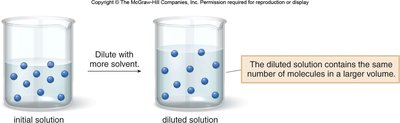
Dilution is the process of adding solvent to decrease the concentration of solute in a solution. The total amount of solute remains constant, but the volume increases. The relationship is given by:
Formula: (for molarity)
Formula: (for percent concentrations)
Example: How many mL of a 4.0% (w/v) solution are needed to prepare 250 mL of a 0.080% (w/v) solution?
Rearrange:
Calculate:
The concept of dilution is visually represented below:
Summary Table: Common Concentration Units
Unit | Formula | Typical Use |
|---|---|---|
(w/v)% | Solid in liquid | |
(v/v)% | Liquid in liquid | |
ppm | Very dilute solutions | |
Molarity (M) | General chemistry solutions |
Additional info: All formulas and examples are expanded for clarity and completeness. Images included are directly relevant to the explanation of molarity and dilution.
