Back
Study Guide: The Periodic Table and Periodic Properties
Study Guide - Smart Notes
 Tailored notes based on your materials, expanded with key definitions, examples, and context.
The Periodic Table
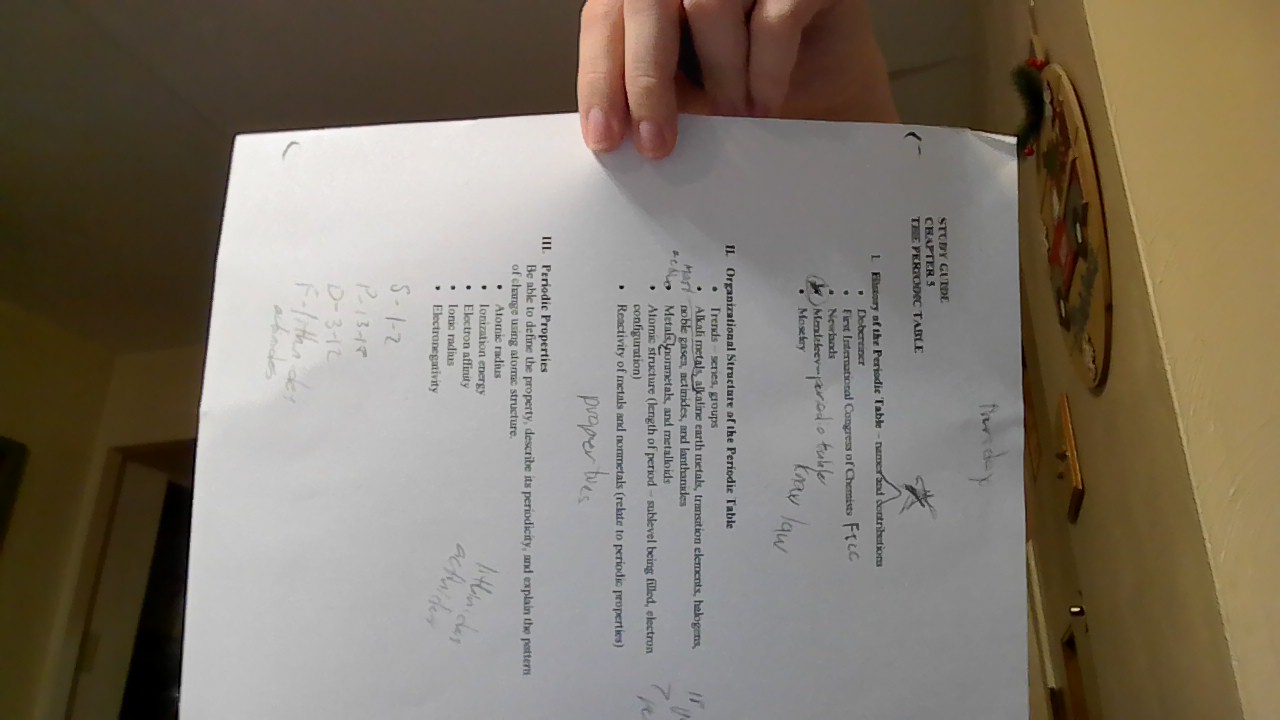
Elements of the Periodic Table
The periodic table is a fundamental organizational tool in chemistry, arranging elements according to increasing atomic number and recurring chemical properties. Understanding its history and structure is essential for predicting element behavior and chemical reactions.
First International Congress of Chemists (FICC): Early efforts to standardize chemical knowledge and element classification.
Mendeleev: Developed the first widely recognized periodic table, arranging elements by atomic mass and predicting undiscovered elements.
Moseley: Refined the periodic table by organizing elements according to atomic number, leading to the modern layout.
Organizational Structure of the Periodic Table
The periodic table is organized into rows (periods) and columns (groups or families), each with distinct properties. Understanding these divisions helps explain element reactivity and periodic trends.
Periods: Horizontal rows; elements in the same period have the same number of electron shells.
Groups/Families: Vertical columns; elements in the same group share similar chemical properties due to similar valence electron configurations.
Main Group Elements: Groups 1, 2, and 13-18; include alkali metals, alkaline earth metals, halogens, and noble gases.
Transition Elements: Groups 3-12; characterized by partially filled d subshells.
Periodic Law: Properties of elements recur periodically when arranged by increasing atomic number.
Periodic Properties
Periodic properties are characteristics of elements that show predictable trends across periods and groups. These trends are crucial for understanding chemical reactivity and bonding.
Atomic Radius: The distance from the nucleus to the outermost electron; decreases across a period and increases down a group.
Ionization Energy: The energy required to remove an electron from an atom; increases across a period and decreases down a group.
Electron Affinity: The energy change when an atom gains an electron; generally becomes more negative across a period.
Electronegativity: The ability of an atom to attract electrons in a chemical bond; increases across a period and decreases down a group.
Examples and Applications
Example: Sodium (Na) and chlorine (Cl) are in the same period but different groups; sodium is a reactive metal, chlorine is a reactive nonmetal.
Application: Predicting the reactivity of elements based on their position in the periodic table.
Key Formulas
Periodic Law:
Effective Nuclear Charge (Zeff): where is the atomic number and is the shielding constant.
Comparison Table: Periodic Trends
Property | Across a Period | Down a Group |
|---|---|---|
Atomic Radius | Decreases | Increases |
Ionization Energy | Increases | Decreases |
Electron Affinity | Becomes more negative | Becomes less negative |
Electronegativity | Increases | Decreases |
Additional info:
Handwritten notes suggest focus on periodic properties and main group/transition elements.
Students should be able to describe, explain, and predict periodic trends and their effects on chemical behavior.