 Back
Study Notes: Properties and Laws of Gases
Study Guide - Smart Notes
 Tailored notes based on your materials, expanded with key definitions, examples, and context.
Gases
Properties of Gases
Gases exhibit unique physical properties that distinguish them from solids and liquids. Understanding these properties is essential for predicting gas behavior under various conditions.
Gases are fluids: They have no definite shape and can flow, adapting to the shape of their container.
Low density: Gases have the least amount of particles per unit volume. Density is calculated as:
Easily compressed: Gas particles are far apart, allowing them to be pushed closer together with applied pressure.
Expansion: Gases expand to fill their container completely.
Avogadro’s Principle: Equal volumes of different gases under the same conditions contain the same number of molecules. At STP (Standard Temperature and Pressure: 1 ATM, 0°C), one mole of any gas occupies 22.4 L.
Pressure Units and Measurement
Pressure is a fundamental variable in gas behavior, measured in several units:
101.325 kPa
1 ATM
760 mm Hg
760 Torr
101 Bars
14.7 psi (pounds per square inch)
Atmospheric Pressure Measurement
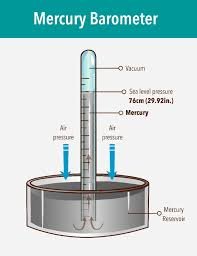
Atmospheric pressure is commonly measured using a barometer. Mercury barometers are traditional instruments, but alcohol is sometimes used due to mercury's toxicity. Manometers are used to measure gas pressure in a closed system.
Barometer: Measures atmospheric pressure using a column of mercury.
Manometer: Measures pressure in a vacuum chamber, where pressure can be zero.
Ideal Gas and Kinetic Molecular Theory
The concept of an ideal gas is central to understanding gas laws. The Kinetic Molecular Theory describes the behavior of ideal gases, especially at STP.
Ideal gas: A hypothetical gas whose particles have negligible volume and no intermolecular forces.
Kinetic Molecular Theory:
Gas particles are so small that their individual volume is negligible compared to the total gas volume.
Particles move in constant, rapid, random motion in straight lines until they collide.
No attractive or repulsive forces exist between particles; collisions are perfectly elastic (no energy lost).
Average kinetic energy of particles is directly proportional to temperature in Kelvin.
Variables Affecting Gas Behavior
Four main variables describe the state of a gas:
P: Pressure
V: Volume
T: Temperature (always in Kelvin)
n: Number of moles
Gas Laws
Gas laws relate the variables of pressure, volume, temperature, and moles for a gas sample. Each law assumes certain variables are held constant.
Charles’s Law: Volume and temperature are directly proportional at constant pressure. Equation:
Boyle’s Law: Pressure and volume are inversely proportional at constant temperature. Equation:
Gay-Lussac’s Law: Pressure and temperature are directly proportional at constant volume. Equation:
Combined Gas Law: Relates pressure, volume, and temperature for a fixed amount of gas. Equation:
Ideal Gas Law: Relates all four variables for an ideal gas. Equation: Where is the universal gas constant: 0.0821 L·ATM/mol·K or 8.314 L·kPa/mol·K.
Example: Using the Ideal Gas Law
Calculate the volume occupied by 2 moles of an ideal gas at 1 ATM and 273 K:
Given: mol, ATM, K, L·ATM/mol·K
Equation:
Calculation: L
Additional info: The gas laws are foundational for understanding chemical reactions involving gases, predicting changes in laboratory and real-world conditions, and calculating quantities in stoichiometry.
