 Back
Summary of Ion Charges, Polyatomic Ions, Nomenclature, and Diatomic Elements
Study Guide - Smart Notes
 Tailored notes based on your materials, expanded with key definitions, examples, and context.
Naming Ions and Compounds
Monatomic Ions
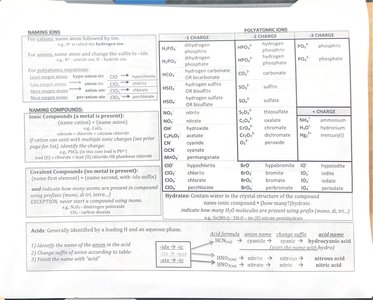
Monatomic ions are ions formed from a single atom. Their names are derived from the element name, with modifications depending on whether the ion is a cation or anion.
Cations (positively charged): Named after the element. For example, Na+ is called sodium ion.
Anions (negatively charged): Named by taking the root of the element name and adding the suffix -ide. For example, Cl- is called chloride ion.
For polyatomic ions, the names and formulas must be memorized, as they do not follow simple naming rules.
Examples:
Na+: sodium ion
Cl-: chloride ion
CO32-: carbonate ion
Naming Compounds
Compounds are named based on the types of elements present and their charges.
Ionic Compounds (metal is present): Name the cation first, then the anion. If the metal can have more than one charge, indicate the charge with Roman numerals (e.g., FeCl2: iron(II) chloride).
Covalent Compounds (no metal is present): Use prefixes to indicate the number of each atom (e.g., CO2: carbon dioxide).
Prefixes for Covalent Compounds: mono-, di-, tri-, tetra-, penta-, hexa-, hepta-, octa-, nona-, deca-.
Acids
Acids are generally identified by a leading H and as aqueous phases. The naming depends on the anion present:
If the anion ends in -ide: Use "hydro-" prefix and "-ic" suffix (e.g., HCl: hydrochloric acid).
If the anion ends in -ate: Use "-ic" suffix (e.g., HNO3: nitric acid).
If the anion ends in -ite: Use "-ous" suffix (e.g., HNO2: nitrous acid).
Example Table:
Acid Formula | Anion Name | Acid Name |
|---|---|---|
HNO3 | nitrate | nitric acid |
HNO2 | nitrite | nitrous acid |
HCl | chloride | hydrochloric acid |
Polyatomic Ions
Common Polyatomic Ions and Their Charges
Polyatomic ions are groups of atoms that carry a charge. Their names and formulas must be memorized.
Ion | Formula | Charge |
|---|---|---|
Hydroxide | OH- | -1 |
Nitrate | NO3- | -1 |
Sulfate | SO42- | -2 |
Phosphate | PO43- | -3 |
Ammonium | NH4+ | +1 |
Some polyatomic ions have related forms with different numbers of oxygen atoms (e.g., nitrate NO3- and nitrite NO2-).
Hydrates
Hydrates are compounds that contain water molecules within their crystal structure. The number of water molecules is indicated by prefixes (e.g., CuSO4·5H2O: copper(II) sulfate pentahydrate).
Diatomic Elements and Ion Charges
Diatomic Elements
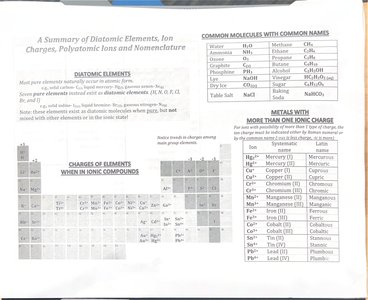
Some elements naturally exist as diatomic molecules (two atoms bonded together) in their elemental form. These include:
Hydrogen (H2)
Nitrogen (N2)
Oxygen (O2)
Fluorine (F2)
Chlorine (Cl2)
Bromine (Br2)
Iodine (I2)
Charges of Elements in Ionic Compounds
The charge of an ion is determined by its position in the periodic table. Main group elements typically form ions with predictable charges:
Group 1: +1
Group 2: +2
Group 17: -1
Group 16: -2
Transition metals can have multiple possible charges, which are indicated in compound names using Roman numerals.
Common Molecules and Metals with Multiple Charges
Common Molecules with Common Names
Some molecules are known by common names rather than systematic names. Examples include:
Common Name | Formula |
|---|---|
Water | H2O |
Ammonia | NH3 |
Methane | CH4 |
Table Salt | NaCl |
Metals with More Than One Ionic Charge
Many transition metals can form ions with different charges. Their names include Roman numerals to indicate the charge:
Metal | Possible Charges |
|---|---|
Iron (Fe) | +2, +3 |
Copper (Cu) | +1, +2 |
Lead (Pb) | +2, +4 |
Mercury (Hg) | +1, +2 |
For example, FeCl2 is iron(II) chloride, while FeCl3 is iron(III) chloride.
Summary Table: Ion Charges and Nomenclature
This summary provides a quick reference for naming ions, compounds, acids, and recognizing common molecules and diatomic elements. Mastery of these concepts is essential for understanding chemical formulas, reactions, and stoichiometry in General Chemistry.
