 Back
The First Law of Thermodynamics: Internal Energy, Heat, and Work
Study Guide - Smart Notes
 Tailored notes based on your materials, expanded with key definitions, examples, and context.
The First Law of Thermodynamics
Definition and Statement
The first law of thermodynamics is a fundamental principle of energy conservation in thermodynamic systems. It states that the change in the internal energy of a system is equal to the heat added to the system minus the work done by the system on its surroundings.
Internal Energy (Eint): The total energy contained within a system, arising from the kinetic and potential energies of its molecules.
Heat (Q): Energy transferred between a system and its environment due to a temperature difference.
Work (W): Energy transferred when a force acts through a distance, often due to volume changes in gases.
The mathematical expression for the first law is:
Q > 0: Heat is added to the system.
Q < 0: Heat is removed from the system.
W > 0: Work is done by the system (expansion).
W < 0: Work is done on the system (compression).
Thermodynamic Sign Conventions
Process | Convention |
|---|---|
Heat added to system | Q > 0 |
Heat removed from system | Q < 0 |
Work done by system | W > 0 |
Work done on system | W < 0 |
State Functions and Path Independence
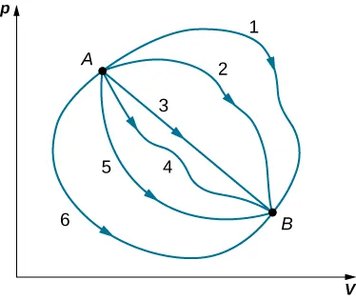
Internal energy is a state function, meaning its value depends only on the current state of the system, not on the path taken to reach that state. In contrast, heat and work are path functions and depend on the specific process taken between two states.
For any transition between two equilibrium states A and B, regardless of the path taken, the change in internal energy is the same:
This is illustrated in the following pV diagram, where multiple paths connect states A and B, but the change in internal energy is identical for all:
Differential Form of the First Law
For infinitesimal changes, the first law can be written as:
Here, is the infinitesimal change in internal energy, is the infinitesimal heat exchanged, and is the infinitesimal work done by the system.
Applications and Examples
Example: Calculating Internal Energy Change
If a system is supplied with 400 J of heat and does 100 J of work, the change in internal energy is:
If the system returns to its original state, the total change in internal energy over the cycle is zero.
Example: Work Done by Friction
A machinist applies a force to polish a copper fitting, doing work on the system. If no heat is exchanged with the environment, all work increases the internal energy (raising temperature).
The temperature change can be calculated using the specific heat capacity:
Example: Isothermal Expansion of an Ideal Gas
For an isothermal (constant temperature) expansion of an ideal gas, the change in internal energy is zero:
The work done by the gas is:
All heat added to the system is used to do work:
Example: Vaporization of Water
When water vaporizes at constant pressure, the heat required is given by the latent heat of vaporization:
The work done by the system during expansion is:
The change in internal energy is:
Summary Table: Key Equations
Quantity | Equation | Description |
|---|---|---|
First Law | Change in internal energy | |
Differential Form | Infinitesimal changes | |
Work (isothermal, ideal gas) | Work done during isothermal expansion | |
Heat (phase change) | Heat required for vaporization | |
Work (constant pressure) | Work done at constant pressure |
Key Concepts
The first law of thermodynamics is a statement of energy conservation for thermodynamic systems.
Internal energy is a state function; heat and work are path functions.
For cyclic processes, the net change in internal energy is zero.
In isothermal processes for ideal gases, all heat added is converted to work.
During phase changes, internal energy can change even if temperature remains constant.
