 Back
BackThe Lewis Model and Chemical Bonding: A Comprehensive Study Guide
Study Guide - Smart Notes
 Tailored notes based on your materials, expanded with key definitions, examples, and context.
The Lewis Model of Chemical Bonding
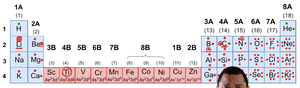
Lewis Dot Symbols and Valence Electrons
The Lewis Dot Symbol (or Electron Dot Diagram) is a visual representation of the valence electrons in an atom or ion. For main group elements (Groups 1A–8A), the number of valence electrons equals the group number. For transition metals, the number of valence electrons is the sum of the s and d electrons. The element symbol represents the nucleus and core electrons, while dots around the symbol represent valence electrons.
Chemical Bonds: Types and Formation
A chemical bond is the force that holds atoms or ions together in a compound. Atoms bond by losing, gaining, or sharing electrons to achieve a stable electron configuration, often resembling that of noble gases.
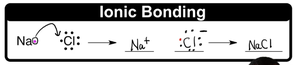
Ionic Bonds: Formed by the transfer of electrons from metals (which become cations) to nonmetals (which become anions). The resulting electrostatic attraction lowers the potential energy, making the process exothermic.
Covalent Bonds: Involve the sharing of valence electrons between nonmetals, allowing each atom to achieve a noble gas configuration.
Metallic Bonds: Characterized by a 'sea' of delocalized electrons surrounding positive metal ions, giving rise to unique metallic properties.
Electronegativity and Bond Polarity
Electronegativity (EN) is an atom's ability to attract electrons in a bond. The difference in electronegativity between two atoms determines the bond type:
Nonpolar Covalent: ΔEN < 0.5 (equal or nearly equal sharing)
Polar Covalent: 0.5 ≤ ΔEN ≤ 1.7 (unequal sharing, partial charges)
Ionic: ΔEN > 1.7 (complete transfer of electrons)
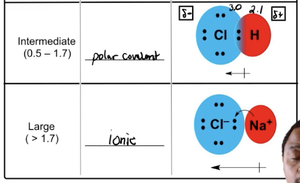
The dipole moment arises in polar molecules, indicated by a dipole arrow pointing toward the more electronegative atom.
The Octet Rule and Exceptions
The Octet Rule
The Octet Rule states that main-group elements tend to form bonds until they are surrounded by eight valence electrons, achieving a noble gas configuration. Each covalent bond represents two shared electrons.
Formula:

Exceptions to the Octet Rule
Some elements can be stable with fewer or more than eight electrons:
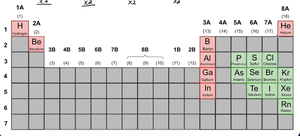
Incomplete Octet: Elements like Be, B, and Al can be stable with fewer than 8 electrons.
Expanded Octet: Elements in period 3 or higher (e.g., P, S, Cl) can have more than 8 electrons due to available d orbitals.
Formal Charge and Lewis Structures
Calculating Formal Charge
Formal Charge is used to determine the most stable Lewis structure by assigning charges to atoms within a molecule, assuming equal sharing of electrons in bonds.
Formula:
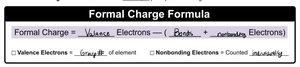
Valence electrons: Group number of the element
Bonds: Number of bonds to the atom
Nonbonding electrons: Counted individually
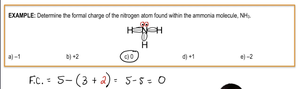
Example: Determining the formal charge of nitrogen in NH3:
Steps for Drawing Lewis Structures
Count total valence electrons.
Place the least electronegative atom in the center (except H and halogens).
Connect atoms with single bonds.
Complete octets for surrounding atoms, then the central atom.
Add double/triple bonds if necessary to satisfy the octet rule.
Check formal charges; the most stable structure has the lowest formal charges, with negative charges on the most electronegative atoms.
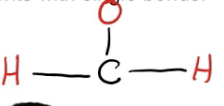
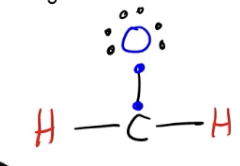
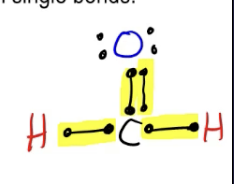
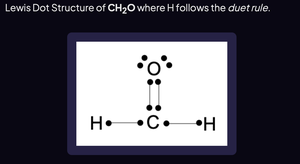
Example: Lewis structure for formaldehyde (CH2O):
Lewis Structures for Polyatomic Molecules and Ions
Lewis structures can be drawn for more complex molecules and ions by following the same steps, adjusting for overall charge as needed.
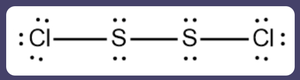
Example: Disulfur dichloride (S2Cl2):
Lewis Dot Symbols for Single Elements
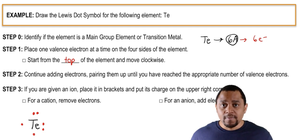
To draw the Lewis dot symbol for an element, place one dot for each valence electron around the element symbol, pairing them as needed.
Example: Tellurium (Te):
Lone Pairs and Bonding Electrons
Lone Pairs
Lone pairs are pairs of valence electrons not involved in bonding. They influence molecular shape and reactivity.
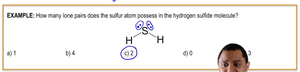
Example: Sulfur in H2S has 2 lone pairs:
Bonding Electrons
Bonding electrons are those shared between atoms in covalent bonds. For example, the central carbon in CO2 has 8 bonding electrons.
Sigma and Pi Bonds
Types of Covalent Bonds
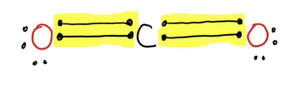
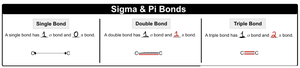
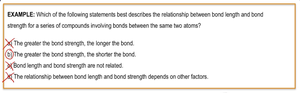
Sigma (σ) bonds are the first bonds formed between two atoms and are the strongest type of covalent bond. Pi (π) bonds are additional bonds (in double and triple bonds) that increase bond strength and decrease bond length.
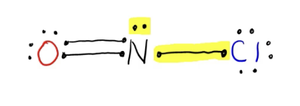
Key Point: As the number of pi bonds increases, bond strength increases and bond length decreases.
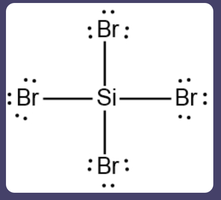
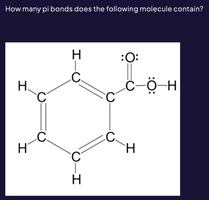
Example: Counting pi bonds in a molecule:
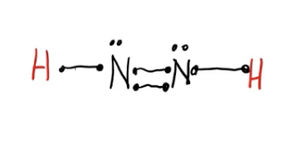
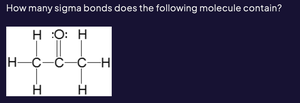
Example: Counting sigma bonds in a molecule:
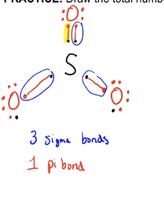
Example: SO3 has 3 sigma bonds and 1 pi bond:
Lewis Structures for Ions and Ionic Compounds
Lewis Structures for Ions
For ions, adjust the total number of valence electrons according to the charge. Enclose the structure in brackets and indicate the charge.
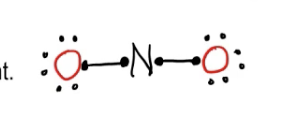
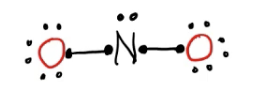
Example: NO2- ion:
Example: NH4+ ion:
Lewis Structures for Ionic Compounds
Draw the Lewis structures for both the cation and anion, then place them near each other to represent the ionic compound.
Resonance Structures and Bond Order
Resonance Structures
Resonance structures are different valid Lewis structures for the same molecule, showing the delocalization of electrons. The actual structure is a resonance hybrid, an average of all resonance forms.
Bond Order
Bond order is the average number of bonds between two atoms in a molecule. Higher bond order means stronger, shorter bonds.
Summary Table: Key Concepts in Lewis Structures and Bonding
Concept | Definition | Example/Formula |
|---|---|---|
Lewis Dot Symbol | Shows valence electrons as dots around element symbol | O: ..O.. |
Octet Rule | Atoms form bonds to achieve 8 valence electrons | Octet Electrons = Valence + Shared |
Formal Charge | Charge assigned to atom in a molecule | Valence - (Bonds + Nonbonding) |
Sigma Bond (σ) | First, strongest covalent bond | Single bond: 1 σ |
Pi Bond (π) | Additional bond in double/triple bonds | Double bond: 1 σ, 1 π |
Resonance | Multiple valid Lewis structures | NO2- resonance forms |
