 Back
week 3
Study Guide - Smart Notes
 Tailored notes based on your materials, expanded with key definitions, examples, and context.
The Matrix Equation
Definition and Interpretation
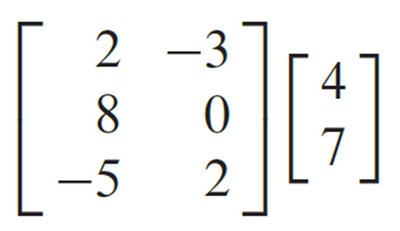
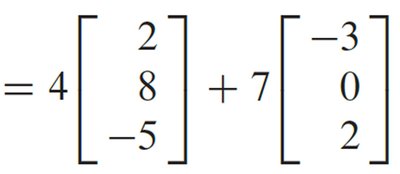
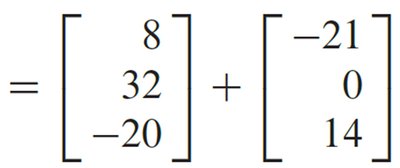
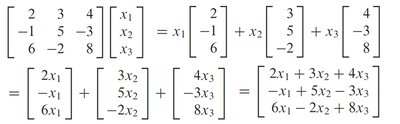
The matrix equation is a central concept in linear algebra, representing a system of linear equations in a compact form. Here, is an matrix, is a vector in , and is a vector in . The product is defined as the linear combination of the columns of using the corresponding entries in as weights:
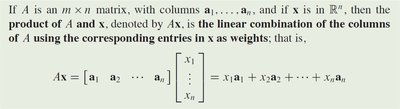
Matrix-vector product:
Interpretation: Each entry of scales the corresponding column of ; their sum gives the result.
Worked Examples
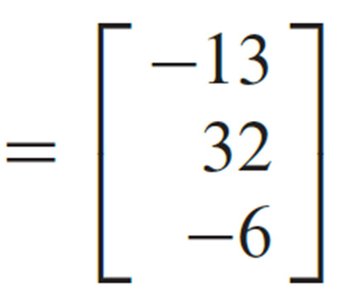
Consider the following example of matrix-vector multiplication:
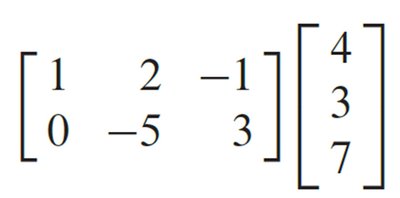
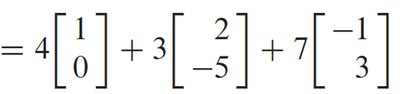
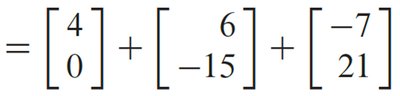
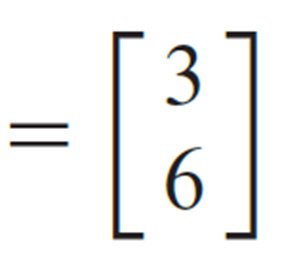
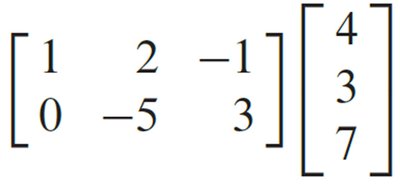
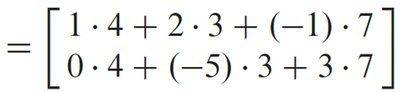
Another example:
Existence of Solutions
The equation has a solution if and only if is a linear combination of the columns of :

Row Reduction and Augmented Matrices
To determine if is consistent for all , we use row reduction on the augmented matrix :
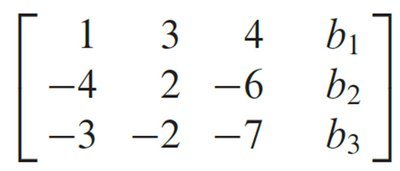
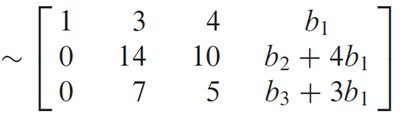

If the last row yields a contradiction (e.g., where ), the system is inconsistent for some .
Theorem 4: Equivalent Statements for Consistency
The following statements are logically equivalent for an matrix :
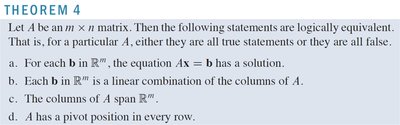
For each in , has a solution.
Each in is a linear combination of the columns of .
The columns of span .
has a pivot position in every row.
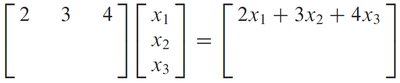
Computing : Row-Vector Rule
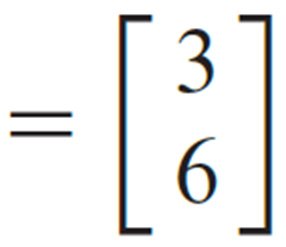
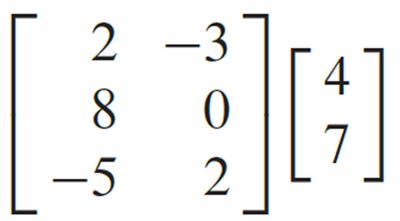
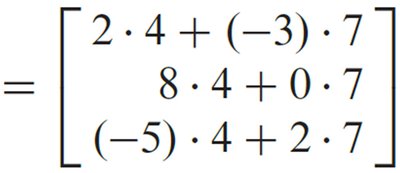
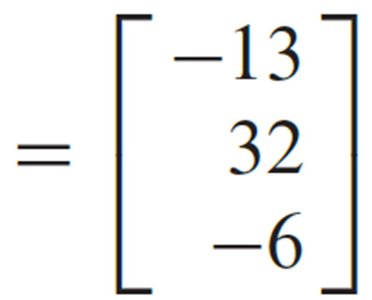
The th entry in is the sum of the products of corresponding entries from row $i$ of and from :
Example:


Another example:
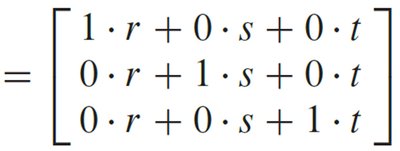
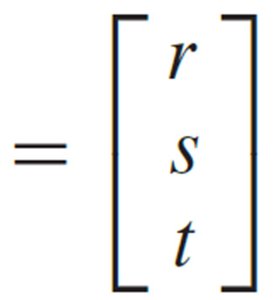
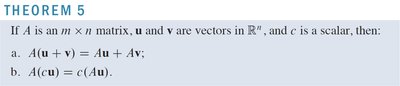
Identity Matrix and Properties
The identity matrix satisfies for any vector :
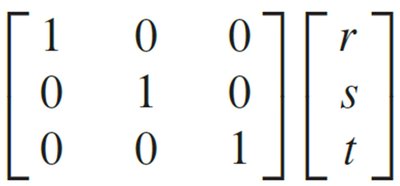
Properties of the Matrix-Vector Product (Theorem 5)
for scalar
Practice Problems
Practice problems reinforce the above concepts, including expressing vectors as linear combinations, verifying properties, and constructing matrices with specific solution properties.
Homogeneous Systems:
Definition and Solution Structure
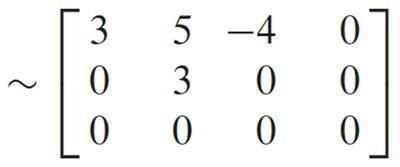
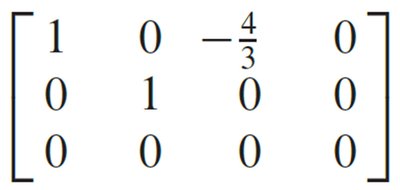
A system is homogeneous if it can be written as . Such a system always has the trivial solution , but may also have nontrivial solutions if there are free variables.
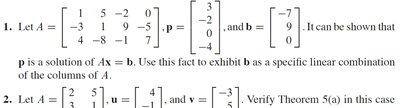
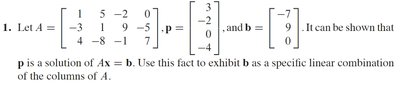
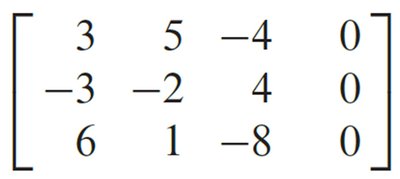
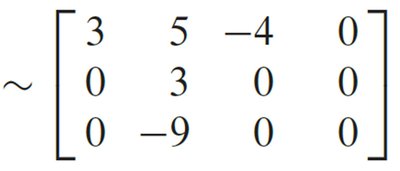
Example: Row Reduction and Solution Set




Geometric Interpretation
If there is one free variable, the solution set is a line through the origin; with two free variables, it is a plane through the origin.
Parametric Vector Form
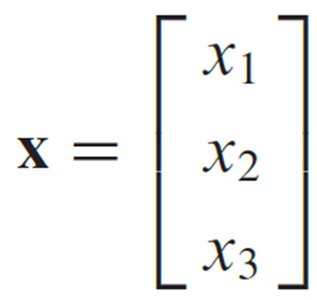
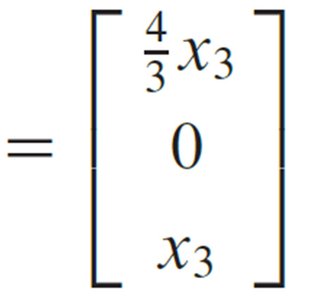
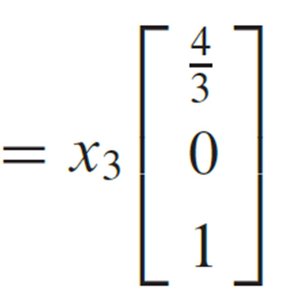
The general solution can be written as a parametric vector equation:
For one free variable:
For two free variables:
Summary Table: Solution Types
Number of Free Variables | Solution Set | Geometric Interpretation |
|---|---|---|
0 | Trivial solution only | Origin (point) |
1 | Line through origin | Line |
2 | Plane through origin | Plane |
Summary
The matrix equation expresses a system of equations as a linear combination of columns of .
Existence of solutions depends on whether is in the span of the columns of .
Homogeneous systems always have the trivial solution; nontrivial solutions exist if there are free variables.
General solutions can be written in parametric vector form, describing lines or planes through the origin.
