 Back
The Molecular Model of an Ideal Gas and Gas Laws
Study Guide - Smart Notes
 Tailored notes based on your materials, expanded with key definitions, examples, and context.
The Molecular Model of an Ideal Gas
Characteristics of Gases
Gases are distinguished from solids and liquids by the large distances between their molecules, resulting in negligible intermolecular forces except during collisions. This randomness in molecular motion simplifies the connection between microscopic and macroscopic properties for gases.
Compression: Gases are easily compressed due to large intermolecular spacing.
Expansion: Gases expand rapidly with temperature changes, exhibiting large coefficients of volume expansion.
Behavior: At high temperatures and low densities, gases behave ideally, meaning their properties depend mainly on the number of molecules per unit volume and temperature.
Additional info: The behavior of gases is less constrained than that of liquids and solids, where intermolecular forces play a significant role.
The Gas Laws
Boyle's Law
Boyle's law states that at constant temperature and number of molecules, the absolute pressure of a gas and its volume are inversely proportional.
Mathematical Expression:
Application: Used to describe how volume decreases as pressure increases, and vice versa, for a fixed amount of gas at constant temperature.
Example: Pumping air into a tire initially increases volume with little change in pressure; once the tire is full, further air increases pressure.
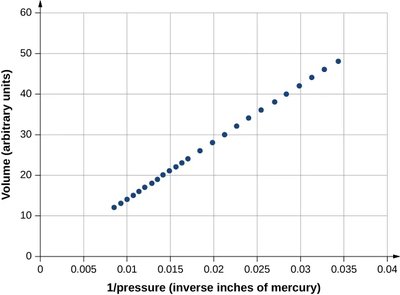
Additional info: The linearity of the graph of volume versus 1/pressure confirms the inverse relationship.
Charles's Law
Charles's law states that at constant pressure and number of molecules, the volume of a gas is proportional to its absolute temperature.
Mathematical Expression:
Application: Used to describe how volume increases with temperature for a fixed amount of gas at constant pressure.
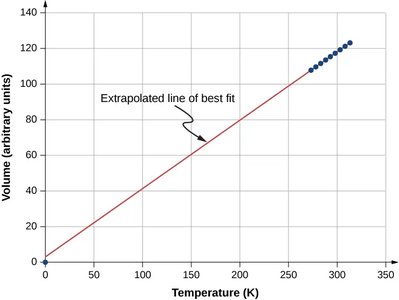
Additional info: The extrapolated line of best fit passes through the origin, confirming proportionality.
Gay-Lussac's Law (Amonton's Law)
Gay-Lussac's law states that at constant volume and number of molecules, the pressure of a gas is proportional to its absolute temperature.
Mathematical Expression:
Application: Used in constant-volume gas thermometers.
The Ideal Gas Law
General Formulation
The ideal gas law combines the above relationships and applies to all gases at low density and high temperature. It is independent of the gas type.
Equation:
Variables: = pressure, = volume, = number of molecules, = Boltzmann constant ( J/K), = absolute temperature
Alternate Form: For constant ,
Ideal Gas Law in Terms of Moles
It is often convenient to use moles instead of molecules. Avogadro's number ( mol) relates the number of molecules to moles.
Equation:
Variables: = number of moles, = universal gas constant ( J/mol·K or L·atm/mol·K)
Moles and Avogadro's Number
A mole is the SI unit for the amount of substance, historically defined as the number of atoms in 12 grams of carbon-12. Avogadro's number is the number of molecules in one mole.
Avogadro's Number: mol
Conversion:
Molar Mass: The mass of one mole of a substance in grams is numerically equal to the mass of one molecule in unified atomic mass units (u).
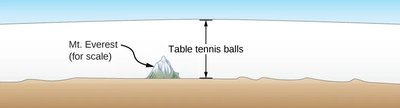
Example: Avogadro's number of table tennis balls would cover Earth to a depth of about 40 km, illustrating the immense scale of a mole.
Applications and Examples
Pressure Changes Due to Temperature
When the temperature of a gas in a fixed volume increases, its pressure increases proportionally, as described by the ideal gas law.
Equation:
Example: A bicycle tire's pressure increases on a hot day due to temperature rise.
Calculating Number of Molecules
The ideal gas law can be used to calculate the number of molecules in a given volume of gas at specified conditions.
Equation:
Example: One breath (500 mL) of air at STP contains molecules.
Density of Air
The density of air can be calculated using the ideal gas law and the molar mass of air.
Equation:
Example: At STP, air density is kg/m; in a hot air balloon at C, density decreases to kg/m$^3$.
The Van der Waals Equation of State
Improving the Ideal Gas Law
The van der Waals equation accounts for intermolecular attractions and the finite volume of molecules, improving upon the ideal gas law for real gases.
Equation:
Variables: and are experimentally determined constants for each gas.
Application: At low density, the equation reduces to the ideal gas law; at high density, it predicts deviations due to molecular interactions.
pV Diagrams and Phase Transitions
Isotherms and Critical Points
pV diagrams plot pressure versus volume for a substance at fixed temperature (isotherms). For ideal gases, the curves are hyperbolas. For real gases, the van der Waals equation predicts more complex behavior, including phase transitions.
Critical Temperature (): The temperature above which a liquid phase cannot exist.
Critical Pressure: The maximum pressure at which a liquid can exist.
Critical Point: The point on the pV diagram at the critical temperature and pressure.
Substance | Critical Temperature (K) | Critical Pressure (Pa) | Critical Pressure (atm) |
|---|---|---|---|
Water | 647.4 | 22.12 × 10⁶ | 219.0 |
Sulfur dioxide | 430.7 | 7.88 × 10⁶ | 78.0 |
Ammonia | 405.5 | 11.28 × 10⁶ | 111.7 |
Carbon dioxide | 304.2 | 7.39 × 10⁶ | 73.2 |
Oxygen | 154.8 | 5.08 × 10⁶ | 50.3 |
Nitrogen | 126.2 | 3.39 × 10⁶ | 33.6 |
Hydrogen | 33.3 | 1.30 × 10⁶ | 12.9 |
Helium | 5.3 | 0.229 × 10⁶ | 2.27 |
Additional info: Above the critical temperature, gases are supercritical and cannot be liquefied by pressure alone.
Problem-Solving Strategy for the Ideal Gas Law
Steps for Solving Gas Law Problems
Determine if the gas is ideal (low density, high temperature).
List known quantities and identify unknowns.
Choose the appropriate form of the ideal gas law ( or ).
Convert all values to proper SI units.
Solve for the unknown quantity.
Substitute values and calculate the answer.
Check if the answer is reasonable.
