 Back
The Octet Rule: Electron Transfer and Sharing in Chemical Bonding
Study Guide - Smart Notes
 Tailored notes based on your materials, expanded with key definitions, examples, and context.
The Octet Rule
Introduction to the Octet Rule
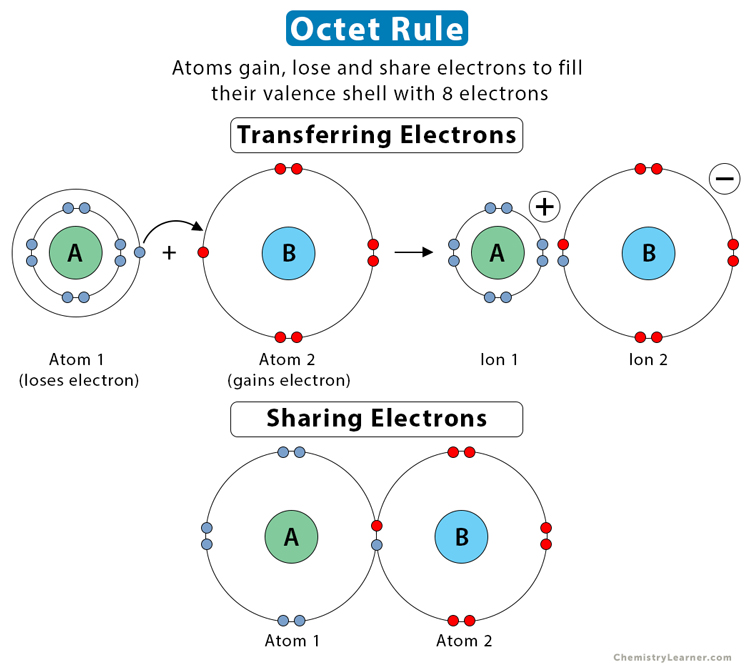
The octet rule is a fundamental principle in chemistry that states atoms tend to gain, lose, or share electrons in order to achieve a stable configuration of eight electrons in their valence shell. This rule explains the formation of most chemical bonds and is central to understanding atomic interactions in molecules and compounds.
Transferring Electrons: Ionic Bond Formation
Atoms can achieve an octet by transferring electrons from one atom to another, resulting in the formation of ions. This process is characteristic of ionic bonding, where one atom loses electrons (becoming a positively charged ion, or cation) and another atom gains electrons (becoming a negatively charged ion, or anion).
Atom 1 (loses electron): Typically a metal, it donates electrons to achieve a stable octet.
Atom 2 (gains electron): Typically a nonmetal, it accepts electrons to complete its valence shell.
Ion Formation: The transfer results in the creation of oppositely charged ions that attract each other, forming an ionic compound.
Example: Sodium (Na) transfers an electron to chlorine (Cl), forming Na+ and Cl- ions, which combine to make sodium chloride (NaCl).
Sharing Electrons: Covalent Bond Formation
Alternatively, atoms can achieve an octet by sharing electrons with other atoms. This process leads to the formation of covalent bonds, where two atoms share one or more pairs of electrons to fill their valence shells.
Atom 1 and Atom 2: Both atoms contribute electrons to the shared pair(s), achieving a stable octet.
Covalent Bond: The shared electrons are counted toward the octet of both atoms involved.
Example: Two hydrogen atoms share electrons with an oxygen atom to form water (H2O), where each atom achieves a stable electron configuration.
Key Terms and Concepts
Valence Shell: The outermost electron shell of an atom, where chemical bonding occurs.
Cation: An ion with a positive charge, formed by losing electrons.
Anion: An ion with a negative charge, formed by gaining electrons.
Ionic Bond: A chemical bond formed by the electrostatic attraction between oppositely charged ions.
Covalent Bond: A chemical bond formed by the sharing of electron pairs between atoms.
Relevant Equations
The process of electron transfer can be represented as:
Electron sharing in covalent bonds can be represented as:
Comparison Table: Ionic vs. Covalent Bonding
Bond Type | Electron Movement | Resulting Species | Example |
|---|---|---|---|
Ionic | Transfer | Cation & Anion | NaCl |
Covalent | Sharing | Molecule | H2O |
Additional info: The octet rule is most applicable to main group elements; transition metals and some exceptions (like hydrogen and helium) do not always follow this rule strictly.
