 Back
BackThe Periodic Table and Atomic Properties: Structure, Trends, and Chemical Compounds
Study Guide - Smart Notes
 Tailored notes based on your materials, expanded with key definitions, examples, and context.
Chapter 9: The Periodic Table and Some Atomic Properties
Classifying the Elements
The periodic table organizes elements based on recurring chemical and physical properties, reflecting their atomic structure. The arrangement allows for the prediction of element behavior and the identification of trends across periods and groups.
Mendeleev’s Periodic Table: Early classification based on atomic mass and recurring properties.
Periodic Law: When elements are arranged by increasing atomic number, properties recur periodically.
Groups and Periods: Vertical columns are groups (similar chemical properties); horizontal rows are periods (properties change progressively).
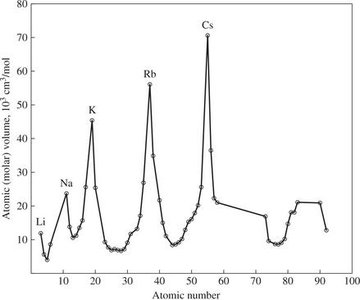
Example: The graph above shows atomic (molar) volume versus atomic number, with peaks at alkali metals (Li, Na, K, Rb, Cs), illustrating periodicity.
Historical Development
Meyer’s Graph: Plots atomic volumes against atomic numbers, highlighting periodic trends.
Early Periodic Tables: Grouped elements by similar chemical formulas and properties.
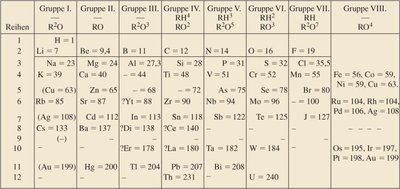
Prediction and Discovery of Elements
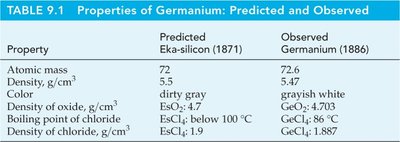
Predicted properties of undiscovered elements (e.g., eka-silicon) closely matched those of later discovered elements (e.g., germanium).
Property | Predicted Eka-silicon (1871) | Observed Germanium (1886) |
|---|---|---|
Atomic mass | 72 | 72.6 |
Density, g/cm3 | 5.5 | 5.47 |
Color | dirty gray | grayish white |
Density of oxide, g/cm3 | 4.7 | 4.703 |
Boiling point of chloride | below 100°C | 86°C |
Density of chloride, g/cm3 | 1.9 | 1.887 |
Metals, Nonmetals, Metalloids, and Noble Gases
Elements are classified based on their physical and chemical properties:
Metals: Good conductors, malleable, ductile, moderate to high melting points.
Nonmetals: Poor conductors, brittle, can be gases or solids at room temperature.
Metalloids: Exhibit both metallic and nonmetallic properties.
Noble Gases: Inert, filled valence shells (He: 1s2; others: ns2np6).
Transition Metal Ions
Transition metals lose ns electrons before (n-1)d electrons when forming cations. Most do not achieve noble-gas configurations.
Example: Fe ([Ar]3d64s2) → Fe2+ ([Ar]3d6) + 2e−; Fe3+ ([Ar]3d5) + 3e−
Sizes of Atoms and Ions
Atomic and ionic sizes are determined by the arrangement of electrons and the effective nuclear charge.
Atomic Radius: Half the distance between nuclei of identical atoms bonded together.
Metallic Radius: Half the distance between nuclei in a metallic crystal.
Van der Waals Radius: For noble gases in solid state.
Ionic Radius: Based on distances in ionic compounds.
Screening and Penetration: Core electrons shield valence electrons from the nucleus, reducing the effective nuclear charge (Zeff).
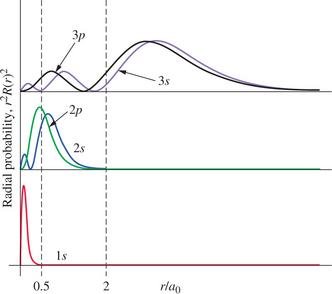
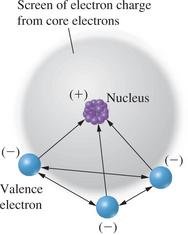
Trends in Atomic and Ionic Radii
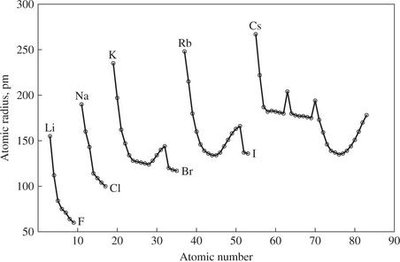
Atomic radius decreases across a period (left to right) due to increasing Zeff.
Atomic radius increases down a group due to additional electron shells.
Cations are smaller than their parent atoms; anions are larger.
Among isoelectronic ions, higher positive charge means smaller radius; higher negative charge means larger radius.
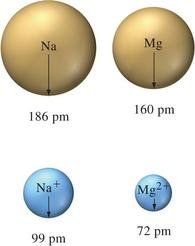
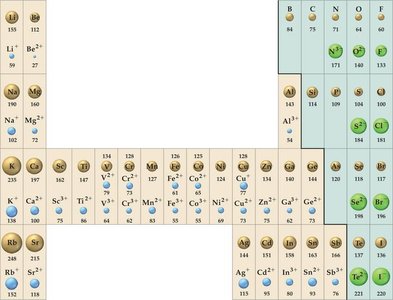
Ionization Energy
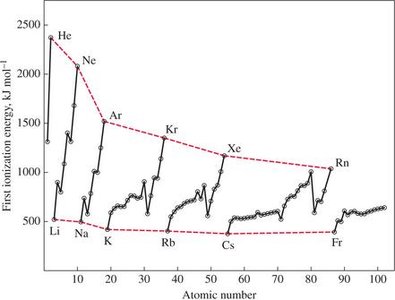
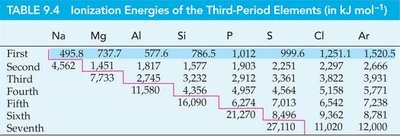
Ionization energy (IE) is the energy required to remove an electron from a gaseous atom or ion. It reflects the strength of attraction between the nucleus and the electron.
First Ionization Energy (I1): Energy to remove the first electron.
Successive Ionization Energies: Increase for each subsequent electron removed.
General Trend: Increases across a period, decreases down a group.
Equation:
Electron Affinity
Electron affinity (EA) is the enthalpy change when an atom in the gas phase gains an electron. It is usually exothermic (negative value), but the addition of a second electron is always endothermic due to repulsion.
Example: ;
Second electron affinity is positive (endothermic).
Magnetic Properties
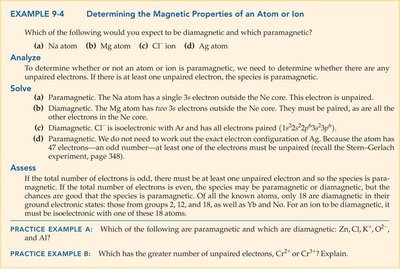
Magnetic properties depend on the presence of unpaired electrons:
Diamagnetic: All electrons paired; weakly repelled by magnetic fields.
Paramagnetic: One or more unpaired electrons; attracted to magnetic fields.
Polarizability
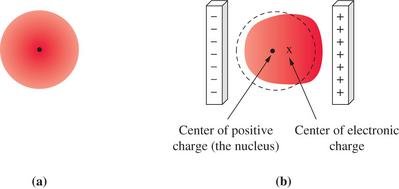
Polarizability is the ease with which the electron cloud of an atom or ion can be distorted by an external electric field. Larger atoms are more polarizable.
Polarizability increases with atomic size.
Polarization leads to temporary dipoles, important in intermolecular forces.
Chapter 3: Chemical Compounds
Types of Chemical Compounds and Their Formulas
Chemical compounds are classified by the types of elements and bonds present. Their formulas represent the composition and structure.
Molecular Compounds: Composed of molecules (e.g., H2O).
Ionic Compounds: Composed of ions (e.g., NaCl).
Empirical Formula: Simplest whole-number ratio of elements.
Molecular Formula: Actual number of atoms in a molecule.
Structural Formula: Shows arrangement of atoms.
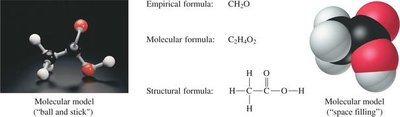
The Mole Concept and Chemical Compounds
The mole is a counting unit for atoms, ions, or molecules. Molar mass relates the mass of a substance to the number of particles present.
Formula Mass: Mass of a formula unit in atomic mass units (u).
Molecular Mass: Mass of a molecule (sum of atomic masses).
Avogadro’s Number: particles per mole.
Example Calculations:
H2O: u
MgCl2: u
Mg(NO3)2: u
Composition of Chemical Compounds
The composition of a compound can be expressed as mass percent of each element. This is useful for determining empirical formulas from experimental data.
Percent Composition:
Empirical Formula Determination: Convert mass percent to moles, find simplest ratio.
Oxidation States: A Useful Tool in Describing Chemical Compounds
Oxidation states (numbers) indicate the hypothetical charge an atom would have if all bonds were ionic. They are used to track electron transfer in reactions and to name compounds systematically.
Rules for assigning oxidation states are based on element position and compound type.
Naming Compounds: Organic and Inorganic Compounds
Systematic nomenclature allows for the clear identification of compounds. Inorganic compounds are named based on the elements and their oxidation states; organic compounds follow IUPAC rules.
Inorganic: Use prefixes, suffixes, and oxidation numbers as needed.
Organic: Based on carbon backbone and functional groups.
Additional info: These notes cover the core periodic trends and chemical compound concepts essential for general chemistry, including historical context, periodic law, atomic and ionic properties, and the basics of chemical nomenclature and composition.
