 Back
BackThe Quantum-Mechanical Model of the Atom: Light, Electromagnetic Radiation, and Atomic Structure
Study Guide - Smart Notes
 Tailored notes based on your materials, expanded with key definitions, examples, and context.
Chapter 8: The Quantum–Mechanical Model of the Atom
Introduction
The quantum-mechanical model of the atom describes the behavior of electrons using the principles of quantum mechanics. This chapter explores the nature of light, the electromagnetic spectrum, quantum numbers, and the structure of atomic orbitals.
The Nature of Light and Electromagnetic Radiation
Electromagnetic Radiation
Light is a form of electromagnetic radiation, which includes radio waves, microwaves, visible light, and x-rays. These waves differ in their wavelength (λ) but all travel at the same speed in a vacuum, known as the speed of light (c = 3.00 × 10⁸ m/s).
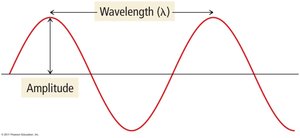
Wavelength (λ): The distance between two consecutive crests or troughs of a wave (measured in meters).
Frequency (ν): The number of wave cycles that pass a point per second (measured in hertz, Hz or s−1).
Amplitude: The height of the wave, related to the intensity or brightness of the light.
Relationship Between Wavelength and Frequency
Wavelength and frequency are inversely proportional, as described by the equation:
Where c is the speed of light, λ is wavelength, and ν is frequency.
If you know one, you can calculate the other.
Example Calculation
Calculate the wavelength of red light with a frequency of 4.62 × 10¹⁴ s−1:
The Electromagnetic Spectrum
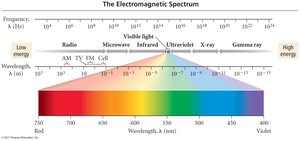
The electromagnetic spectrum encompasses all types of electromagnetic radiation, arranged by wavelength and frequency. Visible light is only a small portion, ranging from about 400 nm (violet) to 700 nm (red).
Color and Visible Light
The color of light is determined by its wavelength. White light is a mixture of all visible wavelengths. The order of colors in visible light is red, orange, yellow, green, blue, and violet.
Wave Properties of Light
Interference
When two or more waves overlap, they interact through interference:
Constructive interference: Waves add together to make a larger wave.
Destructive interference: Waves cancel each other out.

Diffraction
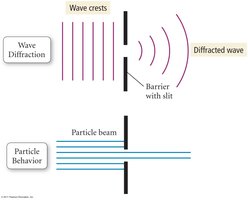
Diffraction occurs when waves bend around obstacles or pass through slits comparable in size to their wavelength. This property distinguishes waves from particles.
The Particle Nature of Light
The Photoelectric Effect
Experiments showed that light can behave as particles called photons. The photoelectric effect demonstrated that electrons are emitted from a material only when the light exceeds a certain frequency (threshold frequency).
Energy of a photon:
Planck’s constant (h): J·s
Photon energy is directly proportional to frequency and inversely proportional to wavelength:
Example Calculation
Calculate the energy of a photon of γ radiation with λ = 1.0 × 10⁻¹³ m:
Atomic Spectroscopy and the Bohr Model
Emission Spectra
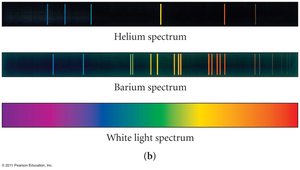
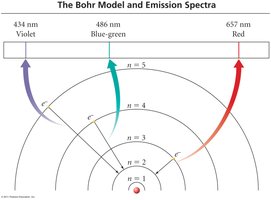
When atoms absorb energy, they emit light at specific wavelengths, producing an emission spectrum unique to each element. This property is used to identify elements.
The Bohr Model of the Atom
The Bohr model describes electrons as orbiting the nucleus in quantized energy levels. When an electron transitions between levels, it absorbs or emits a photon with energy equal to the difference between the levels.
Wave Behavior of Electrons
de Broglie Hypothesis
Louis de Broglie proposed that particles such as electrons have wave-like properties. The wavelength of a particle is inversely proportional to its momentum:
Where m is mass and v is velocity.
Quantum Numbers and Atomic Orbitals
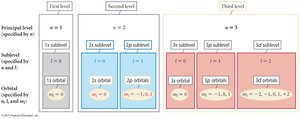
Principal Quantum Number (n)
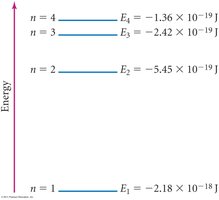
The principal quantum number (n) determines the energy level and size of the orbital. n can be any integer ≥ 1. As n increases, the orbital becomes larger and higher in energy, but the energy difference between levels decreases.
Angular Momentum Quantum Number (l)
The angular momentum quantum number (l) determines the shape of the orbital. l can have integer values from 0 to (n – 1):
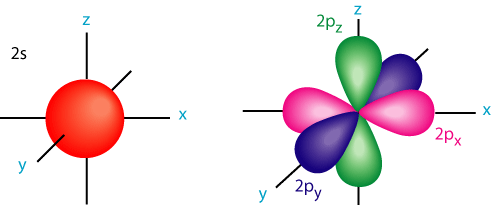
l = 0: s orbital (spherical)
l = 1: p orbital (dumbbell-shaped)
l = 2: d orbital (cloverleaf-shaped)
Magnetic Quantum Number (ml)
The magnetic quantum number (ml) specifies the orientation of the orbital. It can take integer values from –l to +l, including zero.
For l = 1 (p orbitals): ml = –1, 0, +1 (three orientations)
For l = 2 (d orbitals): ml = –2, –1, 0, +1, +2 (five orientations)
Energy Shells, Subshells, and Orbitals
Each set of quantum numbers (n, l, ml) describes a unique orbital. Orbitals with the same n are in the same principal energy level (shell), and those with the same n and l are in the same subshell.
Shapes of Atomic Orbitals
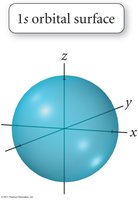
s Orbitals (l = 0)
Each principal energy level has one s orbital, which is spherical in shape and has the lowest energy in its shell. The number of nodes is (n – 1).
p Orbitals (l = 1)
Each principal energy level above n = 1 has three p orbitals (px, py, pz), each oriented along a different axis. They are two-lobed and have one node at the nucleus.
Summary Table: Quantum Numbers and Orbitals
Quantum Number | Symbol | Allowed Values | Physical Meaning |
|---|---|---|---|
Principal | n | 1, 2, 3, ... | Energy level, size of orbital |
Angular Momentum | l | 0 to n–1 | Shape of orbital (s, p, d, ...) |
Magnetic | ml | –l to +l | Orientation of orbital |
Additional info: The quantum-mechanical model forms the foundation for understanding chemical bonding, periodic trends, and the behavior of electrons in atoms.
