Back
BackThe Quantum-Mechanical Model of the Atom: Foundations and Applications
Study Guide - Smart Notes
 Tailored notes based on your materials, expanded with key definitions, examples, and context.
Chapter 7: The Quantum-Mechanical Model of the Atom
The Beginnings of Quantum Mechanics
Quantum mechanics emerged in the early twentieth century as scientists discovered that classical physics could not explain the behavior of subatomic particles. Unlike macroscopic objects, the future state of subatomic particles cannot be predicted with certainty from their present state. This indeterminacy led to the development of quantum theory by physicists such as Albert Einstein, Niels Bohr, Louis de Broglie, Max Planck, Werner Heisenberg, P. A. M. Dirac, and Erwin Schrödinger.
Importance of Quantum Mechanics in Chemistry
Quantum mechanics is the foundation of modern chemistry. It explains:
The structure of the periodic table
The behavior of elements in chemical bonding
The properties of materials and their technological applications (e.g., lasers, computers)
The Behavior of Electrons
Electrons are extremely small and their behavior determines the properties of atoms. Direct observation of electrons is impossible because any attempt to observe them alters their behavior. This is a fundamental aspect of quantum mechanics.
The Quantum-Mechanical Model
The quantum-mechanical model describes how electrons exist and behave in atoms. It helps explain:
Why elements are metals or nonmetals
Why elements form ions with specific charges
Why some elements are reactive and others are inert
The periodic trends in elemental properties
The Nature of Light
Wave Nature of Light
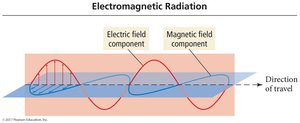
Light is a form of electromagnetic radiation, consisting of oscillating electric and magnetic fields perpendicular to each other and to the direction of propagation. All electromagnetic waves travel at the speed of light, m/s.
Speed of Energy Transmission
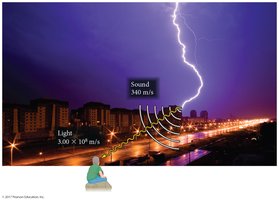
Light travels much faster than sound. For example, during a lightning storm, you see the lightning before you hear the thunder because light travels at m/s, while sound travels at only 340 m/s.
Characterizing Waves
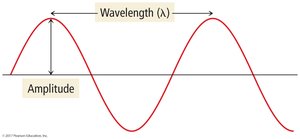
Amplitude: The height of the wave, related to the intensity (brightness) of light.
Wavelength (\( \lambda \)): The distance between successive crests or troughs of a wave.
Wave Characteristics: Amplitude and Wavelength
Different wavelengths correspond to different colors of light.
Different amplitudes correspond to different brightness levels.
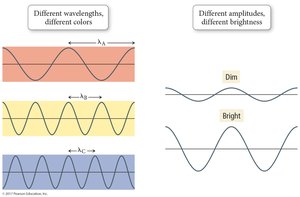
Frequency (\( \nu \))
Frequency is the number of wave cycles that pass a point per second, measured in hertz (Hz). The energy of light is proportional to both its amplitude and frequency.
Relationship Between Wavelength and Frequency
For electromagnetic waves, wavelength and frequency are inversely proportional:
where is the speed of light, is wavelength, and is frequency.
Color and the Electromagnetic Spectrum
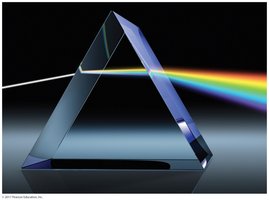
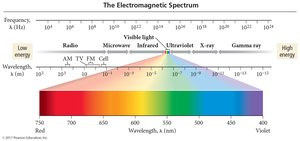
The color of visible light is determined by its wavelength or frequency. White light contains all visible wavelengths. When white light passes through a prism, it separates into a spectrum of colors.
The Electromagnetic Spectrum
Visible light is only a small part of the electromagnetic spectrum, which includes radio waves, microwaves, infrared, ultraviolet, X-rays, and gamma rays. Shorter wavelengths have higher energy and can be biologically damaging (ionizing radiation).
Wave Behavior: Interference and Diffraction
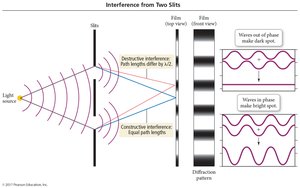
Interference
When waves overlap, they interact through interference:
Constructive interference: Waves add together (in phase) to make a larger wave.
Destructive interference: Waves cancel each other (out of phase).
Diffraction
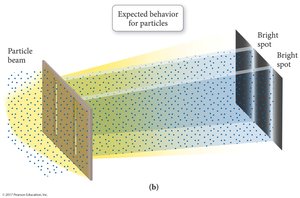
When waves encounter an obstacle or slit comparable in size to their wavelength, they bend around it, producing a diffraction pattern. Particles do not diffract in this way.
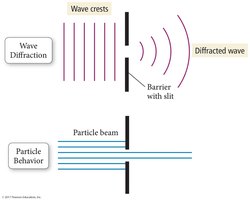
Two-Slit Interference
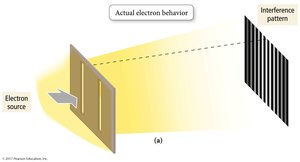
When light passes through two closely spaced slits, it produces an interference pattern characteristic of waves.
The Photoelectric Effect
Discovery and Explanation
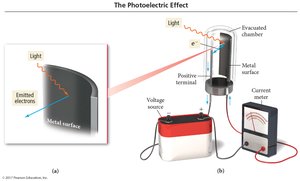
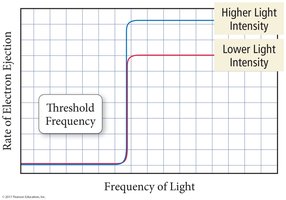
The photoelectric effect is the emission of electrons from a metal surface when light shines on it. Classical wave theory could not explain why only light above a certain frequency could cause electron emission, regardless of intensity.
Threshold Frequency
Experiments showed that a minimum frequency (threshold frequency) is required for electron emission. Increasing the light's intensity increases the number of electrons ejected, but only if the frequency is above the threshold.
Einstein's Photon Theory
Einstein proposed that light consists of packets of energy called photons. The energy of a photon is:
where is Planck's constant ( J·s).
If a photon has energy greater than the binding energy () of an electron, the excess energy becomes the electron's kinetic energy:
Atomic Spectra and the Bohr Model
Emission Spectra
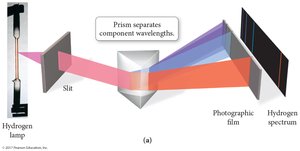
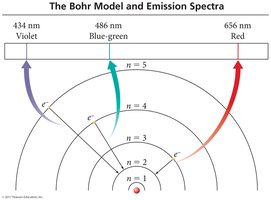
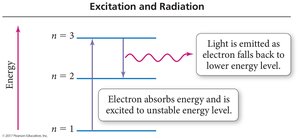
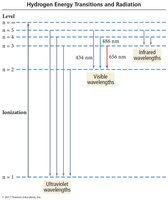
When atoms absorb energy, their electrons move to higher energy levels. When electrons return to lower energy levels, they emit light of specific wavelengths, producing an emission spectrum unique to each element.
Flame Tests
Different elements emit characteristic colors when heated in a flame, which can be used for identification.

The Bohr Model of the Atom
Bohr proposed that electrons travel in fixed orbits around the nucleus, each with a specific energy. Electrons can "jump" between orbits by absorbing or emitting photons with energy equal to the difference between the orbits.
Wave-Particle Duality and Quantum Numbers
Wave Behavior of Electrons
Louis de Broglie proposed that particles such as electrons have wave-like properties. The wavelength of a particle is inversely proportional to its momentum:
Electron Diffraction
Experiments showed that electrons produce interference patterns, confirming their wave nature.
Complementary Properties and the Uncertainty Principle
According to Heisenberg's uncertainty principle, it is impossible to know both the position and velocity of an electron simultaneously:
This means that the more precisely one property is known, the less precisely the other can be known.
Quantum Mechanical Model: Orbitals and Quantum Numbers
Schrödinger's Equation and Orbitals
Schrödinger developed an equation whose solutions (wave functions, ) describe the probability of finding an electron in a particular region of space, called an orbital. The square of the wave function () gives the probability density.
Quantum Numbers
Three quantum numbers describe the properties of orbitals:
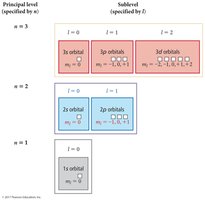
Principal quantum number (n): Energy level (n = 1, 2, 3, ...)
Angular momentum quantum number (l): Shape of the orbital (l = 0 to n-1)
Magnetic quantum number (m_l): Orientation of the orbital (m_l = -l to +l)
Angular Momentum Quantum Number and Orbital Types
Value of l | Letter Designation |
|---|---|
0 | s |
1 | p |
2 | d |
3 | f |

Energy Levels and Sublevels
Each principal energy level (n) contains n sublevels, each with a different value of l. Each sublevel contains a specific number of orbitals:
Number of sublevels in a level = n
Number of orbitals in a sublevel = 2l + 1
Number of orbitals in a level = n^2
Atomic Orbitals: Shapes and Properties
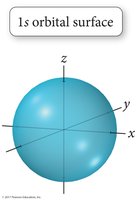
s Orbitals (l = 0)
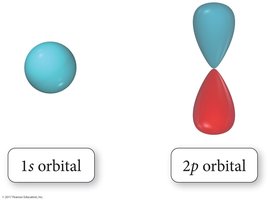
Each principal energy level has one s orbital, which is spherical in shape. The number of nodes in an s orbital is (n – 1).
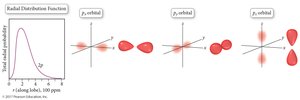
p Orbitals (l = 1)
Each principal energy level above n = 1 has three p orbitals (p_x, p_y, p_z), each oriented along a different axis. p orbitals are two-lobed and have one node at the nucleus.
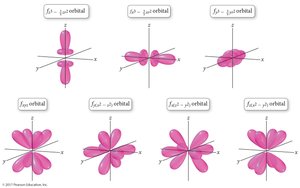
d Orbitals (l = 2)
Each principal energy level above n = 2 has five d orbitals, mainly four-lobed in shape, with complex orientations.
f Orbitals (l = 3)
Each principal energy level above n = 3 has seven f orbitals, which are mainly eight-lobed.
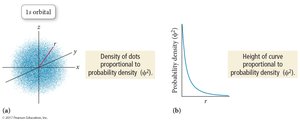
Probability and Radial Distribution Functions
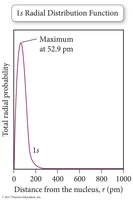
The probability density function () gives the probability of finding an electron at a particular point. The radial distribution function shows the probability of finding an electron at a certain distance from the nucleus. For the 1s orbital of hydrogen, the most probable distance is 52.9 pm.
Electron Transitions and Atomic Spectra
Electron Transitions
When an electron transitions between energy levels, it absorbs or emits a photon with energy equal to the difference between the levels:
Phases of Orbitals
Orbitals are described by wave functions, which can have positive or negative values (phases). The sign of the wave function is important in bonding and chemical interactions.
Why Are Atoms Spherical?
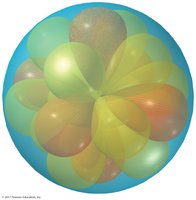
The overall shape of an atom is spherical because the s orbitals, which are spherical, are the lowest energy and most likely to be occupied. The combination of all possible orientations of orbitals in an atom also results in a spherical distribution.