 Back
The Quantum Mechanical Model of the Atom: Light, Atomic Spectra, and Wave-Particle Duality
Study Guide - Smart Notes
 Tailored notes based on your materials, expanded with key definitions, examples, and context.
Chapter 2: The Quantum Mechanical Model of the Atom
8.2 The Wave Nature of Light
The wave nature of light is fundamental to understanding atomic structure and behavior. Light exhibits properties such as amplitude, wavelength, and frequency, each of which influences its energy and interaction with matter.
Amplitude: The height of the wave, which determines the brightness or intensity of the light.
Wavelength (\( \lambda \)): The distance between successive crests of a wave. It determines the energy and color of the light. Shorter wavelengths correspond to higher energy.
Frequency (\( \nu \)): The number of cycles per second, measured in Hertz (Hz), where \( 1\ \text{Hz} = 1\ \text{s}^{-1} \).
Relationship between wavelength and frequency: Light travels at a constant speed (\( c \)), so \( c = \lambda \nu \).
Equation:
Example: What is the wavelength of light with a frequency of \( 4.45 \times 10^{14} \) Hz?
Where \( c = 3.00 \times 10^8 \) m/s (speed of light).

The Particle Nature of Light: The Photoelectric Effect
Light also behaves as a stream of particles called photons. The photoelectric effect demonstrates that light energy is quantized and can eject electrons from a metal surface if the light's frequency is above a certain threshold.
Photoelectric Effect: The emission of electrons from a metal when light shines on it. Einstein explained that light energy comes in discrete packets called photons.
Threshold Frequency (\( \nu_0 \)): The minimum frequency required to eject electrons from a metal surface.
Work Function (\( \phi \)): The minimum energy needed to remove an electron from the metal.
Kinetic Energy of Ejected Electron:
Where \( h \) is Planck's constant (\( 6.626 \times 10^{-34} \) J·s).
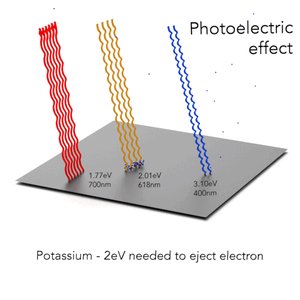
Wave-Particle Duality of Light: Light exhibits both wave-like and particle-like properties, a concept central to quantum mechanics.
8.3 Atomic Spectroscopy and the Bohr Model
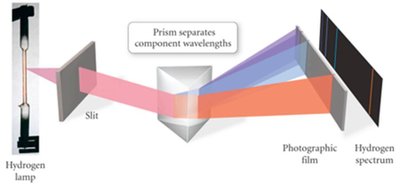
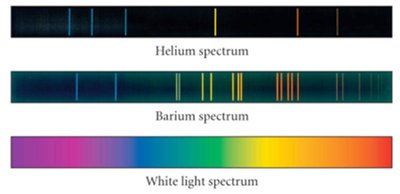
Atomic spectroscopy involves studying the light emitted or absorbed by atoms. The Bohr model explains the discrete energy levels of electrons in atoms and the origin of atomic spectra.
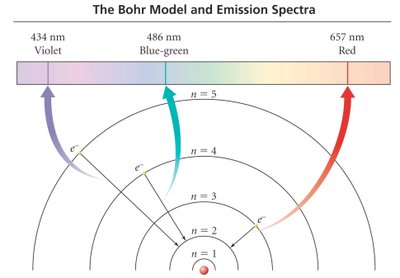
Emission Spectrum: When atoms absorb energy, electrons move to higher energy levels. When they return to lower levels, they emit light of specific wavelengths, producing a line spectrum.
Bohr Model: Electrons orbit the nucleus in fixed energy levels. Transitions between these levels correspond to absorption or emission of photons with energy equal to the difference between levels.
Energy of a Photon:
Example: The hydrogen atom emits light at specific wavelengths (e.g., 434 nm, 486 nm, 657 nm) corresponding to electron transitions between energy levels.
8.4 The Wave Nature of Matter
Just as light exhibits wave-particle duality, matter (such as electrons) also has wave-like properties. This concept is described by the de Broglie hypothesis.
de Broglie Wavelength: Any moving particle has an associated wavelength given by:
Where \( m \) is the mass and \( v \) is the velocity of the particle.
Example: Calculate the wavelength of an electron traveling at a speed of \( 1.33 \times 10^3 \) m/s.
This wave nature of matter is fundamental to quantum mechanics and explains phenomena such as electron diffraction.
