 Back
The Quantum-Mechanical Model of the Atom: Quantum Numbers and Atomic Orbitals
Study Guide - Smart Notes
 Tailored notes based on your materials, expanded with key definitions, examples, and context.
The Quantum-Mechanical Model of the Atom
Introduction to Quantum Numbers and Atomic Structure
The quantum-mechanical model describes the behavior and arrangement of electrons in atoms using mathematical functions and quantum numbers. This model explains atomic structure, energy levels, and the shapes of orbitals, which are regions where electrons are likely to be found.
Quantum Numbers
Principal Quantum Number (n)
The principal quantum number (n) indicates the main energy level or shell of an electron within an atom. It determines the relative size and energy of atomic orbitals.
Values: n = 1, 2, 3, ... (positive integers)
Energy Calculation: The energy of an electron in a hydrogen atom is given by:
The energy is negative because the electron is bound to the nucleus; its energy is less than that of a free electron.
Energy levels are not evenly spaced; higher levels are closer together.
Example values: ,
Angular Momentum Quantum Number (l)
The angular momentum quantum number (l) defines the shape of the orbital and is related to the subshell (s, p, d, f).
Values: l = 0, 1, 2, ..., (n-1)
Subshells:
l = 0: s orbital (spherical shape)
l = 1: p orbital (dumbbell shape)
l = 2: d orbital (cloverleaf shape)
l = 3: f orbital (complex shape)
Magnetic Quantum Number (ml)
The magnetic quantum number (ml) specifies the orientation of the orbital in space.
Values: ml = -l, ..., 0, ..., +l
For each value of l, there are (2l + 1) possible orbitals.
Spin Quantum Number (ms)
The spin quantum number (ms) describes the intrinsic spin of the electron, which can be either +1/2 or -1/2. Each orbital can hold a maximum of two electrons with opposite spins.
Values: ms = +1/2 or -1/2
Spin is a fundamental property and is quantized.
Energy Transitions and Photon Emission
Energy Level Transitions
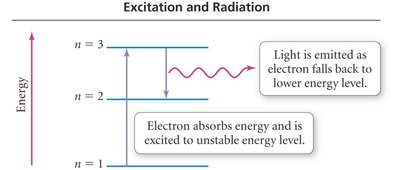
When an electron transitions between energy levels, energy is either absorbed or emitted as a photon. The energy change is given by:
If an electron falls to a lower energy level, a photon is emitted with energy .
If an electron absorbs energy, it moves to a higher energy level.
Example Problem
Question: What is the wavelength of light emitted by an electron falling from n = 5 to n = 3 in a hydrogen atom?
Calculate using the formula above.
Relate energy to wavelength using , where is Planck's constant and is the speed of light.
Additional info: This process is fundamental to atomic spectroscopy and explains the emission spectra of elements.
Atomic Orbitals and Their Shapes
s Orbitals (l = 0)
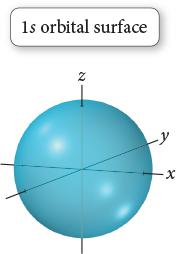
s orbitals are spherical in shape and centered around the nucleus. The 1s orbital is the lowest energy orbital in any atom.
Radial Distribution and Nodes
Higher s orbitals (2s, 3s, etc.) have larger sizes and contain nodes—regions where the probability of finding an electron is zero. The 1s orbital has no nodes, while 2s and 3s have one and two nodes, respectively.
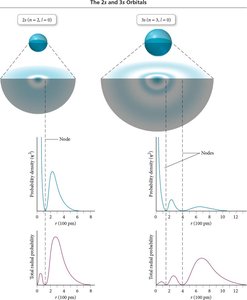
The energy and size of s orbitals increase with increasing n.
Nodes are important features that distinguish different orbitals of the same type.
p Orbitals (l = 1)
p orbitals have a dumbbell shape and are oriented along the x, y, and z axes. Each p subshell contains three orbitals, corresponding to the three possible values of ml (-1, 0, +1). A node exists at the nucleus for all p orbitals.
d and f Orbitals (l = 2, 3)
d orbitals (l = 2) have more complex shapes, often described as cloverleaf, with planar nodes. f orbitals (l = 3) are even more complex, with multiple lobes and nodes.
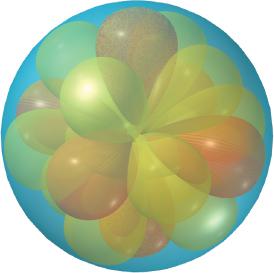
The variety of orbital shapes influences the chemical and physical properties of elements.
Summary Table: Quantum Numbers and Orbitals
Quantum Number | Symbol | Allowed Values | Physical Meaning |
|---|---|---|---|
Principal | n | 1, 2, 3, ... | Energy level, size of orbital |
Angular Momentum | l | 0 to n-1 | Shape of orbital |
Magnetic | ml | -l to +l | Orientation of orbital |
Spin | ms | +1/2, -1/2 | Spin direction of electron |
Additional info: Understanding quantum numbers is essential for predicting electron configurations, chemical bonding, and the periodic properties of elements.
