 Back
The Quantum Mechanical Model of the Atom: Study Notes
Study Guide - Smart Notes
 Tailored notes based on your materials, expanded with key definitions, examples, and context.
The Quantum Mechanical Model of the Atom
Electromagnetic Radiation
Electromagnetic radiation is a fundamental way in which energy is transferred, alongside work and heat. It consists of oscillating waves with perpendicular electric and magnetic components, and includes visible light, ultraviolet light, infrared, gamma rays, X-rays, and microwaves. All electromagnetic waves travel at the speed of light in a vacuum, m/s.
Wavelength (\lambda): The distance between two neighboring peaks, measured in units such as m, cm, nm, or Å.
Frequency (\nu): The number of crests or troughs passing a point per second, measured in s-1 (Hz).
Relationship: Frequency and wavelength are inversely related. The velocity of a wave is given by . For electromagnetic radiation, .
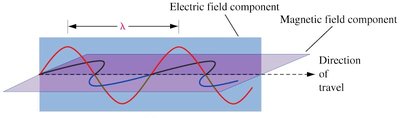
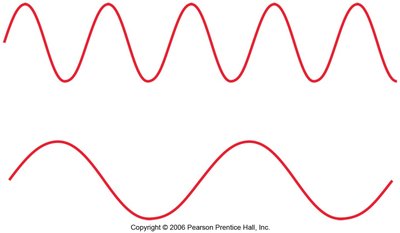
Color: The color of light is determined by its wavelength or frequency. White light is a mixture of all visible colors (ROYGBIV). Objects appear colored when they absorb some wavelengths and reflect others.
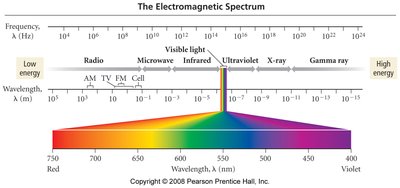
Particle Nature of Electromagnetic Radiation
Blackbody radiation is the energy emitted by an object when heated. Max Planck explained this by proposing that energy is quantized, gained or lost in integral multiples of a smallest unit called a quantum.

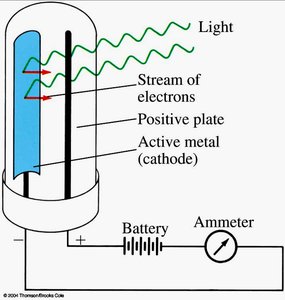
The photoelectric effect demonstrates the particle nature of light. When light strikes certain metals, electrons are ejected. Einstein explained this by proposing that electromagnetic radiation consists of photons, tiny packets of energy.
Photon Energy: , where is Planck’s constant ( J·s).
Kinetic Energy of Ejected Electrons: , where is the binding energy.
Example: The energy of a photon of green light (wavelength 5200 Å) is J; for 1.00 mol, J/mol.
Dual Properties of Light: Light exhibits both wave and particle properties, as shown by the photoelectric effect.
Atomic Spectra
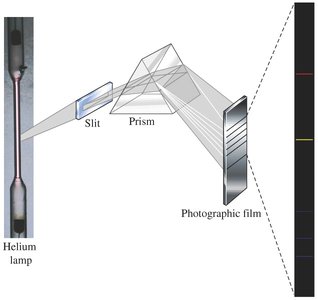
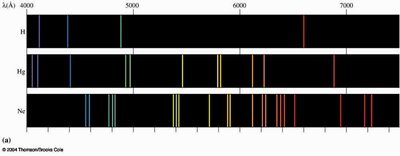
When an electric spark passes through a gas at low pressure, it produces an emission spectrum (line spectrum). Each element has a unique spectrum, which can be used for identification.
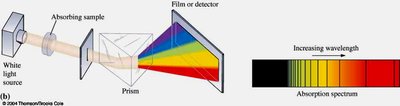
An absorption spectrum is formed by shining white light through an absorbing sample, indicating the wavelengths absorbed.
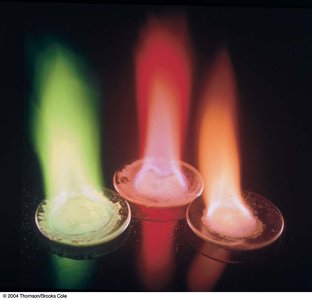
Application: The distinctive lights emitted by elements are used in fireworks.

Rydberg Equation: The wavelength of emission lines is given by:
where is the Rydberg constant ( m-1), and , are principal quantum numbers.
Bohr’s Model of the Atom
Bohr proposed that electrons occupy specific orbits with discrete energies. Energy is absorbed or emitted only when electrons move between these levels.
Energy Levels: The closer an orbit is to the nucleus, the lower its energy.
Quantization: Electron energy is quantized.
Emission: Electrons moving from higher to lower energy levels emit energy.
Absorption: Electrons absorb energy to move to higher levels.

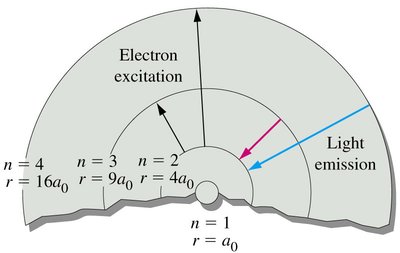
Principal Quantum Number (n): Defines the size and energy of orbitals. Energy for hydrogen:
J
For other one-electron nuclei:
J
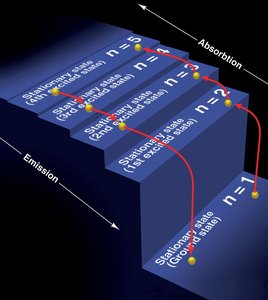
Practice: Calculate the wavelength of light emitted when a hydrogen electron transitions from to (answer: 121 nm).
Limitations: Bohr’s model does not account for wave properties of electrons and fails for multi-electron systems.
The Wave Nature of the Electron
Electrons exhibit wave-like behavior, including interference patterns. When two waves interact, they can be in phase (intensities add) or out of phase (intensities cancel), a phenomenon called interference.

Electrons (and all particles) have both particle and wave-like character, as demonstrated by observed interference patterns.

de Broglie Wavelength: The wavelength of a particle is given by:
where is Planck’s constant, is mass, and is velocity.
Example: The wavelength of an electron (mass kg, velocity m/s) is m. For a tennis ball (mass kg, velocity m/s), the wavelength is m, which is too small to observe.

The Heisenberg Uncertainty Principle
Due to the dual properties of electrons, their position and velocity cannot be determined accurately at the same time. The uncertainty in position and momentum is given by:
In many cases, the uncertainty in an electron’s position is greater than the size of the atom itself.
Quantum Mechanics and the Wave Function
Erwin Schrödinger developed quantum mechanics, a mathematical treatment incorporating both wave and particle nature. The properties of an electron are described by the wave function (), and the square of the wave function () gives a probability map of where an electron is likely to be found.
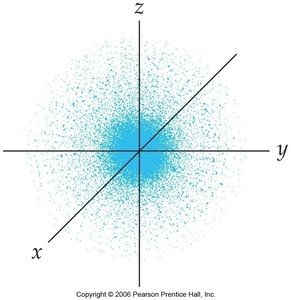
The 3-D region where an electron has a high probability (90%) of being found is called an orbital. Orbitals are different from orbits; we never know exactly where an electron is, but we know where it will be most of the time.
Quantum Numbers and Orbitals
Each orbital is described by a set of three quantum numbers:
Principal Quantum Number (n): Describes the size and energy level of the orbital. .
Angular Momentum Quantum Number (\ell): Defines the shape of the orbital. (s, p, d, f, ...).
Magnetic Quantum Number (m_\ell): Defines the orientation of the orbital. .
s Orbitals: , (spherical symmetry).
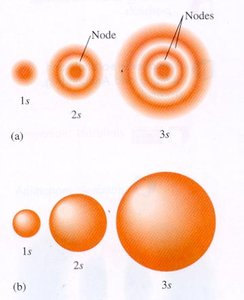
As increases, the size of the s orbital increases. A node is a point where the probability of finding electrons is zero. Number of nodes = .
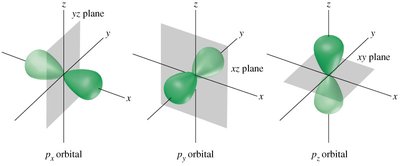
p Orbitals: , (three p orbitals per n level, dumbbell shaped).
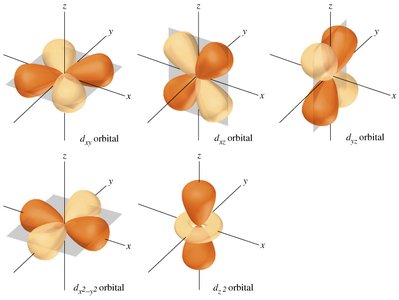
d Orbitals: , (five d orbitals per n level).
f Orbitals: , (seven f orbitals per n level).
Orbitals with the same principal quantum number () form a shell. Orbitals with the same $n$ and form a subshell. A set of $n$, $\ell$, and defines one orbital.
Allowed Combinations of Quantum Numbers for the First 4 Shells
The table below summarizes the allowed combinations of quantum numbers for the first four shells:
n (shell) | l (subshell) | Types of orbital | ml | # of orbitals in subshell | # of orbitals in shell |
|---|---|---|---|---|---|
1 | 0 | 1s | 0 | 1 | 1 |
2 | 0 | 2s | 0 | 1 | 4 |
2 | 1 | 2p | -1, 0, +1 | 3 | 4 |
3 | 0 | 3s | 0 | 1 | 9 |
3 | 1 | 3p | -1, 0, +1 | 3 | 9 |
3 | 2 | 3d | -2, -1, 0, +1, +2 | 5 | 9 |
4 | 0 | 4s | 0 | 1 | 16 |
4 | 1 | 4p | -1, 0, +1 | 3 | 16 |
4 | 2 | 4d | -2, -1, 0, +1, +2 | 5 | 16 |
4 | 3 | 4f | -3, -2, -1, 0, +1, +2, +3 | 7 | 16 |
Summary: The quantum mechanical model of the atom explains the behavior of electrons using quantized energy levels, wave-particle duality, and probability distributions. Quantum numbers describe the properties and arrangements of atomic orbitals, which are fundamental to understanding chemical bonding and atomic structure.
