 Back
2 Thermal Expansion and Thermal Stress: Matter and Energy
Study Guide - Smart Notes
 Tailored notes based on your materials, expanded with key definitions, examples, and context.
Thermal Expansion and Thermal Stress
Introduction to Matter, Temperature, and Thermal Expansion
Thermal expansion is a fundamental concept in physics and chemistry, describing how the dimensions of materials change with temperature. This topic is crucial for understanding the behavior of solids, liquids, and gases under varying thermal conditions, and has significant implications in engineering and everyday life.
Thermal Expansion: Basic Principles
Thermal Expansion refers to the increase in size (length, area, or volume) of a material as its temperature increases.
Most materials expand when heated due to increased kinetic energy of their molecules, which pushes atoms further apart.
Thermal expansion is observed in all states of matter but is most pronounced in gases, followed by liquids and solids.
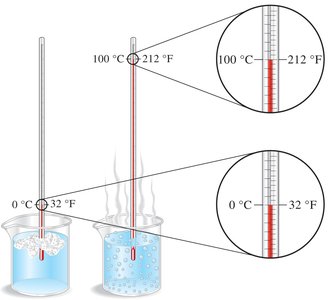
Applications include the calibration of thermometers and the design of structures that must accommodate expansion and contraction.
Linear Thermal Expansion
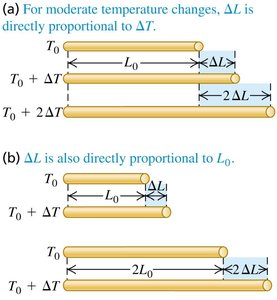
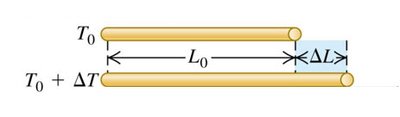
Linear thermal expansion describes the change in one dimension (length) of a solid object as temperature changes.
The change in length, , is directly proportional to the original length and the temperature change .
The relationship is given by:
Where is the coefficient of linear expansion (units: ).
This equation applies to any linear dimension, such as the length of a rod or the diameter of a hole.
Atomic View of Thermal Expansion
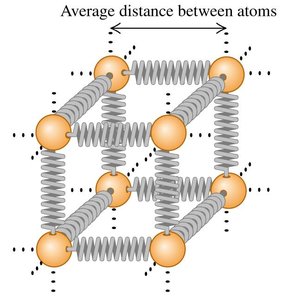
At the atomic level, atoms in a solid are held together by interatomic forces that can be modeled as springs. As temperature increases, the average distance between atoms increases due to greater vibrational energy.
The potential energy curve for atomic interactions is asymmetric, making it easier to stretch than compress the bonds.
Coefficient of Thermal Expansion
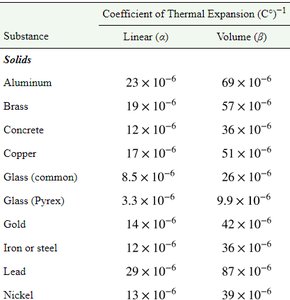
The coefficient of thermal expansion quantifies how much a material expands per degree change in temperature.
Different materials have different coefficients, which are important for material selection in engineering.
Substance | Linear () () | Volume () () |
|---|---|---|
Aluminum | ||
Brass | ||
Concrete | ||
Copper | ||
Glass (common) | ||
Iron or steel | ||
Lead |
Surface and Volume Expansion
Thermal expansion also affects area and volume. For small temperature changes, the relationships are:
Surface (Area) Expansion:
Volume Expansion:
Alternatively, , where for isotropic solids.
Solids | ( or ) |
|---|---|
Aluminum | |
Brass | |
Copper | |
Glass | |
Steel |

Thermal Expansion in Everyday Life
Thermal expansion explains why metal lids loosen when heated, why bridges and railways have expansion joints, and why gaps are left between sections of sidewalks.
Failure to account for expansion can lead to structural damage, such as buckling of railway tracks.



Special Case: Water's Anomalous Expansion
Water behaves unusually between 0°C and 4°C, where it contracts as it warms, reaching maximum density at 4°C. Above 4°C, it expands like most substances.
This property is crucial for aquatic life, as it causes ice to float and lakes to freeze from the top down.

Thermal Stress
When a material is constrained and cannot expand or contract freely with temperature changes, thermal stress develops. This can be compressive or tensile depending on whether the temperature decreases or increases, respectively.
Thermal Stress Equation:
Where is the force, is the cross-sectional area, is Young's modulus, is the coefficient of linear expansion, and is the temperature change.
Units: Stress is measured in Pascals (Pa) or kilopascals (kPa).

Young's Modulus and Hooke's Law
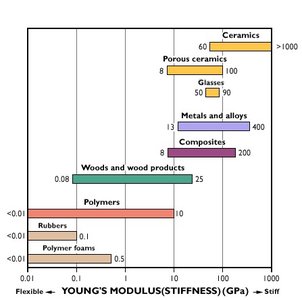
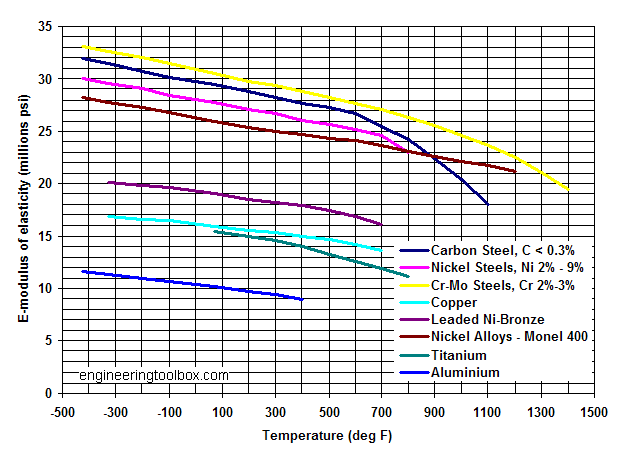
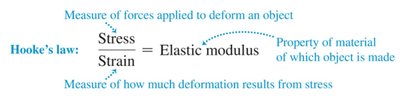
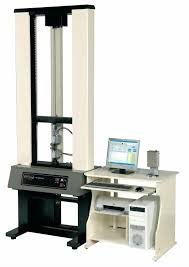
Young's modulus () is a measure of a material's stiffness, indicating its ability to withstand changes in length under tension or compression. Hooke's law relates stress and strain in the elastic region of a material's deformation.
Hooke's Law:
Young's modulus varies with temperature and material type.
Example Calculations
Linear Expansion Example: A steel tape 50.000 m long at 20°C expands to 50.009 m at 35°C. The actual measured distance using the tape at 35°C must be corrected for expansion.
Volume Expansion Example: A 200 cm³ glass flask filled with mercury at 20°C will overflow by 2.7 cm³ when heated to 100°C due to the different expansion rates of glass and mercury.
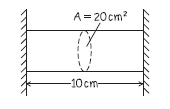
Thermal Stress Example: An aluminum cylinder constrained between two walls develops a compressive stress of Pa and exerts a force of 17 kN when heated from 17.2°C to 22.3°C.
Summary Table: Key Equations
Type | Equation | Description |
|---|---|---|
Linear Expansion | Change in length | |
Area Expansion | Change in area | |
Volume Expansion | or | Change in volume |
Thermal Stress | Stress in constrained rod | |
Hooke's Law | Elastic deformation |
Additional info: These principles are foundational for understanding material behavior in chemistry, physics, and engineering. They are directly relevant to the study of matter, energy, and measurement, as well as practical applications in laboratory and industrial settings.
