 Back
Thermal Expansion and Thermal Stress: Study Notes for General Chemistry
Study Guide - Smart Notes
 Tailored notes based on your materials, expanded with key definitions, examples, and context.
Thermal Expansion
Introduction to Thermal Expansion
Thermal expansion refers to the increase in the dimensions of materials as their temperature rises. This phenomenon is important in both chemistry and engineering, as it affects the physical properties and structural integrity of materials.
Definition: Thermal expansion is the tendency of matter to change its shape, area, and volume in response to a change in temperature.
Key Concept: Most materials expand when heated and contract when cooled, except for some anomalies like water between 0°C and 4°C.
Applications: Thermal expansion is considered in the design of bridges, railways, and containers.
Linear Thermal Expansion
Linear thermal expansion describes how the length of an object changes with temperature. The change in length is proportional to the original length and the temperature change.
Formula:
Variables: = change in length, = coefficient of linear expansion, = original length, = temperature change.
Proportionality: The change in length is directly proportional to both the original length and the temperature change.
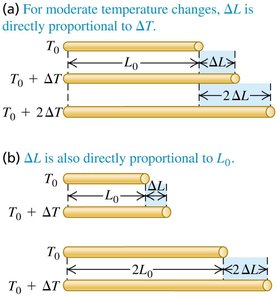
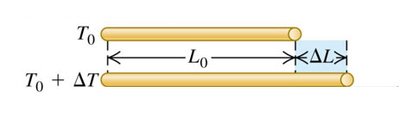
Coefficient of Thermal Expansion
The coefficient of thermal expansion quantifies how much a material expands per degree change in temperature. It varies for different substances and is typically higher for metals than for ceramics or glasses.
Linear Expansion Coefficient (): Measures expansion per unit length per degree Celsius.
Volume Expansion Coefficient (): Measures expansion per unit volume per degree Celsius.
Substance | Linear () | Volume () |
|---|---|---|
Aluminum | 23 × 10−6 | 69 × 10−6 |
Brass | 19 × 10−6 | 57 × 10−6 |
Glass (common) | 8.5 × 10⁻⁶ | 26 × 10−6 |
Steel | 12 × 10−6 | 36 × 10−6 |
Lead | 29 × 10−6 | 87 × 10−6 |
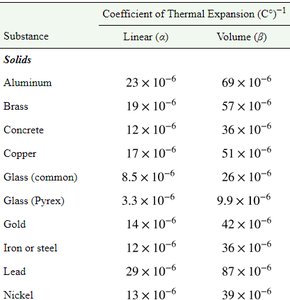
Atomic Perspective of Thermal Expansion
At the atomic level, thermal expansion is explained by the increase in average distance between atoms as their kinetic energy rises. Interatomic forces can be modeled as springs, which are easier to stretch than compress.
Spring Model: Atoms are connected by bonds that behave like springs.
Asymmetry: The potential energy curve is not symmetrical, so expansion is more pronounced than contraction.
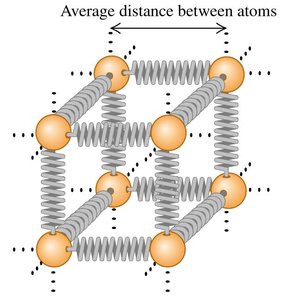
Volume and Surface Expansion
Thermal expansion can also affect the surface area and volume of objects. The formulas for surface and volume expansion are derived from the linear expansion coefficient.
Surface Expansion:
Volume Expansion:
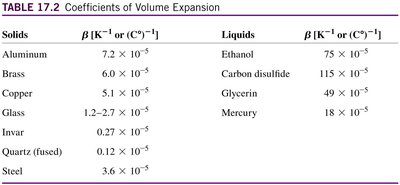
Coefficient of Volumetric Expansion (): For most solids, .
Solids | [K−1] |
|---|---|
Aluminum | 7.2 × 10⁻⁵ |
Brass | 6.0 × 10⁻⁵ |
Copper | 5.1 × 10⁻⁵ |
Steel | 3.6 × 10⁻⁵ |
Thermal Expansion of Water
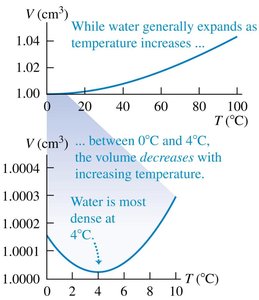
Water exhibits anomalous behavior between 0°C and 4°C, where its volume decreases with increasing temperature. Water is most dense at 4°C, which explains why lakes freeze from the top down.
Density Anomaly: Water expands when it freezes, making ice less dense than liquid water.
Environmental Impact: This property is crucial for aquatic life in cold climates.
Thermal Expansion in Everyday Life
Thermal expansion has practical consequences in engineering and daily life. Structures such as bridges and railways are designed with expansion joints to accommodate changes in length due to temperature fluctuations.
Expansion Joints: Gaps or flexible connections in bridges and railways prevent structural damage.
Railway Tracks: Gaps are left between rails to allow for expansion in hot weather.
Glass Containers: Sudden temperature changes can cause glass to crack due to rapid expansion or contraction.


Thermal Stress
Introduction to Thermal Stress
Thermal stress occurs when a material is constrained and cannot expand or contract freely in response to temperature changes. This can lead to internal forces and potential structural failure.
Definition: Thermal stress is the stress induced in a material due to a change in temperature while its expansion or contraction is restricted.
Units: Stress is measured in Pascals (Pa) or kilopascals (kPa).
Calculating Thermal Stress
The magnitude of thermal stress can be calculated using Young's modulus and the coefficient of linear expansion.
Formula:
Variables: = force, = cross-sectional area, = Young's modulus, = coefficient of linear expansion, = temperature change.
Compressive vs Tensile Stress: Compression occurs when temperature decreases; tension occurs when temperature increases.

Young's Modulus and Hooke's Law
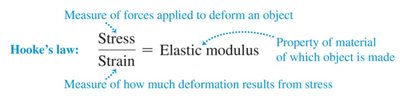
Young's modulus is a measure of a material's ability to withstand changes in length under tension or compression. Hooke's law relates stress and strain in elastic materials.
Young's Modulus ():
Units: Young's modulus is measured in GPa (gigapascals).
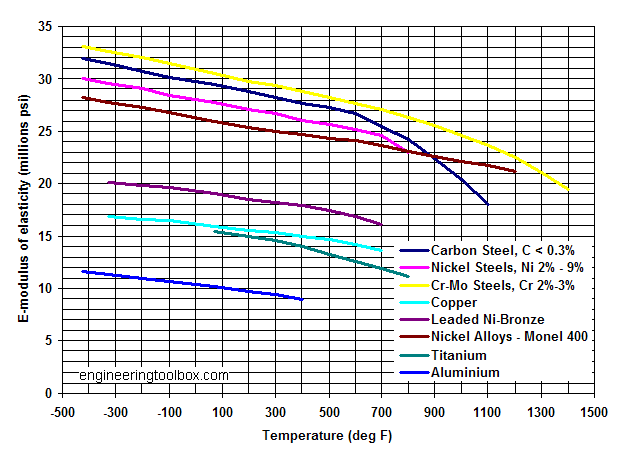
Temperature Dependence: Young's modulus decreases with increasing temperature.

Examples and Applications
Thermal stress is a critical consideration in the design of structures and devices. For example, bridges, railways, and glass containers must be engineered to withstand thermal stresses.
Railway Tracks: Expansion gaps prevent buckling due to thermal stress.
Glass Containers: Sudden temperature changes can cause cracking.
Metal Rods: Clamped rods develop stress when temperature changes and expansion is restricted.

Summary Table: Coefficients of Thermal Expansion
Substance | Linear () | Volume () |
|---|---|---|
Aluminum | 23 × 10−6 | 69 × 10−6 |
Brass | 19 × 10−6 | 57 × 10−6 |
Glass (common) | 8.5 × 10⁻⁶ | 26 × 10−6 |
Steel | 12 × 10−6 | 36 × 10−6 |
Lead | 29 × 10−6 | 87 × 10−6 |
Example: If a steel rod of length 2 m is heated from 20°C to 50°C, the change in length can be calculated using the formula .
Additional info: The notes above expand on the brief points in the original materials, providing full academic context, definitions, and relevant examples for General Chemistry students.
