 Back
Thermochemistry and Enthalpy Change Practice
Study Guide - Smart Notes
 Tailored notes based on your materials, expanded with key definitions, examples, and context.
Q1. Which one of the following conditions would always result in an increase in the internal energy of a system?
Background
Topic: First Law of Thermodynamics
This question tests your understanding of how heat (q) and work (w) affect the internal energy (ΔU) of a system.
Key Terms and Formulas:
Internal energy change:
q = heat absorbed by the system (positive if gained, negative if lost)
w = work done on the system (positive) or by the system (negative)
Step-by-Step Guidance
Recall that internal energy increases when the system gains heat (q > 0) or has work done on it (w > 0).
Analyze each option: does it involve the system gaining heat or having work done on it?
Eliminate options where the system loses heat (q < 0) or does work on the surroundings (w < 0).
Identify the option where both q and w are positive, or their sum is positive.
Try solving on your own before revealing the answer!
Final Answer: D) The system gains heat and has work done on it by the surroundings.
Both heat is absorbed (q > 0) and work is done on the system (w > 0), so increases.
Q2. Of the following, ΔH°f is not zero for ________.
Background
Topic: Standard Enthalpy of Formation
This question tests your knowledge of which substances have a standard enthalpy of formation () of zero.
Key Terms and Formulas:
is zero for elements in their standard state at 1 atm and 25°C.
Standard states: O2(g), N2(g), F2(g), Cl2(g), C(graphite)
Step-by-Step Guidance
Identify the standard state for each element listed.
Recall that only elements in their most stable form at 1 atm and 25°C have .
Check which option is not in its standard state (e.g., solid F2 instead of gaseous F2).
Try solving on your own before revealing the answer!
Final Answer: D) F2 (s)
F2 is a gas in its standard state, so the solid form does not have .
Q3. The value of ΔH° for the reaction below is -790 kJ. The enthalpy change accompanying the reaction of 0.95 g of S is ________ kJ.
2S (s) + 3O2 (g) → 2SO3 (g)
Background
Topic: Stoichiometry and Enthalpy Calculations
This question tests your ability to relate the enthalpy change of a reaction to a specific mass of reactant.
Key Terms and Formulas:
Molar mass of S: 32.07 g/mol
Enthalpy change per mole: use stoichiometry to relate grams to moles, then to kJ.
Step-by-Step Guidance
Calculate the number of moles of S in 0.95 g using its molar mass.
Determine the enthalpy change per mole of S from the balanced equation.
Set up a proportion to find the enthalpy change for the amount of S given.
Try solving on your own before revealing the answer!
Final Answer: C) -12 kJ
0.95 g S × (1 mol/32.07 g) × (-790 kJ/2 mol S) ≈ -12 kJ
Q4. An 6.11 g sample of calcium carbonate [CaCO3 (s)] absorbs ----media/image1.jpeg---- of heat, upon which the temperature of the sample increases from ----media/image2.jpeg---- to ----media/image3.jpeg---- What is the specific heat of calcium carbonate?
Background
Topic: Calorimetry and Specific Heat
This question tests your ability to use the specific heat formula to solve for the specific heat capacity of a substance.
Key Terms and Formulas:
Specific heat formula:
q = heat absorbed (J), m = mass (g), c = specific heat (J/g·K), = change in temperature (K or °C)
Step-by-Step Guidance
Identify the values for q (heat absorbed), m (mass), and (temperature change) from the problem and images.
Calculate by subtracting the initial temperature from the final temperature.
Rearrange the formula to solve for c:
Plug in the known values to set up the calculation for c.
Try solving on your own before revealing the answer!
Final Answer: A) 0.82 J/g-K
Using the formula with the provided values gives 0.82 J/g-K.
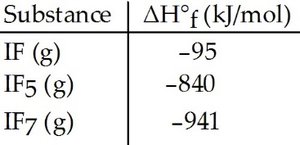
Q5. Given the data in the table below, ΔH°rxn for the reaction IF5 (g) + F2 (g) → IF7 (g) is ________ kJ.
Background
Topic: Enthalpy of Reaction from Standard Enthalpies of Formation
This question tests your ability to use standard enthalpies of formation to calculate the enthalpy change for a reaction.
Key Terms and Formulas:
Standard enthalpy of reaction:
For elements in their standard state,
Step-by-Step Guidance
Write the balanced equation and identify the products and reactants.
List the values for each substance from the provided table.
Apply the formula: sum the of products and subtract the sum for reactants.
Set up the calculation, but do not compute the final value yet.
Try solving on your own before revealing the answer!
Final Answer: E) -101 kJ
kJ
Q6. How much heat is released when 29.5 grams of Cl2 (g) reacts with excess hydrogen?
H2 (g) + Cl2 (g) → 2HCl (g) ΔH° = -186 kJ.
Background
Topic: Stoichiometry and Enthalpy Calculations
This question tests your ability to relate the enthalpy change of a reaction to a specific mass of reactant.
Key Terms and Formulas:
Molar mass of Cl2: 70.90 g/mol
ΔH° is given per mole of reaction as written.
Step-by-Step Guidance
Calculate the number of moles of Cl2 in 29.5 g.
Determine the enthalpy change per mole of Cl2 from the balanced equation.
Set up a proportion to find the enthalpy change for the amount of Cl2 given.
Try solving on your own before revealing the answer!
Final Answer: E) 77.4 kJ
29.5 g Cl2 × (1 mol/70.90 g) × (-186 kJ/1 mol) ≈ -77.4 kJ (heat released, so magnitude is 77.4 kJ)
Q7. A ________ ΔH corresponds to an ________ process.
Background
Topic: Enthalpy Sign Conventions
This question tests your understanding of the sign of ΔH for endothermic and exothermic processes.
Key Terms and Formulas:
ΔH > 0: endothermic (absorbs heat)
ΔH < 0: exothermic (releases heat)
Step-by-Step Guidance
Recall the definitions of endothermic and exothermic processes.
Match the sign of ΔH to the correct process type.
Try solving on your own before revealing the answer!
Final Answer: C) positive, endothermic
Endothermic processes have positive ΔH because they absorb heat.
Q8. ΔH for an endothermic process is ________ while ΔH for an exothermic process is ________.
Background
Topic: Enthalpy Sign Conventions
This question tests your understanding of the sign of ΔH for endothermic and exothermic processes.
Key Terms and Formulas:
ΔH > 0: endothermic
ΔH < 0: exothermic
Step-by-Step Guidance
Recall which sign corresponds to each process.
Match the correct sign to endothermic and exothermic processes.
Try solving on your own before revealing the answer!
Final Answer: E) positive, negative
Endothermic: ΔH positive; Exothermic: ΔH negative.
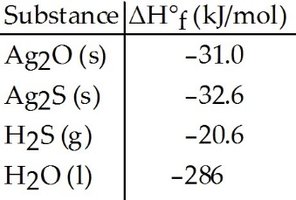
Q9. Given the data in the table below, ΔH°rxn for the reaction Ag2O (s) + H2S (g) → Ag2S (s) + H2O (l) is ________ kJ.
Background
Topic: Enthalpy of Reaction from Standard Enthalpies of Formation
This question tests your ability to use standard enthalpies of formation to calculate the enthalpy change for a reaction.
Key Terms and Formulas:
Standard enthalpy of reaction:
Step-by-Step Guidance
Write the balanced equation and identify the products and reactants.
List the values for each substance from the provided table.
Apply the formula: sum the of products and subtract the sum for reactants.
Set up the calculation, but do not compute the final value yet.
Try solving on your own before revealing the answer!
Final Answer: A) -267 kJ
kJ
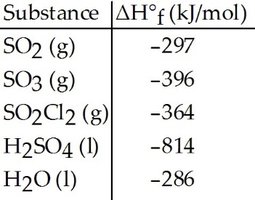
Q10. Given the data in the table below, ΔH°rxn for the reaction 2SO2 (g) + O2 (g) → 2SO3 (g) is ________ kJ.
Background
Topic: Enthalpy of Reaction from Standard Enthalpies of Formation
This question tests your ability to use standard enthalpies of formation to calculate the enthalpy change for a reaction.
Key Terms and Formulas:
Standard enthalpy of reaction:
Step-by-Step Guidance
Write the balanced equation and identify the products and reactants.
List the values for each substance from the provided table.
Remember that for O2 (g) is zero.
Apply the formula and set up the calculation for ΔH°rxn.
Try solving on your own before revealing the answer!
Final Answer: C) -198 kJ
kJ
