 Back
BackThermochemistry: Energy, Enthalpy, and Calorimetry
Study Guide - Smart Notes
 Tailored notes based on your materials, expanded with key definitions, examples, and context.
Thermochemistry: Energy, Enthalpy, and Calorimetry
9.1 Energy & Conservation
Thermochemistry is the study of energy changes, particularly heat, that accompany chemical reactions and physical changes. Understanding energy and its transformations is fundamental to chemistry.
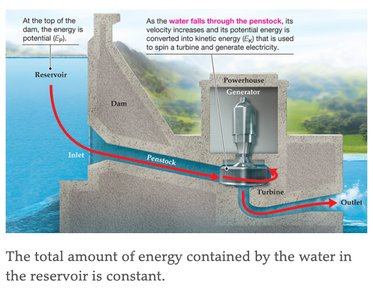
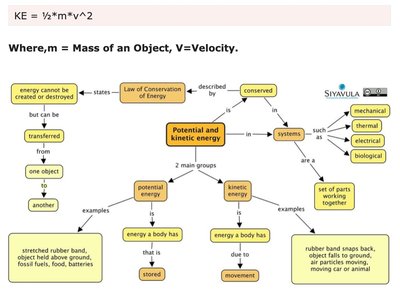
Energy: The capacity to do work or supply heat. It exists in various forms and can be converted from one form to another, but cannot be created or destroyed (Law of Conservation of Energy).
Kinetic Energy (KE): Energy of motion, dependent on mass and velocity. $KE = \frac{1}{2}mv^2$
Potential Energy (PE): Stored energy due to position or composition.
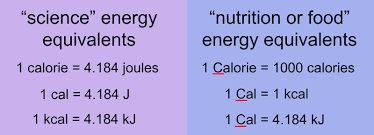
SI Unit of Energy: The joule (J), where $1\ J = 1\ kg\cdot m^2/s^2$.
Other Units: Calorie (cal), kilocalorie (kcal), and their conversions: $1\ cal = 4.184\ J$, $1\ kcal = 1000\ cal = 4184\ J$.

Types of Energy
Mechanical
Thermal
Chemical
Electrical
Radiant (Light)
Nuclear
Sound
Energy can be transferred between objects and converted between forms, but the total energy remains constant.
Thermal Energy Vocabulary
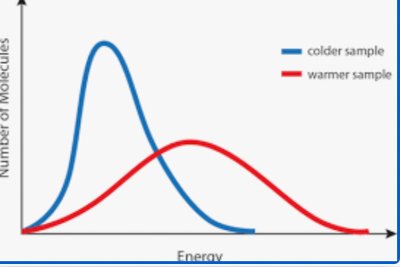
Temperature: Measure of the average kinetic energy of particles. Units: Kelvin (K) and Celsius (°C).
Chemical Energy: Potential energy stored in chemical bonds. Breaking bonds releases energy; forming bonds requires energy.
Heat (q): Transfer of thermal energy due to a temperature difference. It is a path-dependent (nonstate) function.
Heat Capacity (C): Amount of energy required to raise the temperature of an object by 1°C.
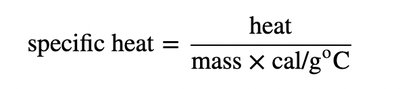
Specific Heat (c or Cs): Amount of energy required to raise the temperature of 1 gram of a substance by 1°C (or 1 K). Water has a high specific heat.
Enthalpy (H): Energy content of a system at constant pressure. Change in enthalpy ($\Delta H$) indicates energy transferred as heat.
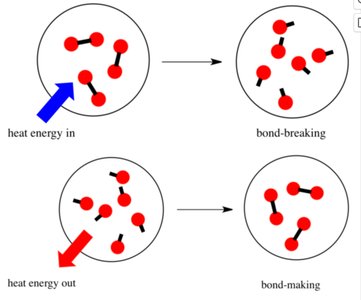
Thermal Energy
The total thermal energy of a substance depends on its mass, temperature, and phase (solid, liquid, gas).
9.2, 9.4 Internal Energy, State Functions, Enthalpy
First Law of Thermodynamics
The First Law of Thermodynamics states that energy can neither be created nor destroyed, only transformed. The total energy of the universe remains constant.
System: The part of the universe under study (e.g., the chemicals in a reaction).
Surroundings: Everything outside the system.
Internal Energy (E): The sum of all kinetic and potential energies of the system. Change in internal energy: $\Delta E = E_{final} - E_{initial}$
Energy leaving the system: negative sign; energy entering the system: positive sign.
State Functions are properties that depend only on the current state, not the path taken (e.g., mass, volume, temperature, internal energy). Nonstate Functions depend on the path (e.g., work, heat).
Enthalpy and Heat of Reaction
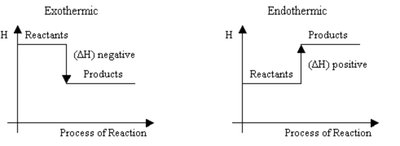
Enthalpy Change ($\Delta H$): The heat absorbed or released at constant pressure.
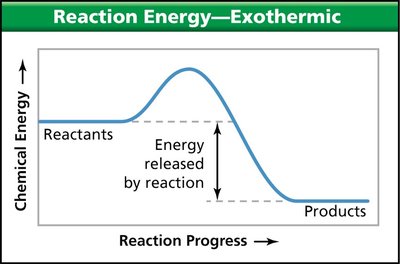
Exothermic Reaction: Releases heat ($\Delta H < 0$); products have less energy than reactants.
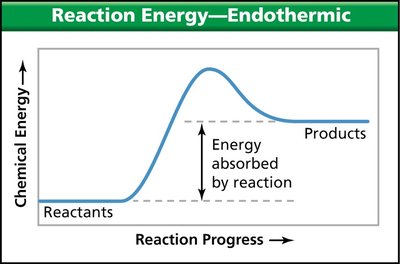
Endothermic Reaction: Absorbs heat ($\Delta H > 0$); products have more energy than reactants.


9.5 Thermodynamic Equations and Standard State
Thermochemical Equations
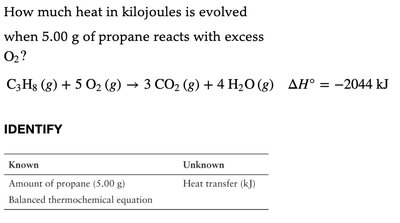
Thermochemical equations show the enthalpy change along with the balanced chemical equation. The sign and magnitude of $\Delta H$ indicate whether the reaction is exothermic or endothermic.
Exothermic: Heat is a product (e.g., $C_3H_8 + 5O_2 \rightarrow 3CO_2 + 4H_2O + 2220\ kJ$)
Endothermic: Heat is a reactant (e.g., $2HgO + 181.7\ kJ \rightarrow 2Hg + O_2$)
9.6 Enthalpy of Physical and Chemical Changes
Phase Changes and Enthalpy
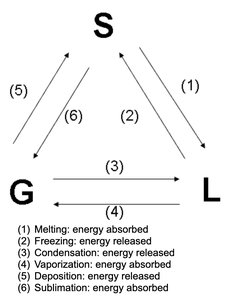
Phase changes involve energy transfer. Melting, vaporization, and sublimation are endothermic (energy absorbed). Freezing, condensation, and deposition are exothermic (energy released).
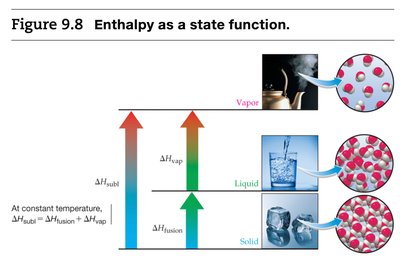
Enthalpy of Fusion ($\Delta H_{fus}$): Energy required to melt 1 mole of a solid.
Enthalpy of Vaporization ($\Delta H_{vap}$): Energy required to vaporize 1 mole of a liquid.
Enthalpy of Sublimation ($\Delta H_{sub}$): Energy required to convert 1 mole of a solid directly to gas.

9.7 Calorimetry and Heat Capacity
Calorimetry
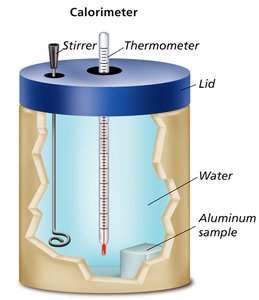
Calorimetry is the measurement of heat flow in a chemical or physical process. A calorimeter is an insulated device used to measure the heat absorbed or released.
Specific Heat Capacity ($C_s$): $q = C_s \times m \times \Delta T$
Molar Heat Capacity ($C_m$): $q = C_m \times n \times \Delta T$
At constant pressure, the heat measured is equal to the change in enthalpy ($\Delta H$).
9.8 Hess’s Law
Hess’s Law
Hess’s Law states that the total enthalpy change for a reaction is the same, no matter how many steps the reaction is carried out in. This allows calculation of enthalpy changes for reactions that are difficult to measure directly by combining known reactions.
Reverse reactions: Change the sign of $\Delta H$.
Multiply reactions: Multiply $\Delta H$ by the same factor.
Add reactions: Add their $\Delta H$ values.
9.9 Standard Heats of Formation and Enthalpies
Standard Heat of Formation ($\Delta H_f^\circ$)
The standard enthalpy change for the formation of 1 mole of a compound from its elements in their standard states. For elements in their standard state, $\Delta H_f^\circ = 0$.
Used to calculate enthalpy changes for reactions using tabulated values.
9.10 Bond Dissociation Energies
Bond Dissociation Energy (D)
The energy required to break one mole of a specific type of bond in a molecule in the gas phase. Always positive because energy must be supplied to break bonds.
Estimate reaction enthalpy: $\Delta H^\circ = D(\text{Reactant bonds}) - D(\text{Product bonds})$
9.11 Introduction to Entropy
Entropy is a measure of the disorder or randomness of a system. It is a key concept in understanding the direction of spontaneous processes and the Second Law of Thermodynamics.
Additional info: This guide covers the core concepts of thermochemistry, including energy, enthalpy, calorimetry, Hess's Law, and bond energies, with relevant equations and diagrams for clarity.
