 Back
BackThermochemistry: Energy, Enthalpy, and Calorimetry
Study Guide - Smart Notes
 Tailored notes based on your materials, expanded with key definitions, examples, and context.
Thermochemistry
Key Terms and Concepts
Thermochemistry is the study of energy changes, particularly heat, that accompany chemical reactions and physical changes. Understanding the following terms is essential for mastering this topic:
Energy (E): The ability to do work or produce heat. The sum of all potential and kinetic energy in a system is called the internal energy.
Potential Energy: Energy stored in chemical bonds.
Kinetic Energy: Energy of motion, proportional to temperature and dependent on mass and velocity:
Law of Conservation of Energy: Energy cannot be created or destroyed; it can only be transformed. Also known as the First Law of Thermodynamics.
Heat (q): The transfer of energy due to temperature difference; flows from warmer to cooler objects.
Enthalpy (H): The heat content of a system at constant pressure.
System: The part of the universe under study (e.g., the reaction vessel).
Surroundings: Everything outside the system.
Endothermic Process: Absorbs heat; energy is a reactant.
Exothermic Process: Releases heat; energy is a product.
State Function: A property that depends only on the current state, not the path taken.
Entropy (S): A measure of disorder or randomness.
Gibbs Free Energy (G): Determines spontaneity and the maximum work obtainable from a process.
Work (w): Force acting over a distance.
Energy, Work, and Internal Energy
Internal Energy and Its Components
The internal energy change of a system () is the sum of heat () and work ():
Sign conventions for heat (q): if heat is absorbed by the system; if released.
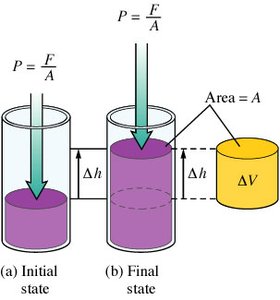
Sign conventions for work (w): if work is done on the system (compression); if work is done by the system (expansion).
For gases, work is related to pressure and volume change:
Energy is a state function; heat and work are not.
Sample Calculations
Example 1: Calculate for a system absorbing 15.6 kJ of heat and having 1.4 kJ of work done on it:
Example 2: Calculate work for a gas expanding from 46 L to 64 L at 15 atm:
Convert to Joules:
Enthalpy and Enthalpy Changes
Definition and Calculation of Enthalpy
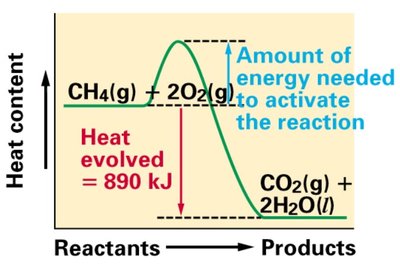
Enthalpy () is the heat content of a system at constant pressure. The change in enthalpy () is measured as:
is a state function.
At constant pressure, (heat at constant pressure).
Enthalpy changes can be determined by stoichiometry, calorimetry, standard enthalpies of formation, Hess's Law, or bond energies.
Types of Enthalpy Changes
Enthalpy of Reaction (): Heat absorbed or released in a chemical reaction.
Enthalpy of Combustion (): Heat change when one mole of a substance burns in oxygen.
Enthalpy of Formation (): Heat change when one mole of a compound forms from its elements in standard states.
Enthalpy of Fusion (): Heat absorbed to melt one mole of solid to liquid at melting point.
Enthalpy of Vaporization (): Heat absorbed to vaporize one mole of liquid to gas at boiling point.
Sample Problem: Stoichiometry and Enthalpy
Given:
For 14.0 g KOH: (exothermic, beaker gets warmer)
Calorimetry: Measuring Heat Changes
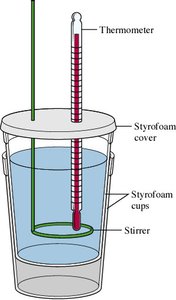
Coffee-Cup Calorimetry (Constant Pressure)
This method uses a simple insulated cup to measure heat changes at constant pressure, suitable for reactions in solution. The temperature change is used to calculate the heat exchanged:
= heat (Joules or calories)
= mass (grams)
= specific heat capacity (J/g°C)
= (final - initial temperature)
Bomb Calorimetry (Constant Volume)
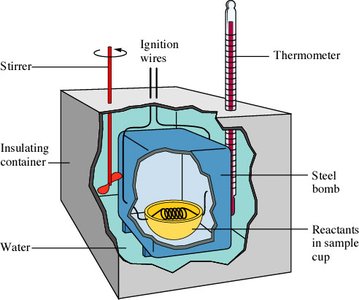
Used for measuring energy changes in combustion reactions. The reaction occurs in a sealed steel container (the bomb) submerged in water. The temperature change of the water is used to calculate the energy released.
Heat capacity of the calorimeter must be known.
Commonly used to determine food calories and fuel values.
Heat Capacity and Specific Heat
Heat Capacity: Energy required to raise the temperature of an object by 1°C (J/°C).
Specific Heat Capacity (): Energy required to raise 1 gram of a substance by 1°C (J/g°C).
Molar Heat Capacity: Energy required to raise 1 mole of a substance by 1°C (J/mol·K).
Specific heat of water:
Sample Problem: Calorimetry Calculation
Mixing 100.0 mL of 1.0 M NaOH and 100.0 mL of 1.0 M HCl, temperature rises from 24.6°C to 31.3°C. Calculate for the reaction using .
Answer:
Standard Enthalpies of Formation and Reaction
Standard Enthalpy of Formation ()
The enthalpy change when one mole of a compound forms from its elements in their standard states (25°C, 1 atm, 1 M concentration). For elements in their standard states, .
Compound | (kJ/mol) |
|---|---|
NH3(g) | -46 |
NO2(g) | 34 |
H2O(l) | -286 |
Al2O3(s) | -1676 |
Fe2O3(s) | -826 |
CO2(g) | -394 |
CH3OH(l) | -239 |
C8H18(l) | -269 |
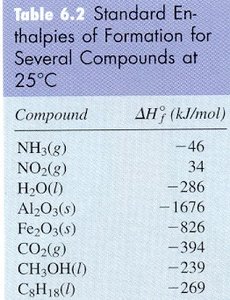
The enthalpy change for a reaction can be calculated using:
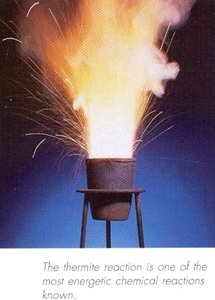
Sample Problem: Thermite Reaction
Calculate for
Answer:
Hess's Law
Combining Equations to Find Enthalpy Changes
Hess's Law states that the total enthalpy change for a reaction is the same, no matter how many steps the reaction is carried out in. If you can add chemical equations to get a desired overall equation, you can also add their values.
Reverse the sign of if you reverse an equation.
Multiply by the same factor as the equation's coefficients.
Ensure all substances not in the overall equation cancel out.
Bond Energies and Enthalpy Calculations
Bond Energy Method
Energy is required to break bonds (endothermic) and released when bonds form (exothermic). The enthalpy change is:
Example:
Bond energies: H-H = 432 kJ/mol, F-F = 154 kJ/mol, H-F = 565 kJ/mol
Calculation:
Summary of Enthalpy Significance
: Endothermic reaction (absorbs heat)
: Exothermic reaction (releases heat; favored by nature)
