 Back
Thermochemistry: Energy, Enthalpy, and Calorimetry
Study Guide - Smart Notes
 Tailored notes based on your materials, expanded with key definitions, examples, and context.
Thermochemistry
Introduction to Energy
Thermochemistry is the study of energy changes that occur during chemical reactions and changes of state. Energy is the ability to do work or transfer heat, and it plays a central role in chemical processes.
Work: Energy used to cause an object with mass to move.
Heat: Energy used to cause the temperature of an object to rise.
Classification of Energy
Energy can be classified as kinetic or potential.
Kinetic Energy (KE): Energy due to motion.
Potential Energy (PE): Energy due to position or chemical composition.
Thermal Energy: Associated with temperature.
Electrical Energy: Associated with electrical current.
Chemical Energy: Associated with the positions of electrons and nuclei.
Units of Thermal Energy
1 calorie (cal): Heat required to raise the temperature of 1.00 g of H2O by 1.0 °C.
1 kilocalorie (kcal) = 1000 cal (equal to one food Calorie).
1 calorie = 4.184 joules (J).
Internal Energy and Enthalpy
The internal energy (U) of a system is the sum of all kinetic and potential energies of its components.
Energy is conserved: First Law of Thermodynamics.
Internal energy depends on number and type of particles and temperature.
Change in internal energy: (where q = heat, w = work).
At constant pressure: (work term drops out).
Enthalpy (H):
Change in enthalpy:
At constant pressure:
System and Surroundings
System: The part of the universe under study (e.g., reactants and products).
Surroundings: Everything outside the system.
Universe: System + surroundings.
Work and Heat
Work: (force times distance).
For gases: (pressure-volume work).
Heat: Flows from warmer to cooler objects.
Energy Transfer: Exothermic and Endothermic Processes
Exothermic: Energy leaves the system (negative sign), surroundings gain energy.
Endothermic: Energy enters the system (positive sign), surroundings lose energy.
State Functions
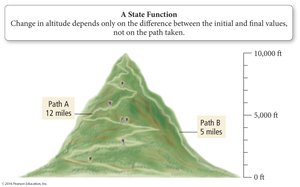
State functions depend only on the initial and final states, not the path taken. Internal energy and enthalpy are state functions, while heat and work are not.
State Function Analogy: Change in altitude depends only on the difference between the initial and final values, not on the path taken.
Enthalpy of Reaction
Change in enthalpy:
Enthalpy is an extensive property and a state function.
Standard conditions: 1 atm, 25°C, 1 M concentration.
Standard enthalpy of formation (): Enthalpy change for forming 1 mole of a compound from its elements in their standard states.
Calorimetry
Calorimetry is the measurement of heat flow.
Heat capacity: Energy required to raise the temperature of a substance by 1 K.
Specific heat capacity (s): Energy required to raise 1 g of a substance by 1 K.
Formula:
Heat gained or lost:
Constant Pressure Calorimetry
Used to measure heat changes in reactions in aqueous solution.
Specific heat of water: 4.184 J/g·K.
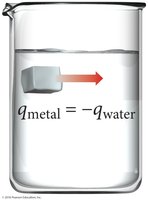
Example: Determining specific heat of a metal by mixing with water.
Bomb Calorimetry
Reactions occur in a sealed container at constant volume.
Measures change in internal energy ().
Hess’s Law
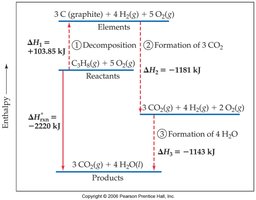
Hess’s Law allows calculation of enthalpy changes for reactions by combining known enthalpy changes of other reactions.
Statement: "If a reaction is carried out in a series of steps, for the overall reaction is the sum of the enthalpy changes for the individual steps."
Formula:
Example: Calculation of for combustion of propane.
Energy in Foods and Fuels
Most energy in food comes from carbohydrates and fats.
Most energy consumed comes from fossil fuels.
Sample Problems and Applications
Calculating specific heat capacity and energy changes in calorimetry experiments.
Using Hess’s Law to determine enthalpy changes for reactions.
Summary Table: Key Thermochemistry Concepts
Concept | Definition | Formula |
|---|---|---|
Kinetic Energy | Energy of motion | |
Potential Energy | Energy due to position | |
Internal Energy | Total energy of system | |
Enthalpy | Heat content at constant pressure | |
Heat Capacity | Energy to raise temp by 1 K | |
Specific Heat | Energy to raise 1 g by 1 K | |
Hess's Law | Sum of enthalpy changes |
