Back
BackThermochemistry: Energy, Heat, and Chemical Reactions
Study Guide - Smart Notes
 Tailored notes based on your materials, expanded with key definitions, examples, and context.
Thermochemistry
Introduction to Thermochemistry
Thermochemistry is the study of energy changes, particularly heat, that accompany chemical reactions and physical transformations. Understanding how energy is transferred and transformed is essential for predicting reaction behavior and designing chemical processes.
Energy is the capacity to do work or produce heat.
Work is the result of a force acting over a distance.
Heat is the flow of energy due to a temperature difference.
Nature and Classification of Energy
Kinetic and Potential Energy
Energy can be classified based on its form and how it is stored or transferred.
Kinetic Energy: Energy associated with the motion of objects. Thermal energy is a form of kinetic energy related to temperature.
Potential Energy: Stored energy due to position or composition (e.g., chemical energy, nuclear energy).
Energy can be exchanged between objects or converted from one form to another.
Units of Energy
Joules and Kilojoules
The SI unit of energy is the joule (J).
1 J = 1 N·m = 1 kg·m2/s2
1 kJ = 1000 J
The First Law of Thermodynamics
Law of Conservation of Energy
The first law states that energy cannot be created or destroyed, only transferred or transformed.
Total energy of the universe is constant.
Internal Energy and State Functions
Definition and Properties
Internal energy (E) is the sum of all kinetic and potential energies of the particles in a system. It is a state function, meaning its value depends only on the initial and final states, not the path taken.

Energy Exchange: Heat and Work
Relationship Between Heat, Work, and Internal Energy
Energy can be transferred as heat (q) or work (w):
If the system loses energy, the surroundings gain it, and vice versa.
Heat Capacity and Specific Heat
Definitions and Calculations
Heat Capacity (C): Amount of heat required to change the temperature of a system by 1°C (units: J/°C or J/K).
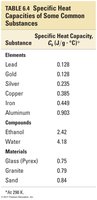
Specific Heat Capacity (C_s): Heat required to raise the temperature of 1 gram of a substance by 1°C (units: J/g·°C).
Molar Heat Capacity: Heat required to raise the temperature of 1 mole of a substance by 1°C.
Heat Calculations
The amount of heat absorbed or released is calculated by:
Example: How much heat is absorbed by a 3.10 g copper penny heated from -8.0°C to 37.0°C? Given J/g·°C, °C, J.
Thermal Energy Transfer and Calorimetry
Heat Exchange Between Substances
When two substances at different temperatures are mixed, heat flows from the hotter to the colder substance until thermal equilibrium is reached.
For each substance:

Coffee-Cup Calorimeter
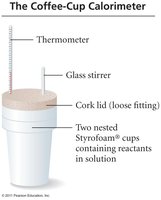
A coffee-cup calorimeter is used to measure heat changes at constant pressure, typically for reactions in solution.
Enthalpy and Enthalpy Changes
Definition of Enthalpy (H)
Enthalpy is the sum of the internal energy and the product of pressure and volume:
At constant pressure,
Exothermic and Endothermic Reactions
Exothermic: is negative; heat is released.
Endothermic: is positive; heat is absorbed.
Stoichiometry of Thermochemical Equations
Relating Heat to Amounts of Reactants and Products
Thermochemical equations relate the amount of heat evolved or absorbed to the amount of substance reacted.
Example: , kJ
Calorimetry Calculations
Determining Enthalpy Change from Calorimetry Data
Calculate , then , and finally moles reacted.
Hess's Law
Combining Reactions to Find Enthalpy Changes
Hess's Law states that the enthalpy change for a reaction is the same, no matter how many steps the reaction is carried out in.
If a reaction is reversed, the sign of changes.
If a reaction is multiplied by a factor, is multiplied by the same factor.
If reactions are added, their values are added.
Standard Enthalpy of Formation and Reaction
Definitions and Calculations
Standard enthalpy of formation (): Enthalpy change when one mole of a compound forms from its elements in their standard states.
For elements in their standard state, .
Standard enthalpy change of reaction ():
Energy Use and the Environment
Fossil Fuels and Environmental Impact
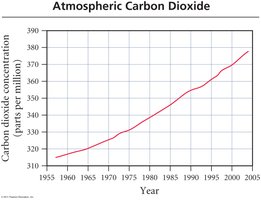
Combustion of fossil fuels releases energy but also produces pollutants and greenhouse gases, contributing to air pollution, acid rain, and global warming. 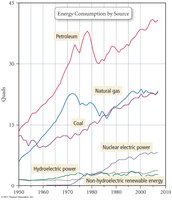
Renewable Energy Sources
Renewable energy sources such as solar, wind, and hydroelectric power are alternatives to fossil fuels and are more sustainable for the environment.