 Back
BackThermochemistry: Energy, Heat, and Work in Chemical Systems
Study Guide - Smart Notes
 Tailored notes based on your materials, expanded with key definitions, examples, and context.
Thermochemistry
Getting Started: Terminology and Types of Systems
Thermochemistry is the study of energy changes, particularly heat, that accompany chemical reactions and physical transformations. Understanding the types of systems and their interactions with surroundings is fundamental.
System: The part of the universe under study (e.g., a chemical reaction in a flask).
Surroundings: Everything outside the system.
Types of Systems:
Open system: Exchanges both matter and energy with surroundings.
Closed system: Exchanges energy but not matter.
Isolated system: Exchanges neither matter nor energy.
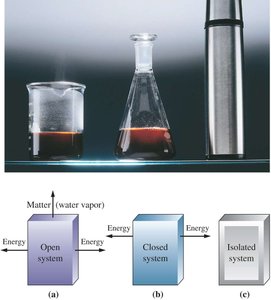
Energy: Kinetic and Potential
Energy is the capacity to do work or transfer heat. It exists in various forms, primarily as kinetic and potential energy.
Kinetic Energy (KE): Energy of motion. Calculated as where m is mass and v is velocity.
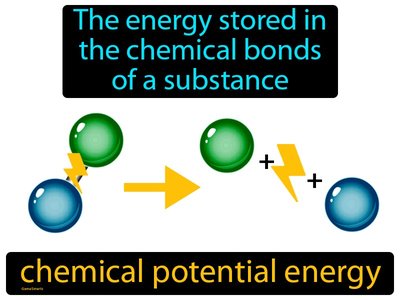
Potential Energy (PE): Energy due to position or composition, such as chemical bonds or gravitational position.


Internal Energy and Thermal Energy
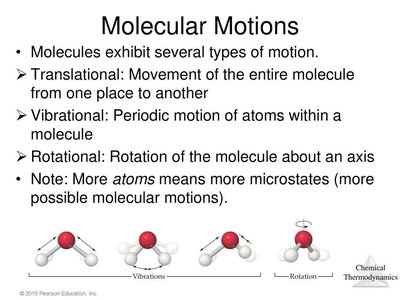
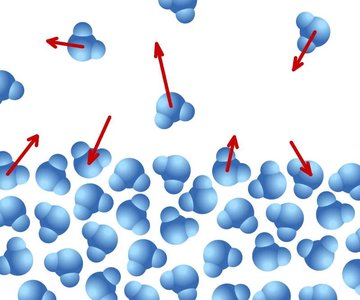
Internal energy is the sum of all kinetic and potential energies within a system. Thermal energy is a form of kinetic energy due to molecular motion.
Thermal Energy: Associated with temperature and molecular motion.
Chemical Energy: Stored in chemical bonds; released or absorbed during reactions.
Heat and Calorimetry
Heat, Specific Heat, and Heat Capacity
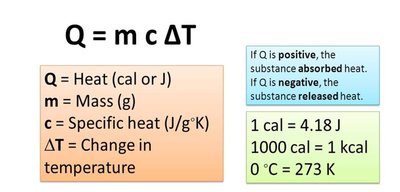
Heat is energy transferred between a system and its surroundings due to temperature difference. The amount of heat required to change temperature depends on the substance's heat capacity and specific heat.
Heat (q): Measured in Joules (J) or calories (cal).
Heat Capacity (C): Amount of heat needed to raise the temperature of an object by 1°C.
Specific Heat (c): Amount of heat needed to raise 1 g of a substance by 1°C.
Formula:
Calculating Heat and Specific Heat
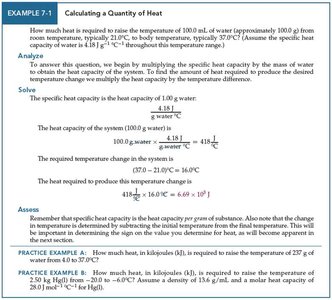
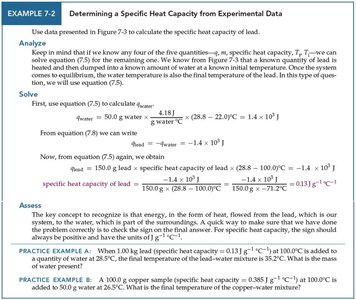
To determine heat transfer, use the formula . Specific heat values are essential for calculations involving temperature changes.
Example: Calculating the heat required to raise water temperature.
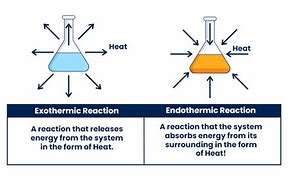
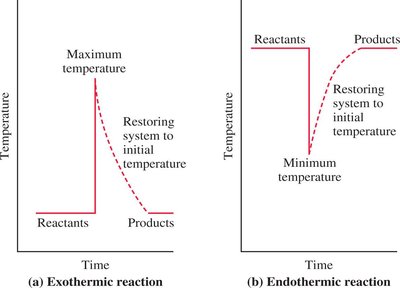
Endothermic and Exothermic Processes
Heat transfer can be classified as endothermic (heat absorbed) or exothermic (heat released).
Endothermic: System absorbs heat; .
Exothermic: System releases heat; .
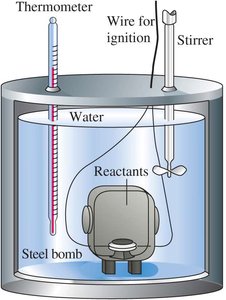
Calorimetry: Measuring Heat of Reactions
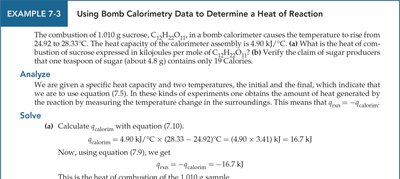
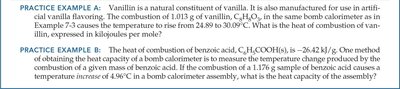
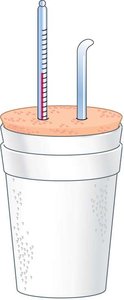
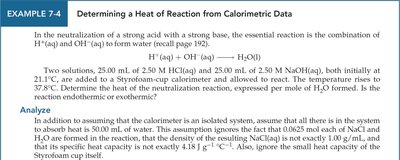
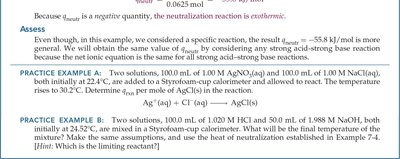
Calorimetry is the experimental measurement of heat changes in chemical reactions. Two main types are bomb calorimeters (constant volume) and coffee cup calorimeters (constant pressure).
Bomb Calorimeter: Used for reactions generating gas, such as combustion.
Coffee Cup Calorimeter: Used for reactions at constant pressure.
Work and the First Law of Thermodynamics
Work in Thermochemistry
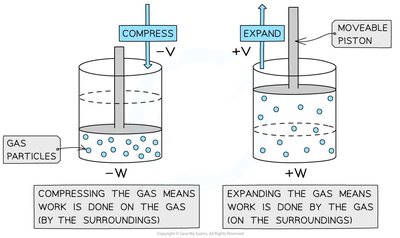
Work is energy transferred when a force moves an object. In chemistry, work is often associated with volume changes in gases.
Formula: (force × distance)
Units: Joules (J);
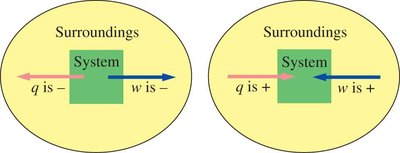
Sign convention: Work done on the system is positive; work done by the system is negative.
The First Law of Thermodynamics
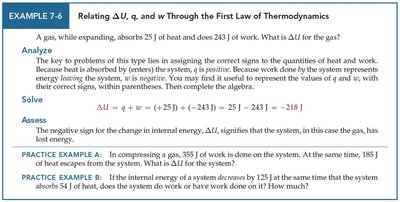
The first law states that energy cannot be created or destroyed, only transferred or transformed. The change in internal energy () is the sum of heat () and work ().
Formula:
State Function: Internal energy is a state function, depending only on the initial and final states, not the path.
Path Function: Heat and work are path functions, depending on the process.
Enthalpy and Heats of Reaction
Enthalpy of Reaction ()
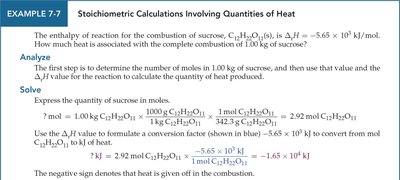
Enthalpy () is the heat content of a system at constant pressure. The enthalpy change () for a reaction is the heat transferred under constant pressure.
Formula:
Exothermic reactions: (heat released)
Endothermic reactions: (heat absorbed)
Hess's Law
Hess's Law states that the total enthalpy change for a reaction is the sum of the enthalpy changes for individual steps, regardless of the path taken.
Extensive property: is proportional to the amount of substance.
Reversibility: changes sign when the reaction is reversed.
Formula:
Standard Enthalpies of Formation ()
The standard enthalpy of formation is the enthalpy change when one mole of a compound is formed from its elements in their standard states.
Reference form: The standard enthalpy of formation for a pure element in its reference form is zero.
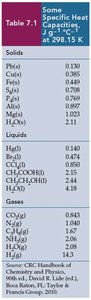
Summary Table: Specific Heat Capacities
Specific heat capacities for various substances are important for calorimetry calculations.
Substance | Specific Heat (J/g·°C) |
|---|---|
Pb(s) | 0.130 |
Cu(s) | 0.385 |
Fe(s) | 0.449 |
Al(s) | 0.897 |
H2O(l) | 4.18 |
Hg(l) | 0.140 |
CH3OH(l) | 2.51 |
O2(g) | 0.918 |
H2(g) | 14.3 |
CO2(g) | 0.843 |
Additional info: This table is a selection from the full list in the original notes.
----------------------------------------
