 Back
Thermochemistry: Energy, Heat, and Work in Chemical Reactions
Study Guide - Smart Notes
 Tailored notes based on your materials, expanded with key definitions, examples, and context.
Thermochemistry
Introduction to Thermochemistry
Thermochemistry is the study of the relationships between chemistry and energy, focusing on how energy is transferred during chemical reactions. Energy is defined as the capacity to do work, and work is a force acting over a distance. Heat is the flow of energy caused by a difference in temperature, and it can be exchanged between objects through contact.
Nature and Classification of Energy
Types of Energy
Energy can be classified into several forms, each with distinct characteristics:
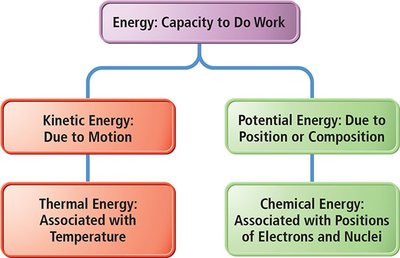
Kinetic Energy: Energy due to motion; directly proportional to mass and velocity. Thermal energy, associated with temperature, is a form of kinetic energy.
Potential Energy: Energy stored in an object or associated with its composition and position. Chemical energy is a type of potential energy due to the structure and arrangement of atoms and molecules.
Energy Transformations
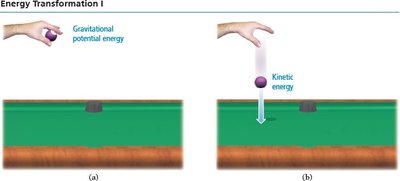
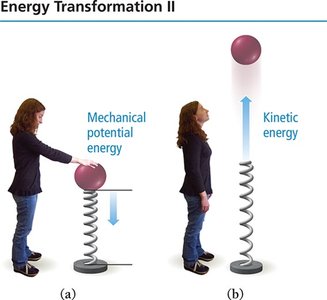
Energy can be transformed from one form to another, such as gravitational potential energy converting to kinetic energy when an object falls, or mechanical potential energy converting to kinetic energy in a spring system.
Conservation of Energy
Law of Conservation of Energy
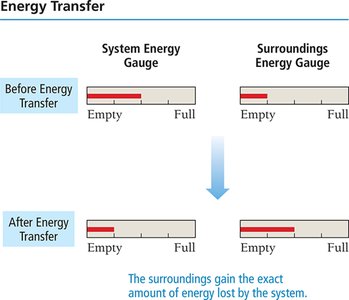
The law of conservation of energy states that energy cannot be created or destroyed. When energy is transferred or converted, the total amount of energy remains constant.
System and Surroundings
Definitions
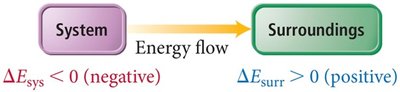
The system is the material or process under study, while the surroundings are everything else with which the system can exchange energy. Energy transfer between system and surroundings must obey conservation laws.
Units of Energy
Common Units
Joule (J): The SI unit of energy; 1 J = 1 kg·m2/s2.
Calorie (cal): The energy needed to raise 1 g of water by 1°C; 1 cal = 4.184 J.
Calorie (Cal): Also known as a kilocalorie; 1 Cal = 1000 cal = 4184 J.
Kilowatt-hour (kWh): 1 kWh = 3.60 × 10⁶ J.
Internal Energy and State Functions
Internal Energy (E)
The internal energy of a system is the sum of the kinetic and potential energies of all particles. The change in internal energy, ΔE, depends only on the initial and final states, not the path taken (state function).

Energy Flow in Chemical Reactions
Exothermic and Endothermic Reactions
Energy can flow out of or into a system during a chemical reaction:
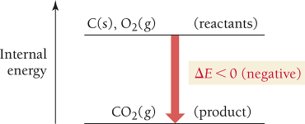
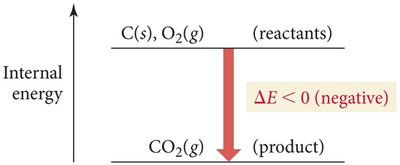
Exothermic: Energy flows out; ΔE is negative.
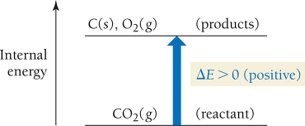
Endothermic: Energy flows in; ΔE is positive.
Energy Flow Diagrams
Energy diagrams visually represent the direction of energy flow during a process. If reactants have higher internal energy than products, ΔE is negative; if lower, ΔE is positive.
Energy Exchange: Heat and Work
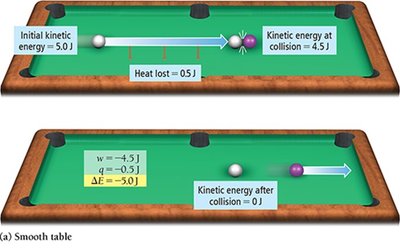
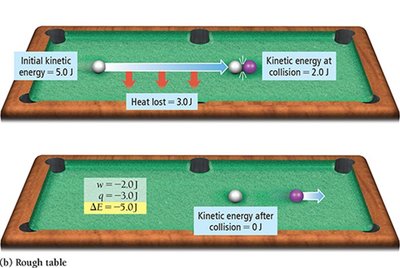
Heat (q) and Work (w)
Energy is exchanged between system and surroundings through heat and work:
Heat (q): Thermal energy transfer due to temperature difference.
Work (w): Energy transfer due to force acting over a distance.
Heat Capacity and Specific Heat
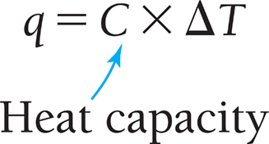
Heat Capacity (C)
Heat capacity is the proportionality constant relating heat absorbed to temperature change:
Specific Heat Capacity (Cs)
Specific heat capacity is the amount of heat required to raise the temperature of 1 g of a substance by 1°C:
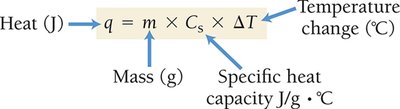
Application: Water as a Coolant
Water's high specific heat capacity allows it to absorb significant heat without a large temperature increase, making it an effective coolant.

Thermal Energy Transfer
Heat Exchange Between Objects
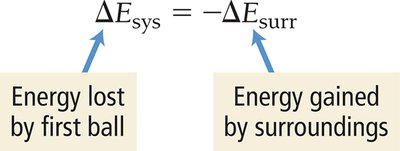
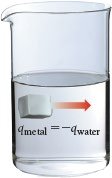
When two objects at different temperatures are placed in contact, heat flows from the hotter to the cooler object until thermal equilibrium is reached. The heat lost by the hot material equals the heat gained by the cold material:
Pressure–Volume Work
PV Work
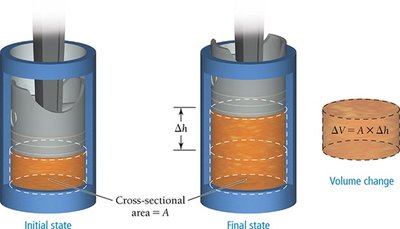
Work caused by a volume change against an external pressure is called pressure–volume (PV) work:
To convert to joules:
Calorimetry
Constant Volume Calorimetry
Calorimetry measures thermal energy exchanged between a reaction and its surroundings. A bomb calorimeter operates at constant volume, measuring ΔE for combustion reactions.
Constant Pressure Calorimetry
Reactions in aqueous solution are often measured at constant pressure using foam cup calorimeters. The heat change at constant pressure is equal to the enthalpy change, ΔH.
Enthalpy (H)
Definition and Properties
Enthalpy is the sum of internal energy and the product of pressure and volume:
At constant pressure,
Endothermic and Exothermic Reactions
Endothermic: ΔH is positive; heat is absorbed.
Exothermic: ΔH is negative; heat is released.
Standard Enthalpy of Formation
Standard State and Enthalpy Change
The standard enthalpy change, ΔH°, is measured when all reactants and products are in their standard states. The standard enthalpy of formation, ΔH°f, is the enthalpy change for forming 1 mole of a compound from its elements in their standard states.
Hess’s Law
Combining Reactions
If a reaction can be expressed as a series of steps, the overall ΔHrxn is the sum of the enthalpy changes for each step:
If a reaction is multiplied by a factor, ΔHrxn is multiplied by that factor.
If a reaction is reversed, the sign of ΔHrxn changes.
Energy Use and Environmental Impact
Fossil Fuels and Pollution
Most energy comes from combustion of fossil fuels, which are non-renewable and contribute to air pollution, acid rain, and global warming. Major pollutants include SOx, CO, NOx, and O3.
Global Climate Change
CO2 is a greenhouse gas that traps heat, leading to global warming. Increased CO2 levels have raised global temperatures and may cause severe environmental consequences.
Renewable Energy
Renewable energy sources such as solar, hydroelectric, and wind power are being developed to reduce reliance on fossil fuels and mitigate environmental impact.
