 Back
Thermochemistry: Energy, Matter, and Chemical Reactions
Study Guide - Smart Notes
 Tailored notes based on your materials, expanded with key definitions, examples, and context.
Chapter 5: Thermochemistry – Energy & Matter
5.1 Chemical Energy: Potential Energy, Matter, and Bonds
Thermochemistry explores how energy is transferred during chemical and physical changes. The energy stored in chemical bonds and the arrangement of atoms is called potential energy, while the energy of motion is kinetic energy. Chemical reactions involve breaking and forming bonds, which changes the potential energy of the system.
Potential Energy (PE): Energy due to position or chemical composition. In molecules, the most important form is electrostatic potential energy.
Kinetic Energy (KE): Energy due to motion. The average kinetic energy of particles is directly related to temperature.
Internal Energy (E): The sum of all kinetic and potential energies of the system's components.
Heat (q): Energy transferred due to temperature difference.
Work (w): Energy transferred when an object is moved by a force.
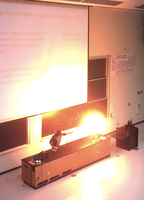
Example: Exploding a hydrogen and oxygen balloon produces about 13 kJ of energy, demonstrating the conversion of chemical potential energy to heat and light.
Energy & Physical Changes
Physical changes such as melting, boiling, and condensation involve energy transfer. The state of matter (solid, liquid, gas) is determined by the balance of kinetic and potential energies.
Melting (solid → liquid): Energy is added to overcome attractive forces between particles.
Boiling (liquid → gas): Energy is added to allow particles to escape into the gas phase.
Condensation (gas → liquid): Energy is removed, allowing particles to come closer together.
Example: Melting ice involves adding energy to convert solid water to liquid water.

Example: Condensation occurs when water vapor loses energy and forms liquid droplets.

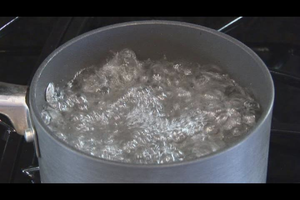
Example: Boiling water involves adding energy to convert liquid water to water vapor.
5.2 The First Law of Thermodynamics: System, Surroundings, Heat, Work, and Sign Conventions
The First Law of Thermodynamics states that energy cannot be created or destroyed, only transferred or transformed. The total energy of the system and surroundings remains constant.
System: The part of the universe being studied (e.g., a chemical reaction).
Surroundings: Everything outside the system.
Closed System: Exchanges energy but not matter with surroundings.
Open System: Exchanges both energy and matter.
Isolated System: Exchanges neither energy nor matter.
The change in internal energy () is given by:
Energy can be transferred as heat () or work ():
q > 0: Endothermic process (heat absorbed by system).
q < 0: Exothermic process (heat released to surroundings).
w > 0: Work done on the system.
w < 0: Work done by the system.
5.3 Enthalpy and 5.4 Enthalpies of Reaction
Enthalpy (H) is a state function that measures the heat content of a system at constant pressure. The change in enthalpy () corresponds to the heat absorbed or released during a reaction.
Enthalpy is extensive: It depends on the amount of substance.
Reversing a reaction: Changes the sign of .
State function: Only initial and final states matter, not the path.
Example: The combustion of methane:
For 24.0 g of methane:
5.5 Calorimetry
Calorimetry is the measurement of heat flow in chemical reactions. It involves calculations using heat capacity and specific heat.
Heat Capacity (C): Amount of heat required to raise the temperature of an object by 1°C.
Specific Heat (c): Amount of heat required to raise the temperature of 1 g of a substance by 1°C.
Calorimetry Equation:
5.6 Hess’s Law
Hess’s Law states that the total enthalpy change for a reaction is the sum of the enthalpy changes for individual steps, because enthalpy is a state function.
Example: If you know for two reactions, you can combine them to find $\Delta H$ for a target reaction.
5.7 Enthalpies of Formation
The standard enthalpy of formation () is the enthalpy change when one mole of a compound is formed from its elements in their standard states.
5.8 Bond Enthalpies
Bond enthalpy is the energy required to break one mole of a specific bond in a molecule. Average bond enthalpy values can be used to estimate enthalpy changes for reactions.
Breaking bonds: Always requires energy (endothermic).
Forming bonds: Always releases energy (exothermic).
Summary Table: Energy Terms in Thermochemistry
Term | Definition | Symbol |
|---|---|---|
Heat | Energy transferred due to temperature difference | q |
Work | Energy transferred when a force moves an object | w |
Potential Energy | Energy due to position or composition | PE |
Kinetic Energy | Energy due to motion | KE |
Internal Energy | Total energy (PE + KE) of a system | E |
Enthalpy | Heat content at constant pressure | H |
Additional info: These notes expand on brief points from the original materials, providing definitions, examples, and equations for clarity and completeness. Images included are directly relevant to the physical changes discussed.
